
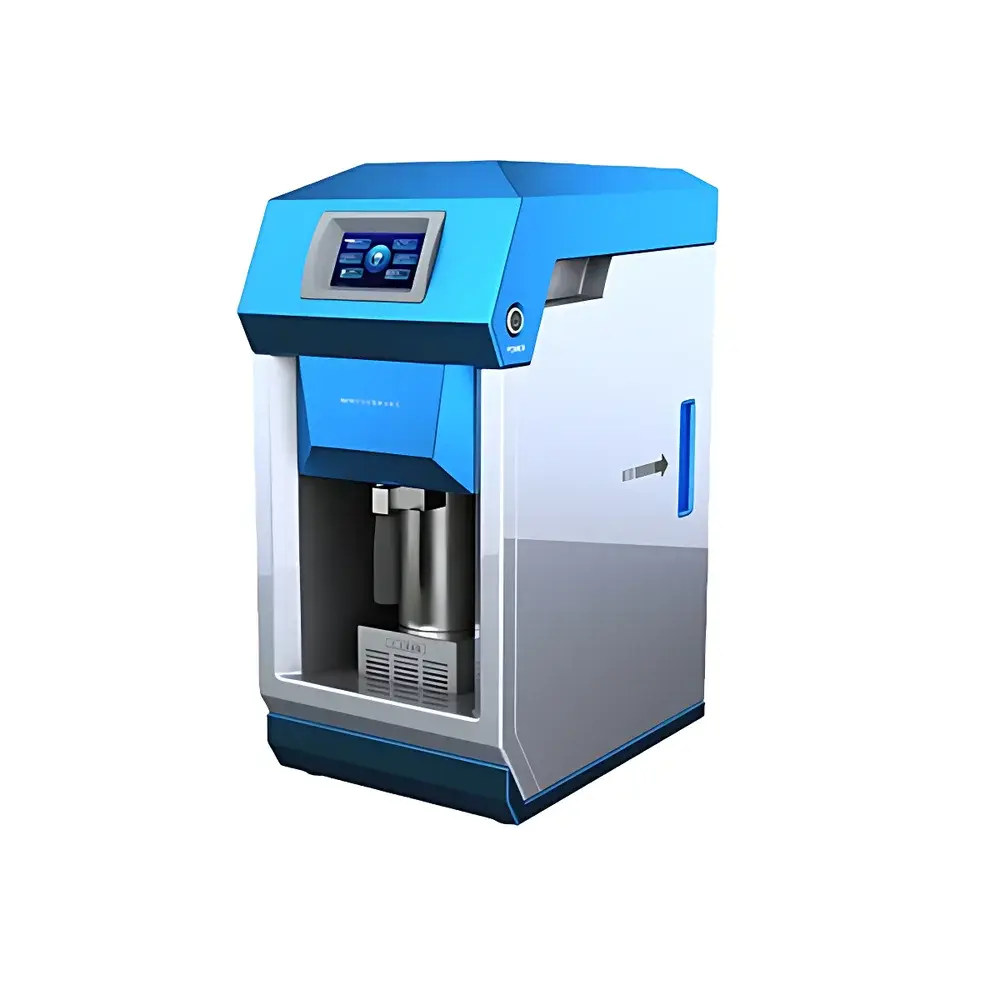
Sonnen G100 Filter-Bag Automated Fat Analyzer
| Brand | Sonnen |
|---|---|
| Origin | Shanghai, China |
| Model | G100 |
| Extraction Chamber Volume | 600 mL |
| Receiving Flask Volume | 500 mL |
| Temperature Range | Ambient to 105 °C |
| Temperature Control Accuracy | ±1 °C |
| Batch Capacity | 10 samples per run |
| Filter Bag Pore Size | 3 µm |
| Solvent Recovery Rate | ≥90% |
| Sample Weight Range | 0.1–5 g |
| Analytical Range | 0.1–100% fat |
| Repeatability | ±0.2% |
| Extraction Time (per batch, excluding heating) | 60 min |
| Cooling Water Flow Rate | 4 L/min |
| Power Supply | AC 220 V, 50 Hz |
| Power Consumption | 500 W |
| Dimensions | 300 × 200 × 450 mm |
| Weight | 30 kg |
Overview
The Sonnen G100 Filter-Bag Automated Fat Analyzer is a fully automated solvent extraction system engineered for precision, reproducibility, and regulatory compliance in quantitative fat and lipid analysis. It operates on the principle of continuous solvent reflux extraction using standardized filter-bag technology—aligned with classical Soxhlet methodology but significantly enhanced by sealed, microprocessor-controlled operation and high-efficiency solvent recycling. Unlike open-vessel or manual Soxhlet systems, the G100 performs batch processing of up to 10 samples simultaneously within a fully enclosed stainless-steel extraction chamber, minimizing operator exposure, solvent loss, and environmental emissions. Its design supports routine compliance with international food, feed, agricultural, and environmental testing standards—including GB/T, ISO, and SN/T methods—making it suitable for accredited laboratories operating under GLP or ISO/IEC 17025 frameworks.
Key Features
- Filter-bag-based extraction with 3 µm pore-size, three-dimensional polypropylene bags ensuring uniform sample retention and complete solvent penetration without channeling or clogging.
- Microprocessor-controlled automation of temperature ramping, extraction timing, solvent reflux cycling, and solvent recovery—eliminating manual intervention during operation.
- Integrated solvent reclamation system achieving ≥90% recovery efficiency, reducing hazardous waste generation and lowering operational costs over time.
- Touchscreen color LCD interface with intuitive navigation, real-time status monitoring, and configurable method storage for repeatable workflows.
- Stainless-steel (AISI 304) extraction cup assembly with leak-tight sealing and passive thermal insulation—enabling safe operation outside fume hoods when paired with proper ventilation protocols.
- Step-motor-driven vertical positioning of receiving and recovery flasks, synchronized with extraction phase transitions to prevent cross-contamination and ensure precise fraction collection.
- Intelligent cooling water management: flow sensor-triggered alarm and temperature feedback loop maintain condenser stability at 4 L/min nominal flow rate.
- Compact footprint (300 × 200 × 450 mm) optimized for benchtop deployment in space-constrained QC labs or research facilities.
Sample Compatibility & Compliance
The G100 accommodates diverse solid and semi-solid matrices requiring lipid or organic compound isolation—including foodstuffs (meat, dairy, cereals), animal feed, oilseeds, soil, sludge, wastewater solids, plastics, leather, and paper products. Its validated performance meets the technical requirements of multiple national and international standards: GB/T 5009.6–2003, GB/T 14772–2008, GB/T 9695.7–2008, GB/T 6433–2006, GB/T 15674–1995, GB/T 5512–1985, ISO 3947:1994, SN/T 0803.1–1999, and SN/T 0800.2–1999. While not certified to FDA 21 CFR Part 11 out-of-the-box, the system’s audit-trail-capable software architecture supports integration into validated environments upon configuration and documentation per laboratory SOPs.
Software & Data Management
The embedded control firmware logs all critical process parameters—including setpoint temperature, actual chamber temperature, extraction duration, solvent volume dispensed, and recovery efficiency—for each run. Data export is supported via USB interface in CSV format, enabling traceable transfer to LIMS or statistical analysis platforms. Method templates can be saved, duplicated, and version-controlled locally; user access levels are configurable to align with multi-operator lab environments. Though no cloud connectivity is built-in, raw data files comply with ISO/IEC 17025 clause 7.5.2 requirements for record retention and integrity verification.
Applications
- Determination of crude fat content in food, feed, and botanical materials per AOAC and ISO reference methods.
- Extraction of semi-volatile organic compounds (SVOCs)—including pesticides, herbicides, and plasticizers—from environmental and industrial matrices prior to GC or HPLC analysis.
- Preparative isolation of lipids for subsequent fatty acid profiling or enzymatic characterization.
- Quality control of raw materials and finished products in agri-food, pet food, and biofuel production sectors.
- Regulatory testing for compliance with labeling requirements (e.g., nutritional facts panels) and import/export certification protocols.
FAQ
What solvents are compatible with the G100?
Petroleum ether (boiling range 30–60 °C) is the primary recommended solvent. Other low-boiling, non-polar solvents such as hexane or diethyl ether may be used subject to validation and safety review.
Is fume hood installation mandatory?
Not strictly required due to its >90% solvent recovery rate and sealed extraction path—but local safety regulations and institutional policies should govern final placement.
Can the G100 be integrated into a laboratory information management system (LIMS)?
Yes, via manual CSV export; direct API or ODBC integration is not natively supported but may be enabled through third-party middleware development.
What maintenance is required for long-term reliability?
Routine cleaning of filter bags and stainless-steel cups after each batch; periodic inspection of gasket integrity, coolant lines, and motor drive alignment every 6 months or 200 runs.
Does the instrument support method validation per ISO/IEC 17025?
Yes—the system provides full parameter logging, repeatability (±0.2%), and temperature accuracy (±1 °C), fulfilling key metrological criteria for method verification when combined with appropriate reference materials and uncertainty budgeting.



