SonTek RiverSurveyor S5/M9 Acoustic Doppler Current Profiler (ADCP)
| Origin | USA |
|---|---|
| Manufacturer Type | Authorized Distributor |
| Origin Category | Imported |
| Model | S5/M9 |
| Pricing | Available Upon Request |
| Operating Temperature | -5°C to 45°C |
| Storage Temperature | -10°C to 70°C |
| Power Supply | 12–18 V DC, rechargeable battery (8 h runtime |
| Memory | 8 GB non-volatile internal storage |
| Max Output Rate | 2 Hz |
| Internal Sampling Rate | up to 70 Hz |
| Velocity Range | ±20 m/s |
| Velocity Accuracy | ±0.25% of measured value |
| Minimum Measurement Distance | 0.06 m |
| Max Depth Range | 80 m (M9) |
| Depth Resolution | 0.01 m |
| Temperature Sensor Resolution | 0.01°C |
| Temperature Accuracy | ±0.1°C |
| Compass/Tilt Range | 360° heading, ±2° heading accuracy, ±1° roll/pitch accuracy |
| RTK GPS Accuracy | 0.03 m horizontal |
| VTG/GGA GPS Accuracy | sub-meter |
| Bluetooth Range | 60 m (mobile), 200 m (laptop) |
| Spread-Spectrum Radio Range | 2000 m |
| Transducer Configurations | Multi-frequency, auto-adaptive cell size, frequency, and sampling mode |
Overview
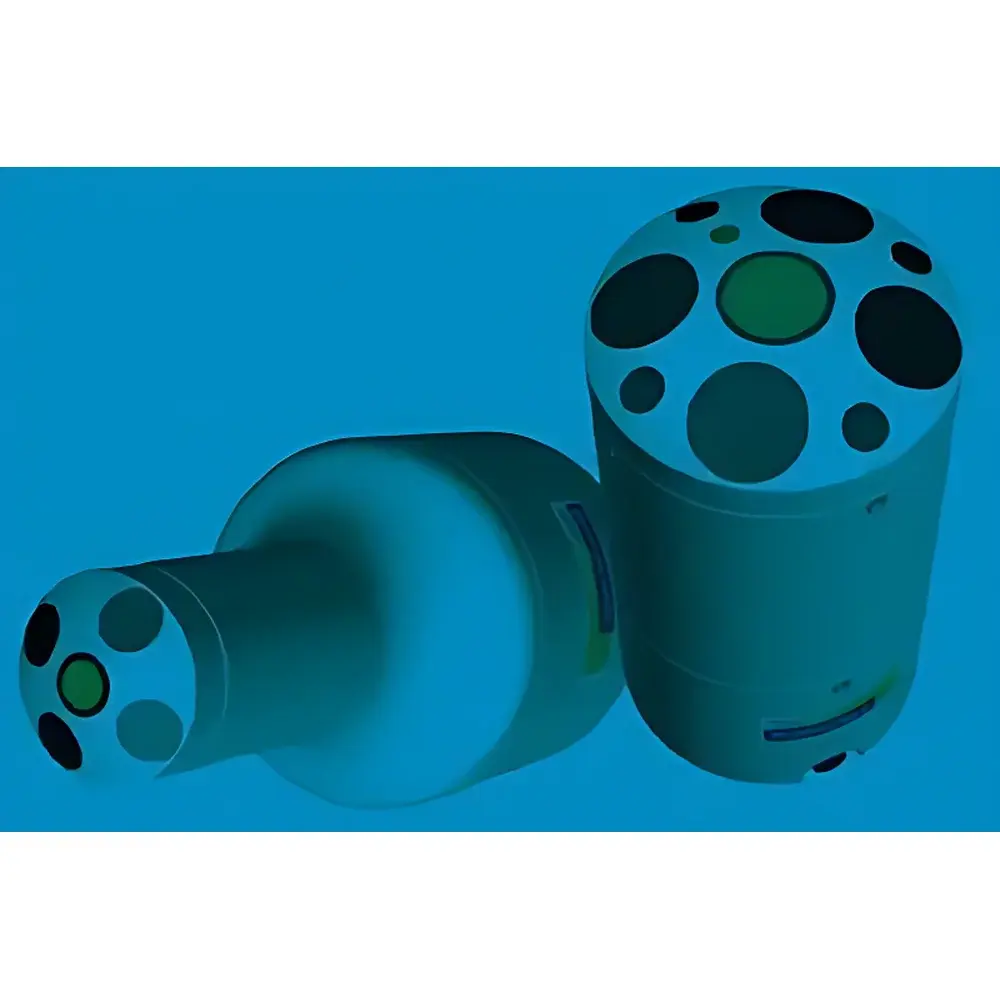
The SonTek RiverSurveyor S5/M9 Acoustic Doppler Current Profiler (ADCP) is a field-deployable, vessel-mounted hydroacoustic instrument engineered for high-accuracy, real-time river discharge measurement across diverse hydraulic conditions. Based on the principles of acoustic Doppler velocimetry, the system transmits pulsed ultrasonic signals into the water column and analyzes the frequency shift (Doppler shift) of backscattered echoes from suspended particles to compute three-dimensional water velocity profiles. Its dual-platform architecture—comprising the compact, shallow-water-optimized S5 and the deep-water-capable M9—enables seamless adaptation from low-flow streams (80 m depth). Unlike traditional single-frequency ADCPs, the S5/M9 employs an adaptive multi-frequency transducer array that dynamically adjusts pulse length, transmission frequency, cell size, and sampling strategy in real time, ensuring optimal signal-to-noise ratio and vertical resolution across variable sediment loads, flow velocities, and bathymetric gradients.
Key Features
- Multi-frequency adaptive profiling: Automatically selects optimal frequency (e.g., 1500 kHz for shallow applications, 600 kHz for deeper sections) and cell size (down to 0.06 m) to maintain resolution and data integrity across heterogeneous flow regimes.
- Integrated RTK GPS subsystem: Provides georeferenced, centimeter-level positioning (0.03 m horizontal accuracy) without reliance on bottom-tracking—critical for low-signal environments such as fine-sediment beds or highly attenuating waters.
- Dedicated vertical beam channel: Enables simultaneous, direct measurement of water depth and riverbed topography via downward-looking acoustic echo analysis—eliminating interpolation errors inherent in sidescan-derived bathymetry.
- Onboard microprocessor and embedded firmware: Performs real-time discharge computation using standardized algorithms (e.g., ISO 748, ASTM D5388), stores raw and processed datasets locally (8 GB non-volatile memory), and maintains data continuity during communication interruptions.
- Pulse-coherent and broadband sampling modes: Switches autonomously between modes to maximize resolution in shallow zones (<2 m) while preserving long-range performance in deep channels.
- Modular power and communications architecture: Supports dual-mode operation with RS232 serial GPS input, Bluetooth (60 m mobile / 200 m laptop), spread-spectrum radio (2 km range), and optional VTG/GGA or RTK GPS receivers—all pre-integrated and field-configurable.
Sample Compatibility & Compliance
The RiverSurveyor S5/M9 is designed for deployment in natural open-channel flows including gravel-bed rivers, sand-dominated estuaries, and vegetated low-gradient streams. It complies with internationally recognized hydrometric standards, including ISO 748:2022 (Measurement of liquid flow in open channels — Velocity-area method), ISO 11827:2021 (Acoustic Doppler current profilers — Performance requirements and test methods), and ASTM D5388-20 (Standard Practice for Measurement of Discharge Using Acoustic Doppler Current Profilers). Its onboard data logging and timestamping support GLP-compliant audit trails, while encrypted data export formats (e.g., .rsv, .csv, .pd0) facilitate integration into regulatory reporting workflows aligned with USGS, Environment Agency (UK), and EU Water Framework Directive monitoring protocols.
Software & Data Management
RiverSurveyor Live—the official desktop and mobile application—provides full control, visualization, and post-processing capability across Windows, macOS, iOS, and Android platforms. The software supports real-time telemetry display, automatic quality control flagging (e.g., correlation coefficient thresholds, signal amplitude filtering), and batch processing of multi-transect datasets. Export options include standardized discharge reports compliant with USGS QWES format, GIS-ready shapefiles (with georeferenced velocity vectors and bathymetry), and time-series CSV files compatible with MATLAB, Python (via adcp and pycurrents libraries), and hydraulic modeling tools (HEC-RAS, MIKE 11). All firmware updates, configuration templates, and calibration logs are managed through secure, version-controlled repositories accessible via authenticated web portal—ensuring traceability and compliance with FDA 21 CFR Part 11 electronic record requirements where applicable.
Applications
- Routine streamflow gauging and rating curve development for hydrometric networks
- Flood forecasting and emergency response flow assessment in ungauged basins
- Sediment transport studies requiring concurrent velocity, depth, and bedform characterization
- Regulatory compliance monitoring for wastewater discharge permits and dam release management
- Long-term climate impact studies tracking changes in baseflow and peak discharge patterns
- Calibration and validation of 2D/3D hydrodynamic models (e.g., TELEMAC, Delft3D)
FAQ
Can the S5/M9 operate without GPS?
Yes—the instrument can acquire velocity profiles and water depth independently using its internal inertial sensors and bottom-tracking capability. However, georeferencing and discharge computation require position input; in GPS-denied environments, external DGPS or total station coordinate injection is supported via RS232.
Is the system suitable for tidal estuaries with bidirectional flow?
Yes—its ±20 m/s bidirectional velocity range, combined with pulse-coherent sampling at up to 70 Hz, ensures accurate resolution of rapidly reversing currents and turbulence structures typical of salt wedge and mixing zone dynamics.
How does the S5 differ from the M9 in terms of hardware compatibility?
Both units share identical firmware, software, and accessory ecosystems (e.g., same battery packs, mounting brackets, and communication modules). The distinction lies in transducer geometry, acoustic power output, and default frequency bands—optimized for their respective depth and signal attenuation envelopes.
Does the system meet NIST-traceable calibration requirements?
SonTek provides factory calibration certificates traceable to NIST standards for velocity, temperature, and pressure (where applicable). Field recalibration is not required under normal operation but may be performed using certified flow tanks per ISO/IEC 17025-accredited laboratories.
What data security protocols are implemented?
All stored data are encrypted at rest using AES-256; firmware updates require digital signature verification; and RiverSurveyor Live enforces role-based access control (RBAC) for multi-user deployments—supporting audit-ready workflows under ISO 27001 and GDPR frameworks.