
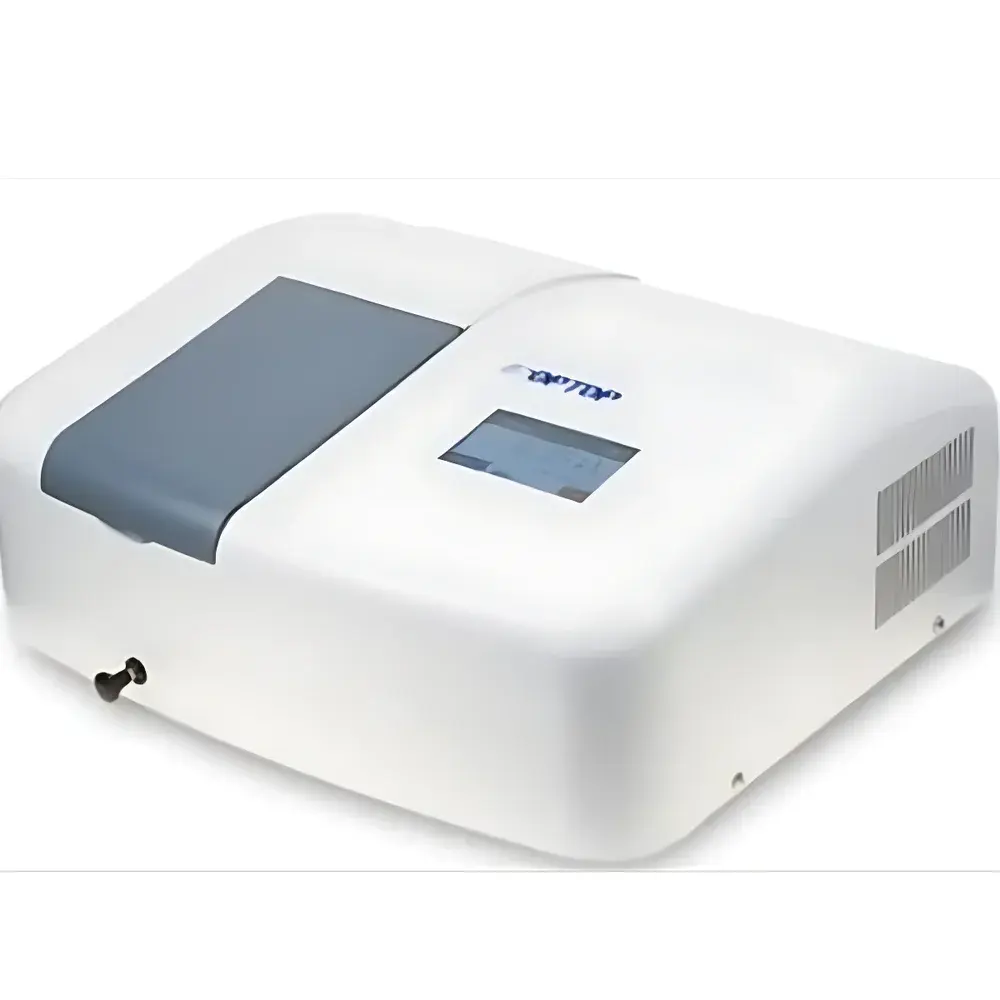
SOPOTOP 752 & 754 UV-Vis Spectrophotometers
| Brand | SOPOTOP |
|---|---|
| Origin | Shanghai, China |
| Model | 752 (Wavelength Range: 200–1000 nm), 754 (Wavelength Range: 190–1100 nm) |
| Optical Design | Single-beam |
| Detector | Photodiode Array |
| Spectral Bandwidth | 4 nm |
| Wavelength Accuracy | ±2.0 nm (752), ±1.0 nm (754) |
| Wavelength Repeatability | 1.0 nm (752), 0.5 nm (754) |
| Stray Light | ≤0.5%T (752), ≤0.3%T (754) |
| Display | 4.3-inch color touchscreen (480×272) |
| Data Interface | USB |
| Power Supply | 220 V ±10%, 50 Hz / 110 V ±10%, 60 Hz, 90 W |
| Net Weight | 10.5 kg |
| Dimensions (W×D×H) | 470×380×225 mm |
Overview
The SOPOTOP 752 and 754 UV-Vis spectrophotometers are single-beam, microprocessor-controlled instruments engineered for routine quantitative analysis in the ultraviolet and visible spectral regions (190–1100 nm). Based on Czerny-Turner monochromator architecture with a 1200-line/mm holographic grating, these instruments deliver stable optical performance optimized for educational laboratories, quality control environments, and applied research settings where robustness, ease of operation, and regulatory traceability are essential. The 754 model extends spectral coverage to 190 nm—enabling reliable detection of low-wavelength absorbers such as nucleic acids and aromatic compounds—while both models incorporate automatic wavelength calibration at startup to maintain long-term photometric integrity. Designed in accordance with fundamental principles of Beer-Lambert law-based absorbance measurement, they support transmittance (T), absorbance (A), and concentration (C) modes with direct concentration calculation using user-defined factors.
Key Features
- 4.3-inch high-resolution color touchscreen (480×272 pixels) with intuitive icon-driven interface for rapid method setup and real-time spectral visualization
- Single-beam optical path with photodiode array detector ensuring consistent signal acquisition across the full wavelength range
- Automated wavelength initialization and positioning—reducing operator dependency and minimizing alignment drift during extended use
- Onboard data storage supporting up to 200 measurement records and 50 calibration curve parameters (754/756PC variants)
- USB host interface for direct export of spectral scans, calibration data, and report files to external storage devices
- Compliance-ready design: instrument firmware supports timestamped audit trails, user-access levels, and parameter lockout—facilitating alignment with GLP and internal QA protocols
Sample Compatibility & Compliance
These spectrophotometers accommodate standard 10 mm pathlength cuvettes (quartz, glass, or plastic) and are compatible with common liquid-phase samples used in environmental testing (e.g., nitrate, phosphate), pharmaceutical assay (e.g., USP endotoxin-related quantitation), food safety (e.g., preservative detection), and biochemical analysis (e.g., protein A280 determination). While not certified to ISO/IEC 17025 or FDA 21 CFR Part 11 out-of-the-box, their operational parameters—including wavelength accuracy (±1.0 nm for 754), stray light performance (≤0.3%T at 220 nm), and photometric repeatability (0.2%T)—meet minimum requirements specified in ASTM E275, ISO 6059, and pharmacopeial general chapters (e.g., USP ). Routine verification using NIST-traceable holmium oxide and didymium filters is recommended to sustain measurement confidence.
Software & Data Management
The included UV-Solution software (Windows-compatible) enables advanced spectral processing including peak identification, derivative spectroscopy, multi-wavelength quantitation, and kinetic time-scan analysis. Raw data export is supported in CSV and ASCII formats for integration into LIMS or statistical analysis platforms (e.g., JMP, OriginLab). All instrument-generated files include embedded metadata: date/time stamp, operator ID (if configured), wavelength range, slit width, and measurement mode. The system logs critical events—including power cycles, calibration resets, and wavelength deviations—providing a foundational audit trail suitable for laboratory documentation systems operating under GxP frameworks.
Applications
- Quantitative determination of analytes in water quality monitoring (COD, TOC precursors, heavy metal chelates)
- Raw material and finished product assay in generic pharmaceutical manufacturing (e.g., paracetamol, ibuprofen)
- Enzyme kinetics studies requiring rapid absorbance tracking at fixed or scanned wavelengths
- Educational instruction in analytical chemistry, covering fundamentals of spectrophotometric calibration, Beer’s law validation, and spectral deconvolution
- Quality assurance in food and beverage production—e.g., color index evaluation, antioxidant capacity (FRAP/DPPH assays), and adulterant screening
FAQ
What is the difference between the 752 and 754 models?
The 754 extends the lower wavelength limit to 190 nm (vs. 200 nm for the 752) and improves wavelength accuracy to ±1.0 nm and repeatability to 0.5 nm. It also achieves lower stray light (≤0.3%T) and supports faster wavelength scanning when paired with UV-Solution software.
Can these instruments be used for kinetic measurements?
Yes—the 754 model supports time-based absorbance monitoring via USB-connected PC and UV-Solution software, enabling collection of up to 10,000 data points per kinetic run with user-defined interval timing.
Is quartz cuvette compatibility confirmed across the full 190–1100 nm range?
Standard fused silica cuvettes are required for measurements below 220 nm; optical path transparency must be verified per manufacturer specifications to avoid UV absorption artifacts.
How is wavelength calibration performed?
Automatic internal calibration occurs at power-on using a built-in holmium oxide reference filter; manual recalibration may be initiated using optional external standards per ISO 6059 Annex B procedures.
Does the instrument meet regulatory requirements for pharmaceutical QC labs?
While compliant with core photometric performance criteria referenced in USP and EP 2.2.25, full 21 CFR Part 11 compliance requires additional IT controls (e.g., electronic signatures, secure audit logs), which are implemented via the UV-Solution software configuration and local network policy enforcement.






