
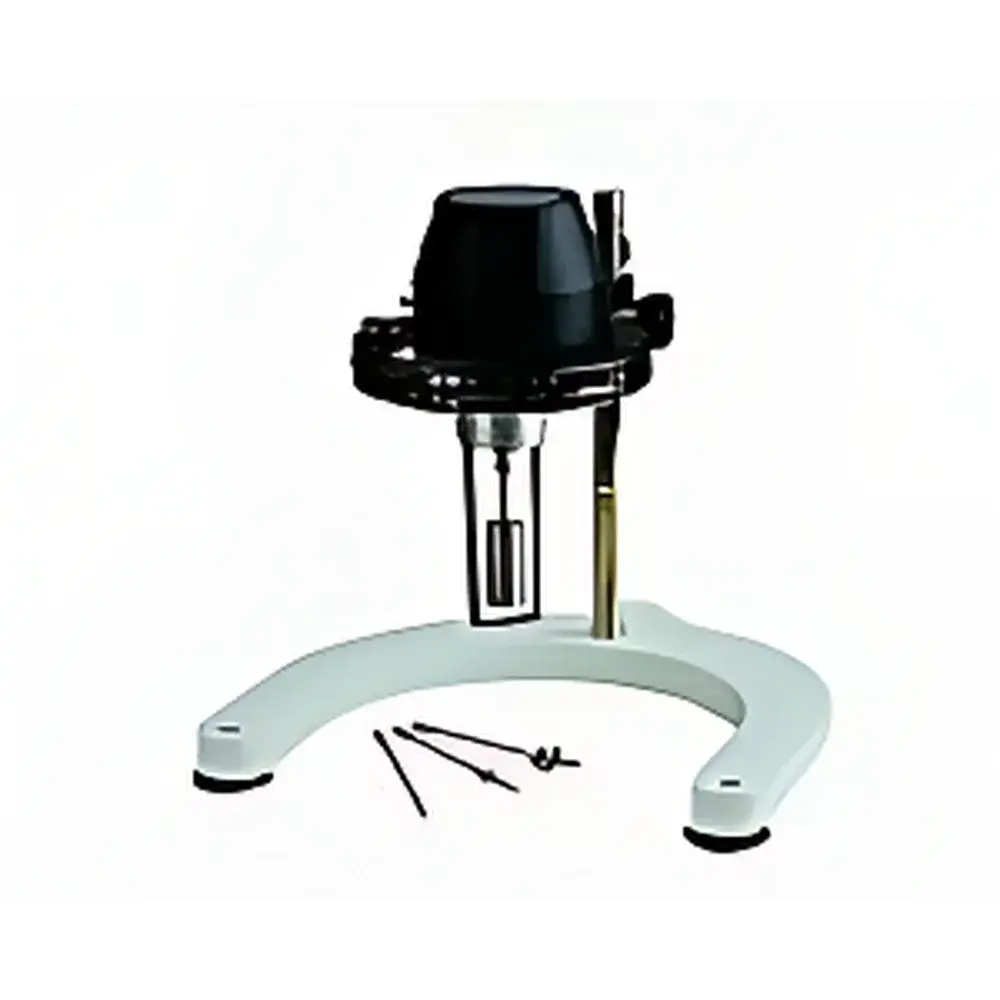
SOPOTOP NDJ-1 Mechanical Rotational Viscometer
| Brand | SOPOTOP |
|---|---|
| Origin | Shanghai, China |
| Model | NDJ-1 |
| Instrument Type | Fixed-base rotational viscometer |
| Viscosity Range | 10–100,000 mPa·s (standard configuration with spindles #1–#4) |
| Extended Range | 0.1–100,000 mPa·s (with optional #0 spindle) |
| Accuracy | ±5% for Newtonian fluids |
| Rotational Speeds | 6, 12, 30, 60 rpm (manually selected) |
| Power Supply | AC 220 V, 50 Hz |
| Operating Environment | Ambient temperature (15–30 °C recommended) |
| Compliance | Designed per GB/T 2794–2013 (Chinese national standard for viscosity measurement), compatible with ASTM D2196 and ISO 2555 practices for routine quality control |
Overview
The SOPOTOP NDJ-1 Mechanical Rotational Viscometer is a precision-engineered instrument based on the Couette principle of rotational viscometry. It measures dynamic viscosity by quantifying the torque required to rotate a cylindrical spindle at fixed angular velocities within a stationary sample. Unlike digital or microprocessor-controlled systems, the NDJ-1 employs a robust mechanical gear-driven transmission system, delivering consistent shear rate application across four discrete speeds (6, 12, 30, and 60 rpm). Its design emphasizes operational simplicity, long-term mechanical stability, and minimal calibration drift—making it particularly suitable for routine QC laboratories where reproducibility under defined shear conditions is prioritized over real-time rheological profiling. The instrument is not intended for non-Newtonian flow characterization (e.g., yield stress, thixotropy, or time-dependent behavior), but provides reliable, traceable viscosity data for homogeneous Newtonian and near-Newtonian liquids in industrial manufacturing and academic teaching environments.
Key Features
- Mechanically actuated speed selection via front-panel gear lever—no electronic controls or firmware dependencies
- Four standardized spindles (#1–#4) covering 10–100,000 mPa·s; optional #0 spindle extends lower limit to 0.1 mPa·s
- Direct analog dial readout with calibrated scale (0–100 divisions), eliminating digitization error and enabling immediate visual trend assessment
- Stainless steel spindle assembly with precision-machined geometry compliant with ISO 3219 reference dimensions
- Fixed-base chassis with leveling feet and anti-vibration rubber mounts for stable operation on standard lab benches
- No internal battery or software—fully functional after AC power connection; zero firmware updates or cybersecurity maintenance required
Sample Compatibility & Compliance
The NDJ-1 accommodates samples in standard 600 mL beakers or cylindrical sample cups (≥80 mm diameter, ≥120 mm height). It is routinely deployed for quality assurance of oils, resins, coatings, food emulsions, pharmaceutical suspensions, and adhesive formulations. While not certified to GLP or FDA 21 CFR Part 11 requirements due to its analog architecture, the instrument supports audit-ready documentation when paired with standardized SOPs: each measurement includes recorded spindle number, selected speed, dial reading, ambient temperature, and operator ID. Its performance aligns with ASTM D2196 (Standard Test Methods for Rheological Properties of Non-Newtonian Materials by Rotational Viscometer) for comparative screening and conforms to ISO 2555 (Plastics — Resins in the liquid state or as emulsions or dispersions — Determination of apparent viscosity) for reporting apparent viscosity at specified shear rates. Calibration verification is performed using NIST-traceable silicone oil standards (e.g., Cannon N4, N10, N100).
Software & Data Management
The NDJ-1 operates without embedded software or digital interfaces. All measurements are manually recorded and transcribed into laboratory notebooks or LIMS-compatible spreadsheets. For labs requiring digital traceability, SOPOTOP recommends pairing the NDJ-1 with external data loggers (e.g., Omega OM-DAQPRO-5300) connected to the analog torque signal output (available via optional adapter kit). Raw dial readings can be converted to mPa·s using factory-provided calibration charts or the universal equation η = K × α, where K is spindle/speed-specific coefficient and α is dial deflection. No proprietary drivers, cloud services, or license subscriptions are involved—ensuring full data sovereignty and compatibility with air-gapped QC environments.
Applications
- Batch release testing of lubricating oils and transformer fluids per IEC 60296 specifications
- Consistency monitoring of paint and ink formulations during production line mixing
- Viscosity grading of edible oils (e.g., soybean, olive) per AOAC 952.03 methodology
- QC screening of topical pharmaceutical gels and ointments prior to filling
- Educational demonstration of Newtonian fluid behavior in university physical chemistry labs
- Pre-screening of polymer solutions before advanced rheometry (e.g., oscillatory tests on TA AR-G2 or Anton Paar MCR series)
FAQ
Is the NDJ-1 compliant with ISO/IEC 17025 requirements for accredited testing labs?
Yes—when operated within documented SOPs, with periodic verification using certified reference materials and technician competency records, the NDJ-1 meets the metrological traceability and uncertainty evaluation criteria outlined in ISO/IEC 17025:2017 Clause 6.4.
Can spindle #0 be used interchangeably with other spindles on the same NDJ-1 unit?
Yes—spindle #0 is mechanically compatible and requires no recalibration; however, its use mandates strict adherence to immersion depth (30 ± 1 mm) and sample volume (≥400 mL) per GB/T 2794–2013 Annex A.
Does the instrument require annual recalibration by an authorized service center?
No—mechanical viscometers like the NDJ-1 do not drift significantly if handled per manual instructions; users perform daily verification with reference oils, and formal recalibration is recommended only after mechanical impact or spindle replacement.
What is the minimum sample volume required for accurate measurement?
600 mL in a standard beaker (ID ≥ 80 mm) ensures full spindle immersion and eliminates wall effects; smaller volumes introduce systematic error exceeding ±10%.
Is the NDJ-1 suitable for measuring non-Newtonian fluids such as ketchup or drilling mud?
It provides single-point apparent viscosity values at fixed shear rates, but cannot characterize shear-thinning, yield stress, or viscoelasticity—applications requiring those parameters necessitate a programmable rheometer with controlled shear stress capability.



