
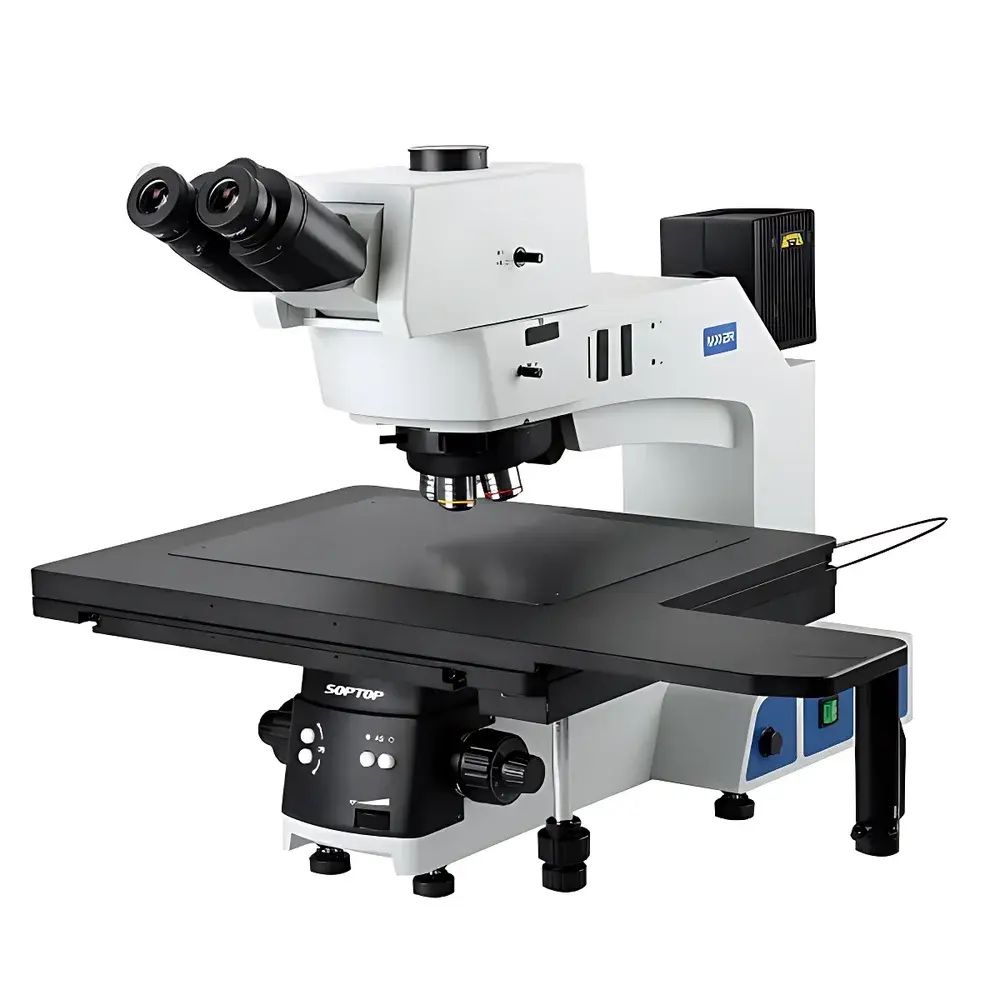
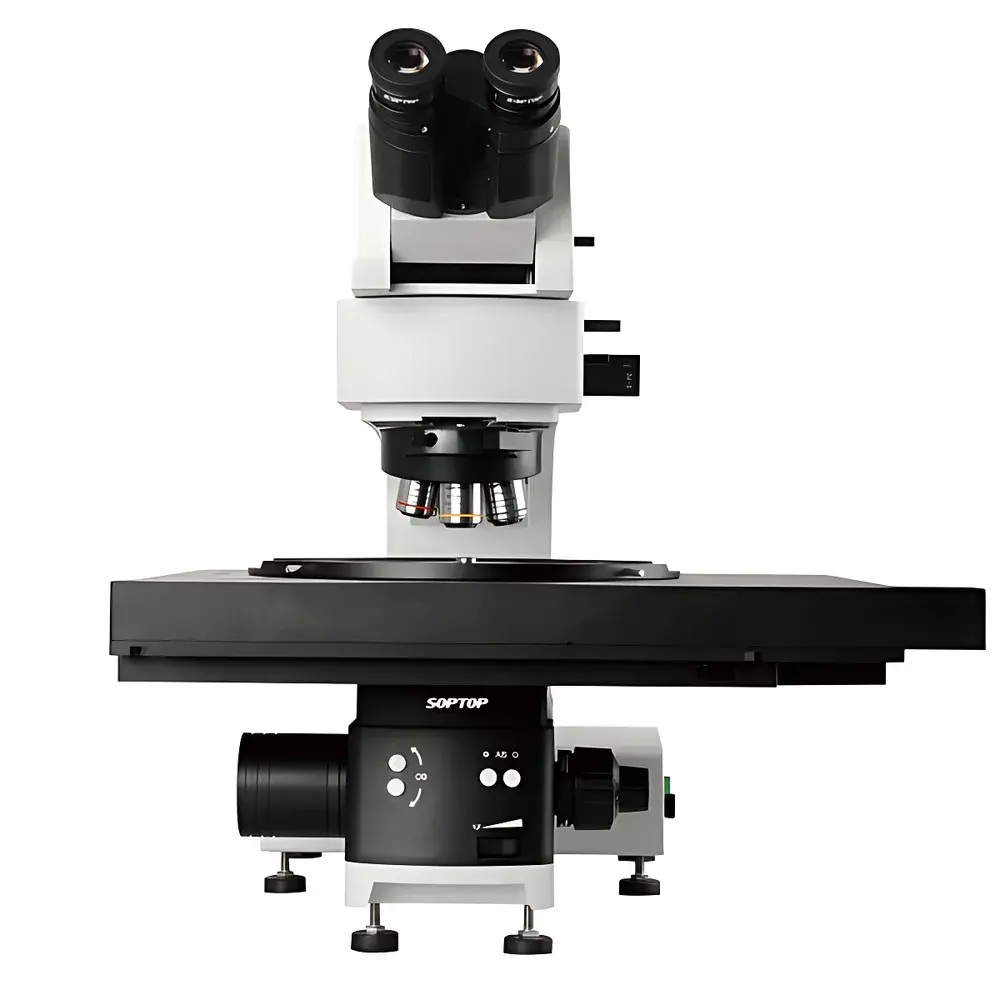
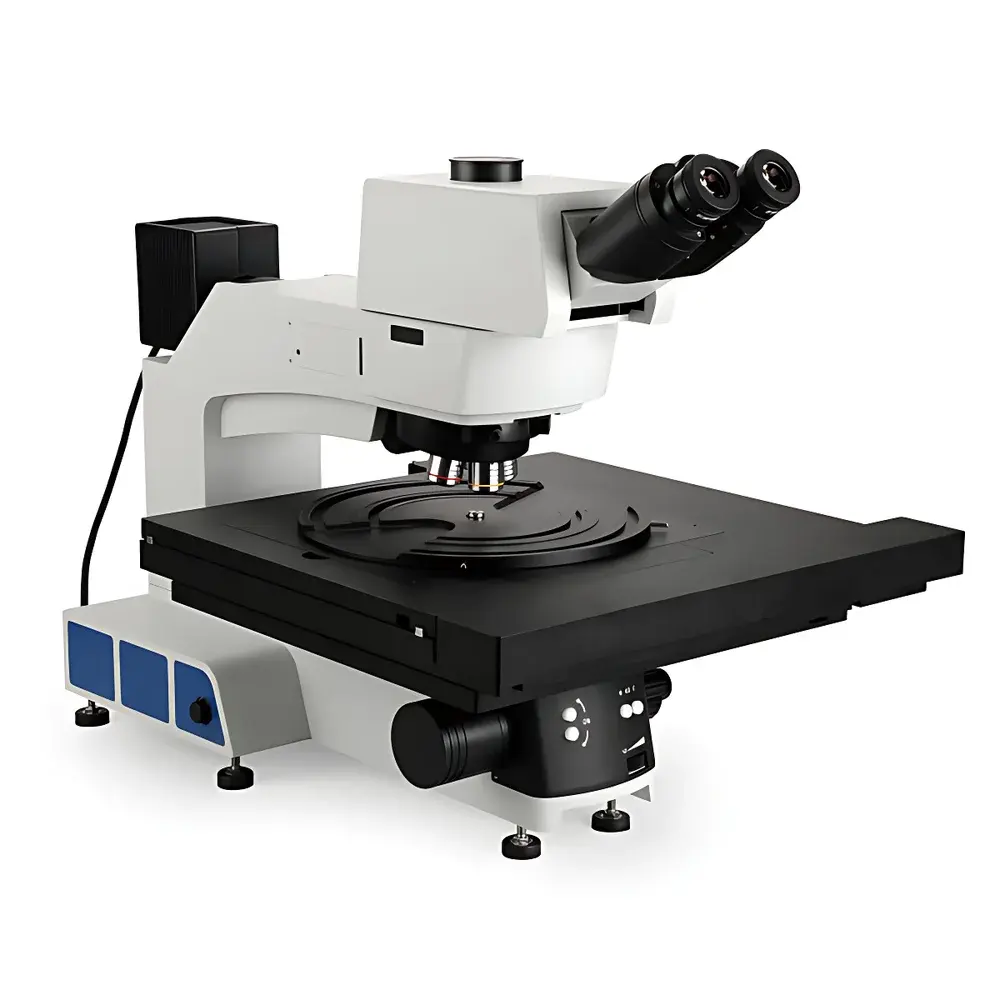
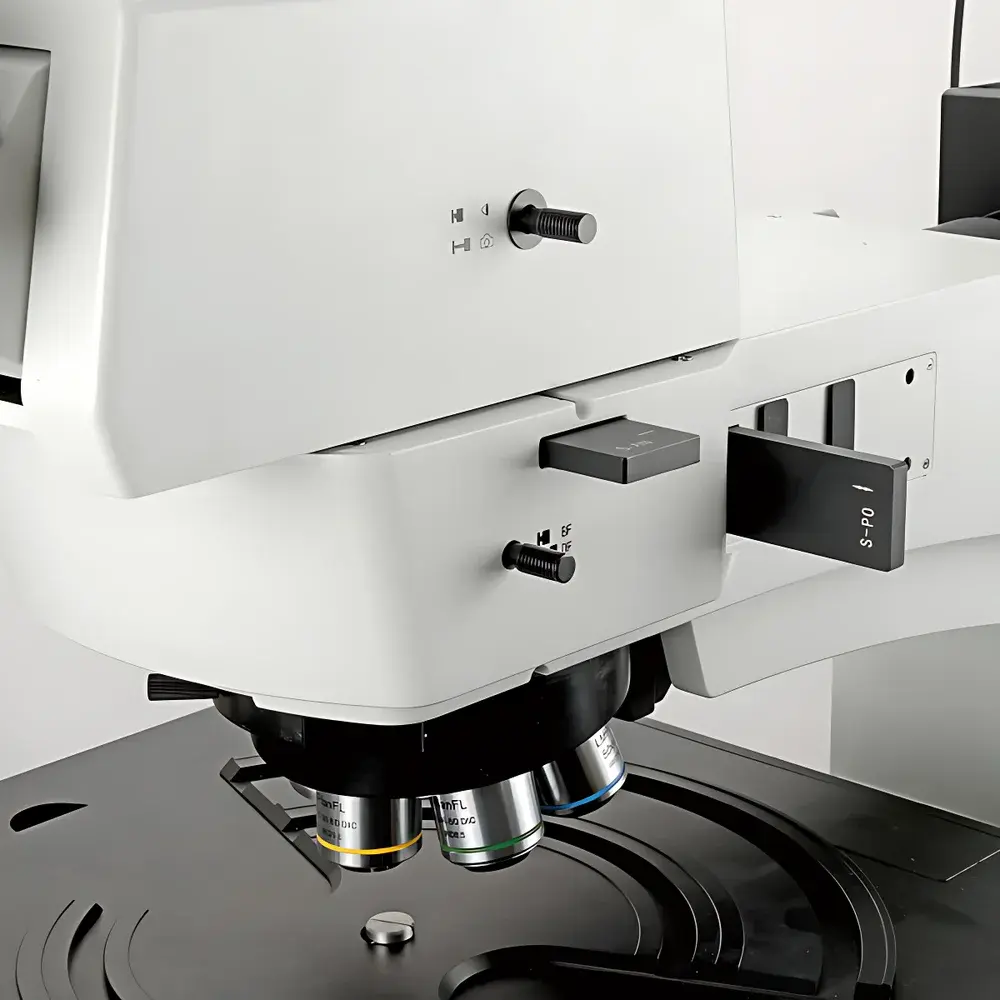
SOPTOP MX12R Upright Metallurgical Microscope
| Brand | SOPTOP |
|---|---|
| Origin | Zhejiang, China |
| Manufacturer Type | Direct Manufacturer |
| Product Type | Upright |
| Total Magnification Range | 50×–1000× |
| Eyepieces | High-Eyepoint Wide-Field Plan Eyepieces PL10×/25 mm |
| Objectives | 5×–100× |
| Wafer Compatibility | Up to 300 mm diameter |
| FPD Panel Support | Up to 17-inch LCD panels |
| Observation Angle Adjustment | 0°–35° continuous tilt |
| Stage Drive | Clutch-Engaged Mechanical Translation with Precision Linear Rails |
| Objective Turret | Motorized, Dual-Direction (Forward/Reverse), High-Repeatability Positioning |
| Aperture & Objective Control | Front-Mounted Electric Actuation |
| Illumination Modes | Brightfield, Darkfield, Polarized Light, Differential Interference Contrast (DIC) |
| Structural Design | Six-Point Low-CG Metal Chassis with Vibration-Damping Rigidity |
| Optional NIR Upgrade | Compatible with Broadband Infrared Cameras for Subsurface Imaging |
Overview
The SOPTOP MX12R is an upright metallurgical microscope engineered for high-precision, production-grade inspection in semiconductor fabrication, flat panel display (FPD) manufacturing, and advanced materials characterization. Based on Köhler illumination and infinity-corrected optical path architecture, the MX12R delivers diffraction-limited resolution across its full 50×–1000× magnification range—achievable through a parfocal, apochromatic objective set (5×, 10×, 20×, 50×, 100×) and wide-field PL10×/25 mm eyepieces. Its optical train supports simultaneous implementation of brightfield (BF), darkfield (DF), polarized light (POL), and differential interference contrast (DIC) modalities without mechanical realignment—enabling rapid, repeatable mode switching during process control or failure analysis workflows.
Key Features
- Motorized objective turret with dual-direction actuation (forward/reverse), offering sub-5 µm repeatability in objective positioning—critical for automated defect review and multi-modal image registration.
- Ergonomic observation head with continuously adjustable inclination (0°–35°), accommodating operators of varying stature while minimizing cervical strain during extended visual inspection sessions.
- Clutch-activated mechanical stage drive: Press-and-hold engagement enables smooth, low-friction translation over large travel ranges; release disengages drive instantly—eliminating hand fatigue associated with sustained manual knob pressure.
- Precision-ground linear rail system integrated into the X-Y stage assembly ensures micron-level positional stability and minimal hysteresis during repeated coordinate navigation.
- Front-panel electric controls for aperture diaphragm and objective selection—positioned within natural reach zone—to reduce workflow interruption and support glove-compatible operation in cleanroom environments.
- Hexapod-base chassis constructed entirely from stress-relieved aluminum alloy, featuring optimized mass distribution and vibration-damping geometry to maintain optical axis stability under ambient floor vibrations (compliant with ISO 25386-2 for metrology-grade microscopes).
Sample Compatibility & Compliance
The MX12R accommodates specimens up to 300 mm in diameter (full-wafer inspection) and planar substrates up to 432 mm × 305 mm (17-inch FPD panels), facilitated by interchangeable nosepiece inserts (4″, 6″, 8″, and 12″ wafer carriers). Its stage design complies with SEMI E10-0303 specifications for semiconductor equipment ergonomics and meets ISO 9001:2015 requirements for calibration traceability in quality management systems. All optical components are coated with anti-reflective and scratch-resistant multilayer dielectric films conforming to ISO 10110-7 standards. The system supports integration into GLP/GMP-compliant laboratories via optional audit-trail-enabled software modules aligned with FDA 21 CFR Part 11 data integrity guidelines.
Software & Data Management
When paired with SOPTOP’s proprietary imaging suite (v5.2+), the MX12R enables synchronized acquisition across BF/DF/POL/DIC channels with timestamped metadata embedding (operator ID, objective used, exposure parameters, stage coordinates). Image stacks support TIFF-64 bit depth export, Z-stacking with focus mapping, and measurement annotation compliant with ASTM E1558–22 (Standard Guide for Quantitative Microstructural Analysis). Raw data files include embedded EXIF tags for full chain-of-custody documentation—essential for internal audit readiness and external accreditation (e.g., ISO/IEC 17025). Remote control via Ethernet TCP/IP interface allows centralized fleet monitoring in multi-station fabs.
Applications
- Semiconductor: Defect localization on patterned wafers, gate oxide integrity assessment, CMP uniformity evaluation, and bond pad morphology analysis.
- FPD Manufacturing: Pixel electrode continuity verification, TFT channel inspection, color filter alignment validation, and backlight unit micro-crack detection.
- Advanced Packaging: Wire bond pull-test fracture surface analysis, solder joint void quantification, and underfill delamination mapping.
- Materials Science: Grain boundary delineation in polycrystalline alloys, phase distribution in heat-treated steels, ceramic sintering density assessment, and composite fiber-matrix interfacial integrity evaluation.
- NIR Extension: With optional broadband infrared camera coupling (900–1700 nm), the MX12R transforms into the NIR-MX12R platform—enabling non-destructive subsurface imaging of flip-chip interconnects, silicon photonics waveguide propagation, and encapsulated die-level thermal anomalies.
FAQ
Does the MX12R support automated focus mapping for roughness profiling?
Yes—when equipped with motorized Z-axis and SOPTOP’s FocusMap module, it performs sequential focal plane acquisition with ±0.1 µm step resolution and generates height maps compliant with ISO 25178-2 surface texture parameters.
Is DIC alignment calibrated at the factory and field-serviceable?
Each unit ships with NIST-traceable DIC shear calibration verified using certified grating standards; field recalibration is supported via guided wizard in the imaging software.
Can the MX12R be integrated into a SECS/GEM host system?
Yes—the Ethernet interface supports SEMI E30 (GEM) and E40 (SECS-II) protocol stacks; integration requires SOPTOP’s OEM communication SDK (v3.1+).
What is the maximum working distance achievable at 100× magnification?
With the standard 100×/0.90 NA objective, working distance is 0.9 mm; extended-working-distance (EWD) variants (100×/0.85 NA, WD = 2.1 mm) are available as configurable options.
Are objective lenses compatible with other SOPTOP microscope platforms?
All MX-series objectives adhere to SOPTOP’s unified M25×0.75 thread standard and share mechanical and optical back focal length specifications—ensuring cross-platform interchangeability within the MX, MS, and MT product families.






