
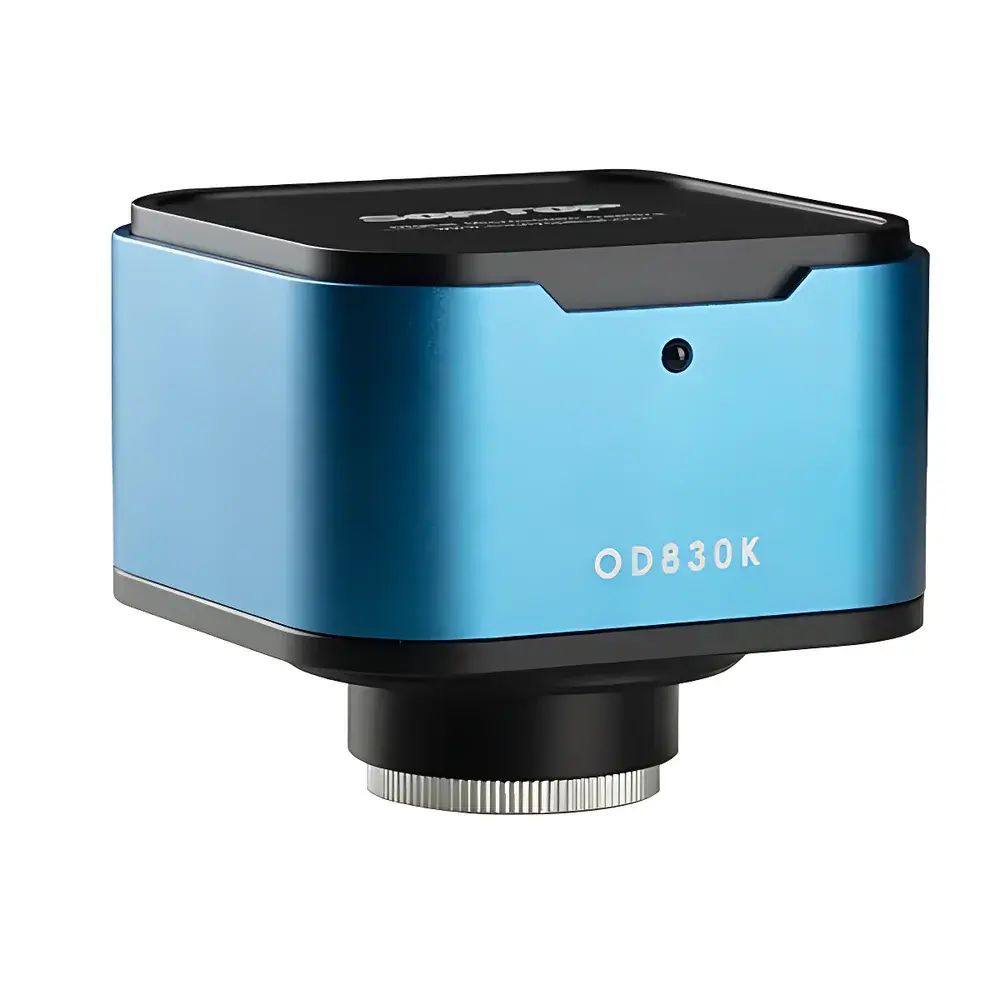
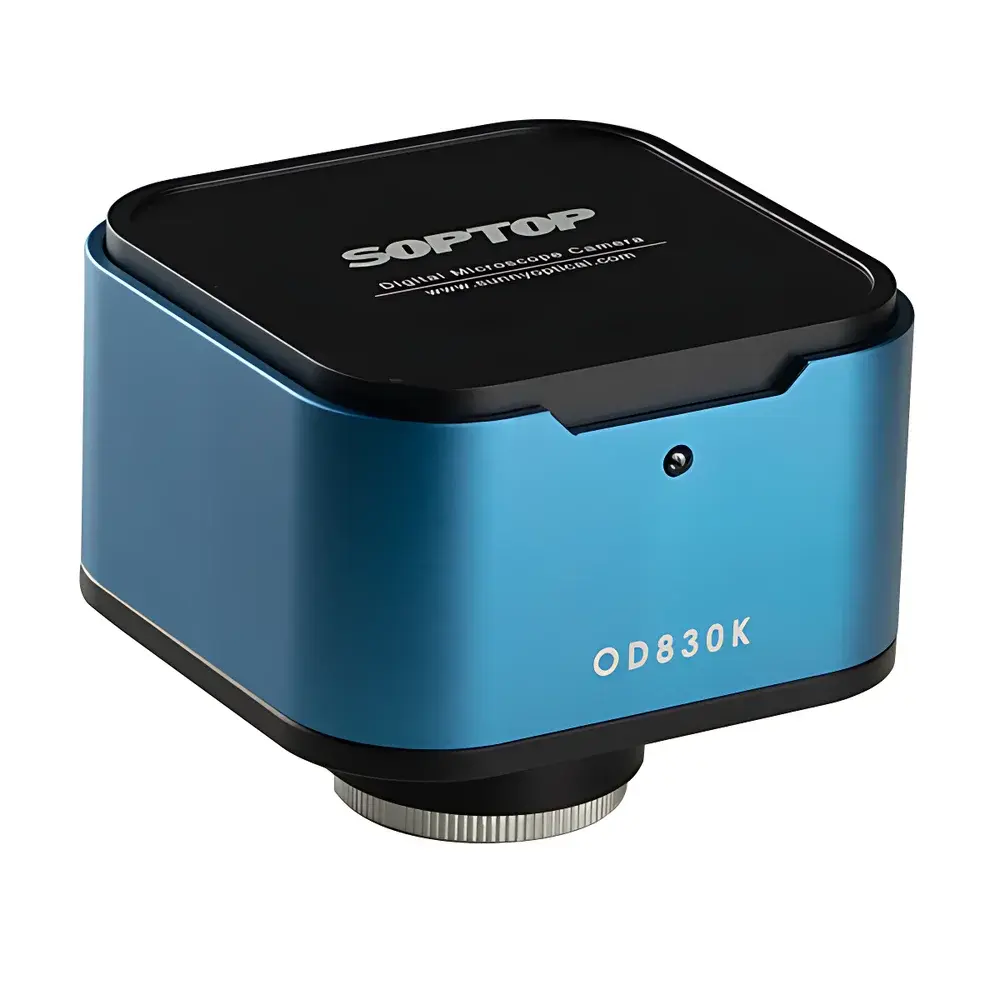
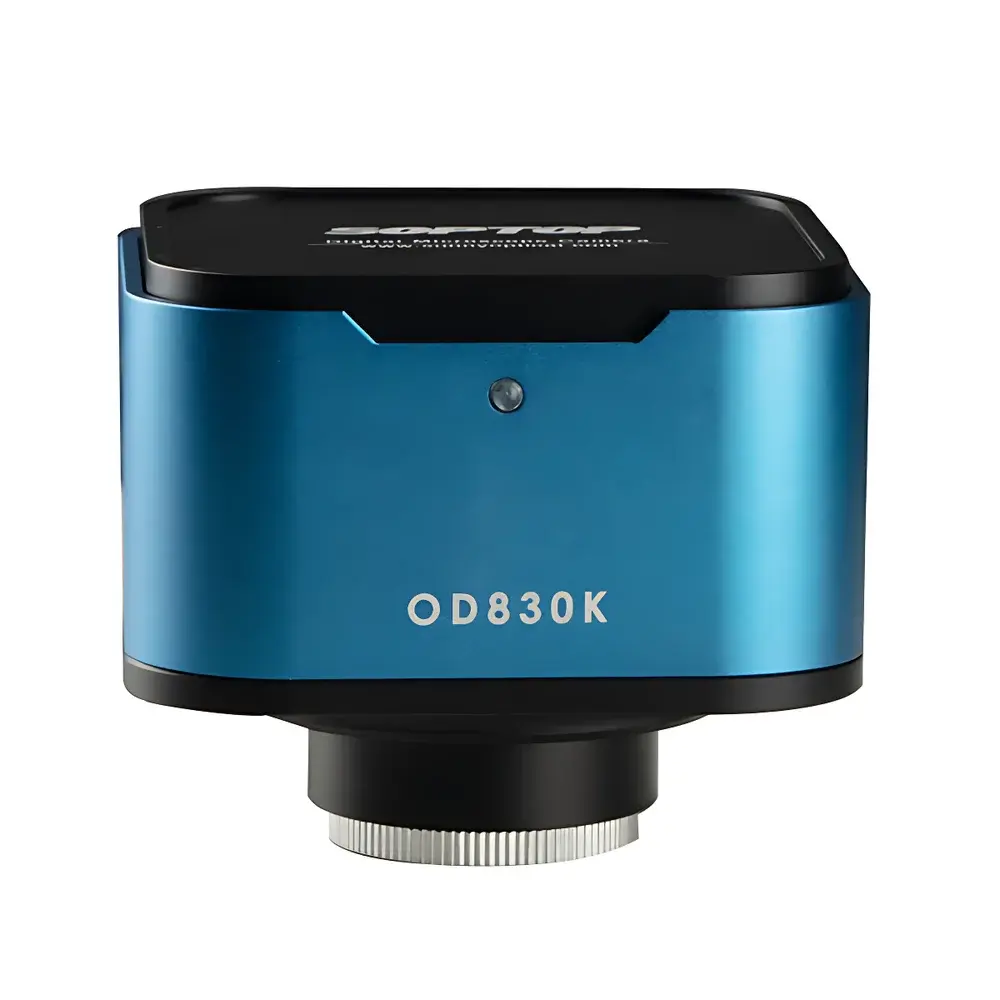
SOPTOP OD830K 4K USB 3.0 CMOS Microscopy Camera
| Brand | SOPTOP |
|---|---|
| Origin | Zhejiang, China |
| Manufacturer Type | OEM/ODM Manufacturer |
| Region of Origin | Domestic (China) |
| Model | OD830K |
| Image Resolution | 3840 × 2160 @ 35 fps |
| Pixel Size | 2.0 µm × 2.0 µm |
| Interface | USB 3.0 |
| Software | MvImage 3.0 |
| Compliance | CE, RoHS, FCC (declared) |
Overview
The SOPTOP OD830K is a high-performance, USB 3.0–enabled 4K CMOS microscopy camera engineered for quantitative optical imaging in demanding scientific and industrial environments. Based on a global-shutter or rolling-shutter CMOS sensor (model-specific configuration), the OD830K delivers full-frame 3840 × 2160 resolution at up to 35 frames per second—enabling real-time visualization of dynamic microscopic processes without motion blur or frame drop. Its optical architecture is optimized for integration with upright and inverted biological microscopes, stereo (dissecting) systems, metallurgical (reflected-light) setups, and polarized light platforms. The camera operates within standard C-mount mechanical interface specifications (17.526 mm flange focal distance), ensuring compatibility with a broad range of objective lenses and tube lenses across OEM microscope platforms. Designed for reproducible image acquisition under variable illumination conditions—including Köhler, LED, halogen, and fiber-coupled sources—the OD830K incorporates hardware-level gain control, 12-bit analog-to-digital conversion, and programmable exposure timing down to 10 µs.
Key Features
- Native 4K resolution (3840 × 2160) output at 35 fps over USB 3.0, supporting lossless data transfer at sustained bandwidth >300 MB/s
- 2.0 µm pixel pitch CMOS sensor with high quantum efficiency (>65% at 550 nm) and low read noise (<2.5 e⁻ RMS), optimized for low-light fluorescence and brightfield applications
- Proprietary SOPTOP ISP (Image Signal Processing) pipeline featuring adaptive white balance, gamma correction, and chromatic aberration compensation
- Dedicated lateral chromatic aberration correction algorithm targeting purple fringing—applied in real time without interpolation artifacts or spatial resolution degradation
- Hardware-triggered acquisition support (TTL input) for synchronization with external devices such as shutters, stages, or laser pulsers
- On-sensor binning modes (2×2, 4×4) for enhanced signal-to-noise ratio in low-illumination scenarios, preserving native aspect ratio and metadata integrity
Sample Compatibility & Compliance
The OD830K is validated for use across life science, materials science, and quality assurance workflows involving transparent, semi-transparent, and opaque specimens—including live-cell cultures, histological sections, semiconductor wafers, solder joints, and alloy microstructures. It meets electromagnetic compatibility requirements per EN 55032:2015 (Class B) and safety standards per EN 62368-1:2014. Regulatory declarations include CE marking under the EU Machinery Directive 2006/42/EC and RoHS 2011/65/EU compliance. While not certified to ISO 13485 or FDA 21 CFR Part 11 out-of-the-box, the camera’s deterministic acquisition behavior, timestamped frame metadata (UTC-synchronized via host system), and unmodified raw data output (12-bit Bayer or RGB) support integration into GLP/GMP-compliant imaging workflows when paired with validated software and audit-trail-enabled acquisition protocols.
Software & Data Management
The OD830K ships with MvImage 3.0—a cross-platform (Windows/macOS/Linux) application developed and maintained by SOPTOP. MvImage 3.0 provides full SDK access (C/C++, Python, MATLAB wrappers) and supports DICOM export, TIFF/RAW12/AVI container formats, and metadata embedding per EXIF 2.3 and TIFF/EP standards. Core analytical modules include focus stacking (Z-stack fusion using variance-based sharpness metrics), particle analysis (ISO 13322-2 compliant counting and sizing with user-defined thresholds), multi-point calibration (NIST-traceable stage micrometer alignment), and panoramic tiling (automated mosaic stitching with sub-pixel registration). All processing operations are non-destructive and preserve original pixel values; histogram equalization, deconvolution (Richardson-Lucy), and spectral unmixing require optional plugin licensing.
Applications
- Live-cell time-lapse imaging in academic and pharmaceutical research laboratories
- Automated defect detection during PCB inspection and additive manufacturing QA
- Quantitative metallography per ASTM E112 and ISO 643 standards
- Educational microscopy demonstrations requiring real-time annotation and screen mirroring
- Forensic fiber and trace evidence documentation with calibrated scale bars and color reference patches
- In-line process monitoring in cleanroom environments where thermal stability and ESD-safe housing are critical
FAQ
Is the OD830K compatible with third-party microscope control software (e.g., Micro-Manager, Ocular)?
Yes—SOPTOP provides a GenICam-compliant driver package and publishes a documented DLL-based API for custom integration. Pre-built adapters exist for Micro-Manager v2.0+ and Hamamatsu HCImage Live.
Does the camera support hardware binning or region-of-interest (ROI) cropping?
Yes—both functions are implemented at the sensor level via register-level configuration and reduce host CPU load without compromising frame rate.
Can MvImage 3.0 generate audit trails for regulatory submissions?
Not natively; however, all acquisition parameters (exposure, gain, timestamp, lens ID) are embedded in TIFF headers and can be parsed programmatically for external logging. Validation packages are available upon request for GxP-aligned deployments.
What is the maximum cable length supported for stable USB 3.0 operation?
Up to 3 meters using certified passive cables; active optical USB 3.2 Gen 1 extenders enable distances up to 10 meters with full bandwidth retention.



