
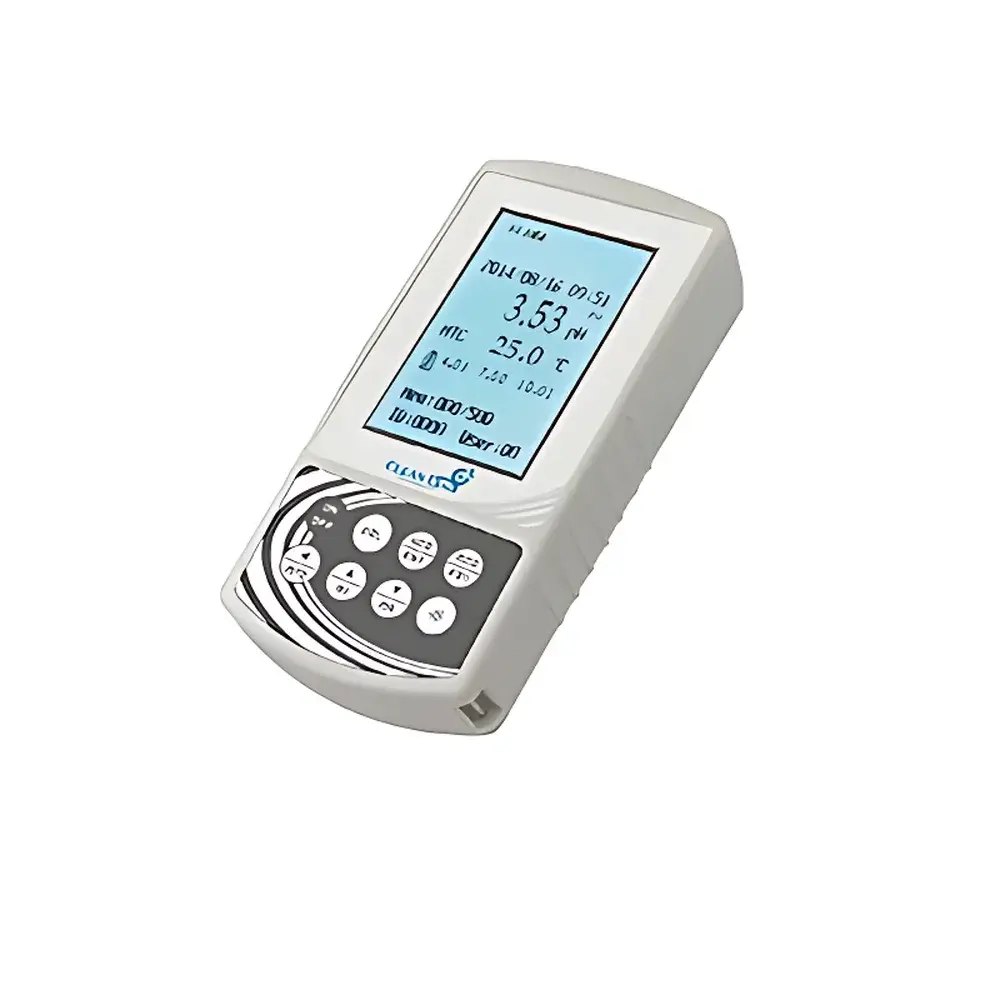
SOPTOP pH6231 Portable Professional pH Meter
| Brand | SOPTOP |
|---|---|
| Model | pH6231 |
| Type | Portable pH Meter |
| Parameter Type | Single-Parameter (pH/mV/Temperature) |
| Measurement Range | −2.000 to 20.000 pH |
| Resolution | 0.001 pH |
| Accuracy | ±0.001 pH |
| mV Range | −2000.0 to +2000.0 mV |
| mV Accuracy | ±0.2 mV |
| Temperature Range | −10.0 to 120.0 °C |
| Temp. Accuracy | ±0.3 °C |
| Temperature Compensation | Automatic or Manual |
| Calibration Points | Up to 5-point NIST-traceable buffer calibration |
| Data Storage | 750 sets with timestamp, instrument ID, and user ID |
| Display | 3.2-inch multi-line LCD with adjustable backlight |
| Power | 2 × 1.5 V AA batteries |
| Auto-Off Delay | Configurable (default: 10 min idle) |
| Interface | USB port for data transfer |
| Compliance | NIST-traceable calibration support |
Overview
The SOPTOP pH6231 Portable Professional pH Meter is an engineered electrochemical measurement system designed for high-precision field and laboratory applications requiring traceable, repeatable pH and redox potential (mV) determinations across extreme aqueous pH ranges. Built upon a dual-junction, temperature-compensated potentiometric architecture, the instrument measures the electromotive force (EMF) generated at the interface between a glass pH sensing electrode and a stable reference electrode—converted in real time using the Nernst equation (−59.16 mV/pH unit at 25 °C). Its extended operational range of −2.000 to 20.000 pH enables reliable characterization of highly acidic industrial effluents, concentrated alkaline cleaning solutions, and non-aqueous or low-ionic-strength samples when paired with appropriate electrodes. Integrated Pt1000 temperature sensing ensures accurate automatic temperature compensation (ATC), while its robust housing meets IP67-rated environmental protection for use in humid, dusty, or splash-prone settings.
Key Features
- High-resolution 3.2-inch multi-line LCD display with user-adjustable backlight intensity and configurable date/time stamping (YY/MM/DD, MM/DD/YY, DD/MM/YY; 12h/24h format)
- Five-point NIST-traceable calibration capability with real-time slope and offset diagnostics—displayed concurrently with measured values
- Configurable auto-calibration reminder (0–60 days) and password-protected setup (4-digit user-defined code)
- 750-sequence internal memory with full metadata logging: timestamp, instrument serial number (4-digit editable), user ID (2-digit editable), and storage count indicator
- Three-stage stability detection algorithm for adaptive endpoint recognition—optimized for slow-response electrodes or viscous media
- Adjustable temperature offset correction (±5.0 °C / ±9.0 °F) to compensate for thermal gradients between sample and probe junction
- USB interface compliant with CDC/ACM class protocols—enabling direct connection to Windows/Linux hosts without proprietary drivers
- Low-power design with dual AA battery operation (typical life >200 hours under normal usage); configurable auto-off delay (1–60 minutes)
Sample Compatibility & Compliance
The pH6231 supports standard combination pH electrodes with BNC connectors and integrated temperature sensors (e.g., Pt1000 or thermistor-based). It is compatible with all common NIST-certified pH buffer standards (4.005, 6.865, 7.000, 9.180, 10.012 at 25 °C) and accommodates custom calibration sequences per ISO 8655-5 and ASTM E70 guidelines. While not certified for GLP/GMP environments out-of-box, its audit-ready data structure—including immutable timestamps, operator identifiers, and calibration diagnostics—facilitates compliance with FDA 21 CFR Part 11 when used with validated third-party software and procedural controls. The instrument meets IEC 61010-1 safety requirements for portable electrical measuring equipment and carries CE marking for EMC and low-voltage directive conformance.
Software & Data Management
The included USB data acquisition software provides secure, timestamp-synchronized export of stored measurements to CSV or Excel-compatible formats. Raw files retain full metadata (date/time, instrument ID, user ID, calibration status flags), supporting traceability in quality-controlled workflows. Software features include batch export, statistical summary generation (mean, SD, min/max), and overlay plotting of pH vs. time. No cloud dependency or subscription model—data remains fully under user control. Firmware updates are delivered via signed binary packages with SHA-256 checksum verification.
Applications
- Environmental monitoring: Field testing of acid mine drainage (pH < 2), alkaline leachates from concrete degradation, or wastewater treatment influent/effluent
- Pharmaceutical QC: Verification of buffer preparation accuracy and stability studies per USP
- Food & beverage: pH profiling during fermentation, dairy processing, and shelf-life validation
- Academic research: Teaching potentiometric principles, electrode kinetics, and non-aqueous pH metrology
- Industrial maintenance: Monitoring corrosion inhibitors, boiler water chemistry, and cleaning solution efficacy
FAQ
Does the pH6231 support automatic electrode recognition?
No—it requires manual selection of electrode type (e.g., gel-filled, refillable, or solid-state) during setup to configure appropriate input impedance and response filtering.
Can it measure pH in non-aqueous solvents?
Yes—with appropriate electrodes and two-point calibration using solvent-matched buffers; however, NIST traceability applies only to aqueous standards.
Is the USB interface compatible with macOS or Linux?
Yes—the device enumerates as a standard CDC ACM serial device; terminal emulation or custom Python scripts can access raw data streams.
What is the maximum allowable temperature for continuous immersion of the electrode?
Electrode compatibility depends on the connected sensor—not the meter itself. Refer to individual electrode specifications for thermal limits.
How is calibration traceability documented?
Each calibration event stores slope (%), offset (mV), and buffer IDs; users must manually record buffer lot numbers and expiration dates per ISO/IEC 17025 documentation requirements.






