
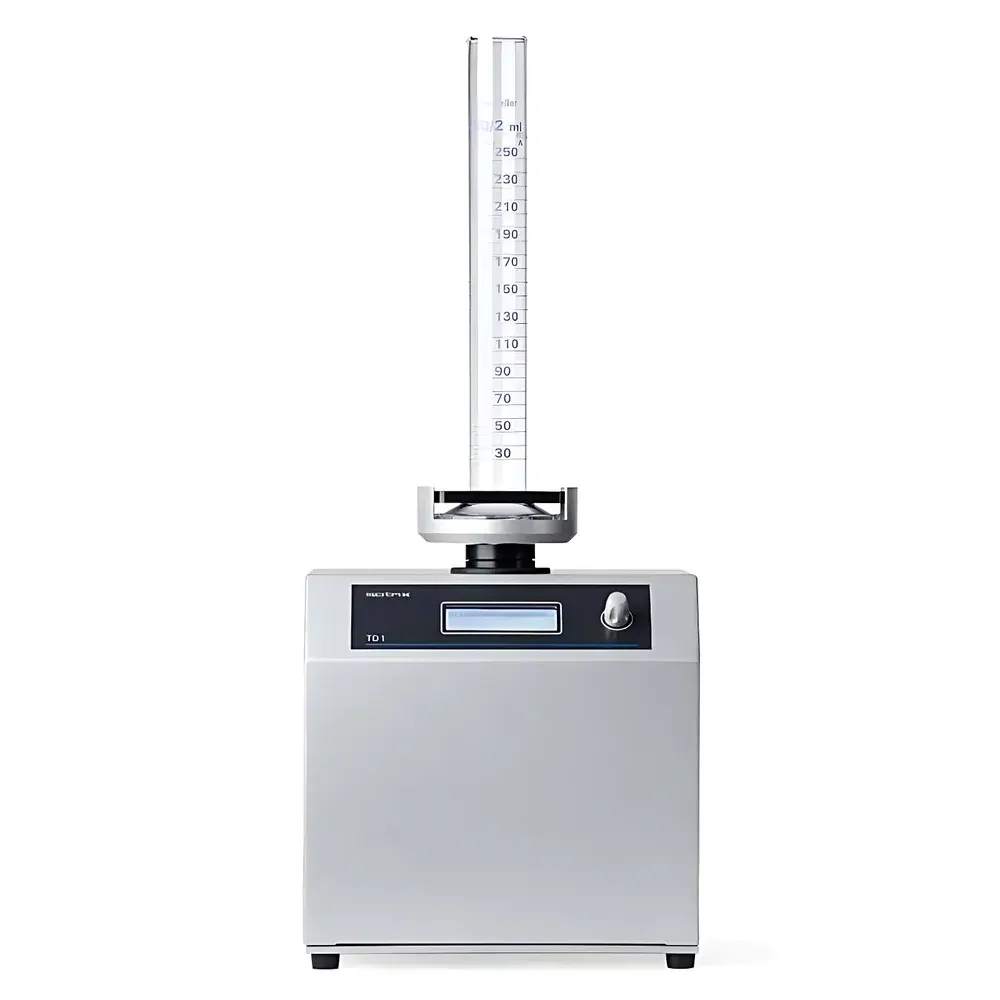
SOTAX TD1 Powder Bulk Density Tester
| Brand | SOTAX |
|---|---|
| Origin | Switzerland |
| Model | TD1 |
| Instrument Type | Bulk Density Tester |
| Application | Solid Pharmaceutical Powders & Granules |
| Compliance | USP <616>, USP <617>, EP 2.9.34, ASTM D1464 |
| Tap Frequency | 300 ±2 taps/min (USP Method I), 250 ±2 taps/min (USP Method II / EP / ASTM) |
| Tap Height | 14 ±2 mm (USP I), 3 ±0.3 mm (USP II / EP / ASTM) |
| Cylinder Positions | 1 |
| Cylinder Volumes | 100 mL and 250 mL (interchangeable) |
| Display | 24×2 character LCD |
| Data Storage | 30 test results with timestamp, method ID, and calculated parameters |
| Output | GMP/GLP-compliant printout (via integrated thermal printer) |
| Design | Benchtop, single-cylinder, electromechanical tapping system with synchronized rotation and tapping motion |
Overview
The SOTAX TD1 Powder Bulk Density Tester is a precision-engineered benchtop instrument designed for the standardized determination of bulk density, tapped density, compressibility index (Carr’s Index), and Hausner ratio of pharmaceutical powders, granules, and soft masses. It operates on the principle of controlled mechanical tapping—applying reproducible vertical impacts to a fixed-volume sample contained in a calibrated glass cylinder—thereby simulating real-world powder handling conditions such as filling, transport, and compression. The TD1 implements rigorously defined tap dynamics per major pharmacopoeial standards, including USP (Method I and II), European Pharmacopoeia 2.9.34, and ASTM D1464. Its robust electromechanical architecture ensures high repeatability across daily QC operations in regulated environments, making it suitable for raw material release, formulation development, and process validation within GMP-compliant pharmaceutical manufacturing.
Key Features
- Pharmacopoeia-compliant tapping: Programmable tap frequencies (300 ±2 taps/min for USP Method I; 250 ±2 taps/min for USP Method II, EP, and ASTM) and precisely controlled tap heights (14 ±2 mm for Method I; 3 ±0.3 mm for Method II/EP/ASTM).
- Single-cylinder design with quick-swap capability for 100 mL and 250 mL calibrated glass cylinders—secured via spring-loaded clamping mechanism for vibration-free operation and rapid setup.
- Synchronized rotational-tapping motion: Cylinder rotates at low speed during tapping to homogenize powder surface and minimize channeling or segregation artifacts, improving measurement reproducibility.
- Dedicated rotary selector switch for direct method selection (USP I, USP II, EP, ASTM), eliminating software navigation delays and reducing operator-induced variability.
- Integrated 24×2 character LCD display showing real-time status—including active method, elapsed taps, current mass reading, and calculated parameters—alongside context-sensitive help prompts and menu navigation cues.
- Onboard calculation engine computes bulk density (g/mL), tapped density (g/mL), compressibility index (%), and Hausner ratio (dimensionless) automatically upon completion of each test sequence.
- Non-volatile memory stores up to 30 complete test records with timestamps, method identifiers, initial/final mass values, cylinder volume, and derived indices—each record traceable to operator and session.
Sample Compatibility & Compliance
The TD1 accommodates free-flowing and cohesive solid dosage forms typical in pharmaceutical development and manufacturing: active pharmaceutical ingredients (APIs), excipients, wet granules, dry granules, milled powders, and soft masses prior to roller compaction or spheronization. Its mechanical design excludes moving parts that contact the sample directly—ensuring no contamination risk or particle attrition during testing. All operational parameters align with regulatory expectations for data integrity: tests are fully traceable, method selection is auditable, and stored results include immutable metadata required for GLP and GMP compliance. The integrated thermal printer generates hard-copy reports containing full test metadata, calculations, and operator identification—formatted to meet FDA 21 CFR Part 11 readiness requirements when paired with appropriate lab documentation practices.
Software & Data Management
The TD1 operates without external PC dependency—its embedded firmware handles all control logic, calibration management, and result computation. While not equipped with USB or Ethernet connectivity, its internal storage provides sufficient capacity for routine batch-level verification and trend analysis. Test records can be manually transcribed or exported via printed output into LIMS or electronic lab notebook (ELN) systems. Calibration verification is performed using certified reference weights and NIST-traceable cylinder volume checks—procedures documented in the instrument’s IQ/OQ protocol package. Firmware updates (if released by SOTAX) are delivered via secure USB stick and require authorized technician execution to maintain validated status.
Applications
- Raw material qualification per USP and EP 2.9.34 specifications.
- Granule characterization during wet/dry granulation process development.
- Compression behavior assessment for tablet formulation optimization.
- Stability-indicating parameter tracking during accelerated aging studies.
- Supplier qualification and incoming inspection of powdered excipients (e.g., microcrystalline cellulose, lactose monohydrate, mannitol).
- Supporting QbD initiatives through correlation of bulk/tapped density with flow function coefficients measured on shear testers.
FAQ
Does the TD1 support automated method switching between USP I and USP II?
Yes—the rotary selector switch enables immediate, tactile method selection without menu navigation or software input.
Can the TD1 be used for non-pharmaceutical powders such as catalysts or food ingredients?
While optimized for pharmacopoeial compliance, its mechanical principles apply broadly to any free-flowing or semi-cohesive particulate solid; however, method validity must be confirmed per application-specific regulatory or internal SOP requirements.
Is cylinder calibration included in the standard delivery?
Calibrated 100 mL and 250 mL glass cylinders are supplied with certificate of conformity; volumetric certification per ISO/IEC 17025 is available as an optional service.
How is data integrity ensured during power interruption?
All test progress and final results are written to non-volatile memory before tap initiation; partial tests are not saved unless completed successfully.
What maintenance is required for long-term accuracy?
Annual verification of tap frequency, height, and cylinder volume—performed using SOTAX-certified service engineers—is recommended to sustain metrological traceability.



