
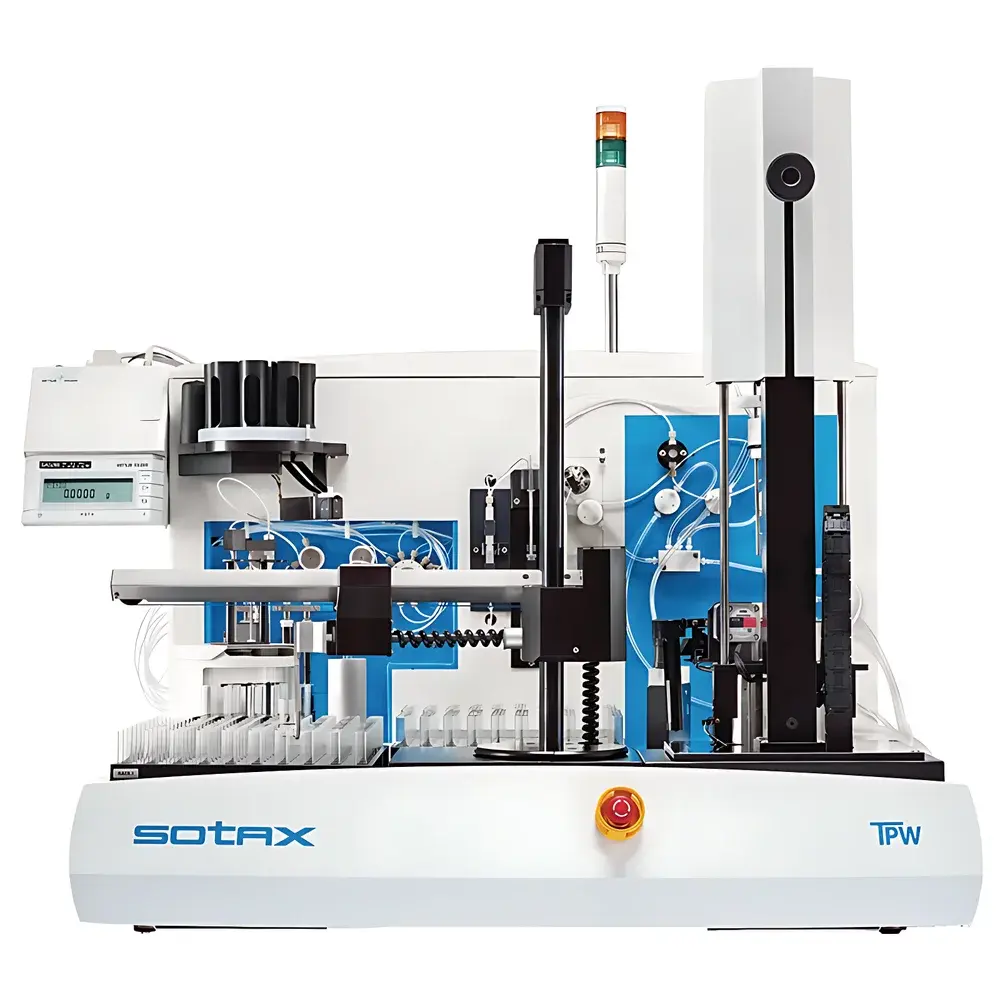
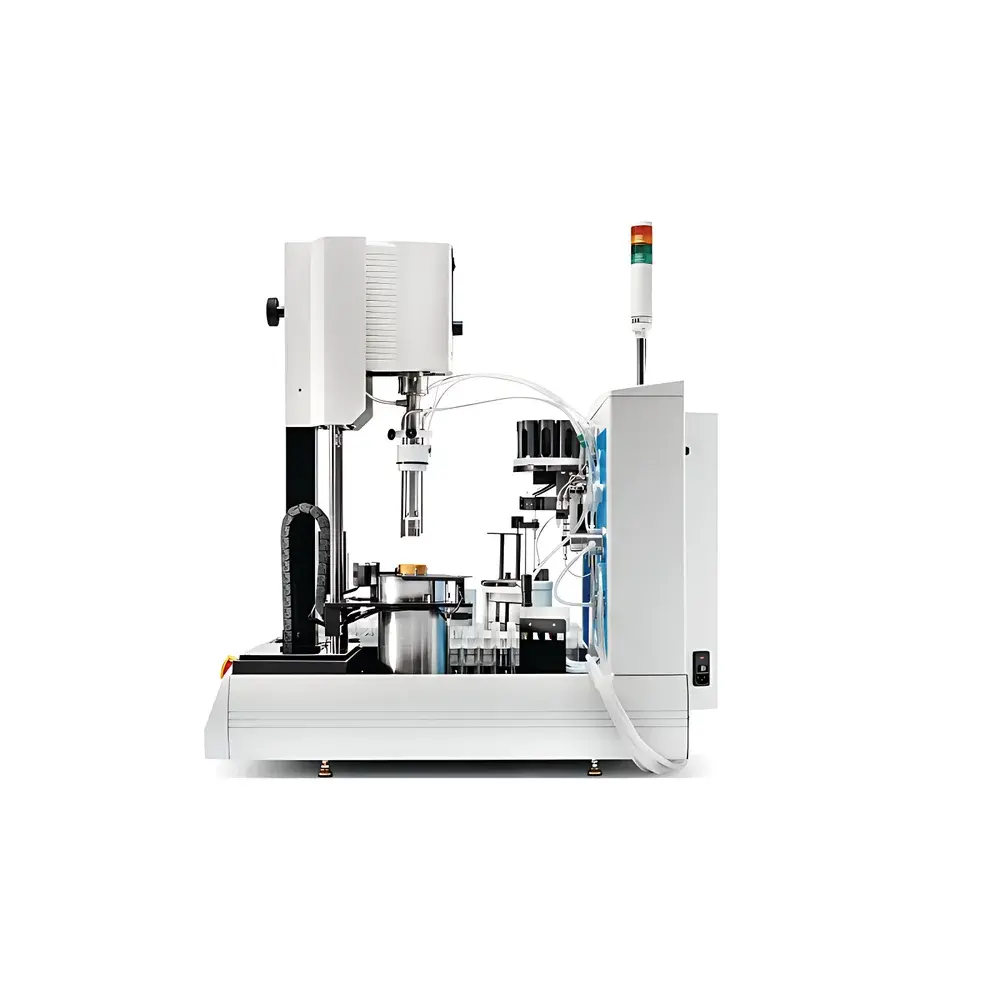
SOTAX TPW Automated Sample Preparation Workstation
| Brand | SOTAX |
|---|---|
| Origin | Switzerland |
| Model | TPW |
| Application Scope | Solid Oral Dosage Forms, Granulation Intermediates, Semi-solids (e.g., Toothpaste, Lipstick) |
| Sample Throughput | 100–200 samples per run |
| Solvent Volume Range | 20–100 mL or 50–520 mL |
| Integrated Unit Functions | Automated Weighing, High-Shear Homogenization, Filtration, Dilution, Data Logging & Storage |
| Software | DoE-Enabled Method Development Suite with Cross-Site Transfer Capability |
| Regulatory Alignment | Designed for GLP/GMP environments |
Overview
The SOTAX TPW Automated Sample Preparation Workstation is an engineered solution for high-integrity, reproducible sample preparation in pharmaceutical development and quality control laboratories. Built upon a modular, closed-system architecture, the TPW implements controlled high-shear homogenization—based on rotor-stator principle—to achieve complete dispersion and solubilization of solid oral dosage forms (e.g., tablets, capsules), granulation blends, and semi-solid consumer products (e.g., toothpaste, lipstick). Unlike manual or semi-automated approaches, the TPW integrates gravimetric dosing, solvent addition, homogenization, membrane filtration, and serial dilution into a single, validated sequence—eliminating operator-induced variability and ensuring analytical traceability from raw material to final extract. Its design conforms to the fundamental requirements of method robustness and transferability under ICH Q2(R2) and USP guidelines for analytical instrument qualification.
Key Features
- Automated gravimetric sample weighing with high-precision balance integration (±0.1 mg resolution, ISO 9001-calibrated)
- Programmable high-shear homogenization module with adjustable speed (5,000–25,000 rpm) and time-controlled cycles to optimize analyte recovery without degradation
- Dual solvent volume configuration support: low-volume mode (20–100 mL) for potency assays and high-volume mode (50–520 mL) for dissolution-like extractions
- Integrated syringe-driven filtration system using certified 0.45 µm or 0.22 µm PVDF membranes, with automatic filter change detection and pressure monitoring
- Multi-step dilution capability with volumetric accuracy ≤1% CV across 1:10 to 1:1000 dilution ranges
- Onboard barcode reader and RFID-compatible sample rack identification for full chain-of-custody tracking
- Modular hardware design compliant with ISO 13485 cleanroom assembly standards and CE/UL safety certification
Sample Compatibility & Compliance
The TPW accommodates a broad spectrum of physical sample types—including immediate-release and modified-release tablets, hard/soft gelatin capsules, powder blends, wet granules, and viscous semi-solids—without requiring mechanical adaptation or custom tooling. All fluid-contact surfaces are constructed from 316L stainless steel and chemically resistant PEEK, ensuring compatibility with organic solvents (e.g., methanol, acetonitrile), aqueous buffers, and surfactant-containing media. The system meets essential regulatory prerequisites for use in GxP environments: it supports configurable user roles, electronic signature workflows, immutable audit trails, and data export in CSV, PDF, and ASTM E1384-compliant XML formats. Validation documentation packages—including IQ/OQ protocols and risk assessments aligned with ASTM E2500—are available upon request.
Software & Data Management
Controlled by SOTAX’s proprietary MethodStudio™ software, the TPW enables fully scriptable method development and execution. The interface supports Design of Experiments (DoE) workflows—allowing simultaneous variation of homogenization speed, duration, solvent composition, and filtration parameters—with real-time statistical feedback on extraction efficiency and RSD. All method files include embedded metadata (operator ID, timestamp, instrument firmware version) and are digitally signed prior to execution. Data storage follows ALCOA+ principles: attributable, legible, contemporaneous, original, accurate, complete, consistent, enduring, and available. Raw sensor logs (torque, temperature, pressure, weight drift) are archived alongside processed results, enabling root-cause analysis during investigations or regulatory inspections.
Applications
- Content uniformity testing per USP and Ph. Eur. 2.9.40 for tablets and capsules
- Stability-indicating assay development for accelerated and long-term stability studies (ICH Q1A–Q1E)
- Blend uniformity assessment during process validation and continuous manufacturing campaigns
- Extraction optimization for poorly soluble APIs using co-solvent or surfactant systems
- Method transfer between R&D, QC, and contract testing laboratories via standardized .tpwmethod file exchange
- Support for PAT initiatives through integration with third-party HPLC/UPLC systems via OPC UA or ASTM E1497 interfaces
FAQ
Does the TPW require external HPLC or UV-Vis instrumentation to function?
No—the TPW is a standalone sample preparation platform. It prepares extracts ready for downstream analysis but does not perform detection or quantification.
Can the TPW be integrated into an existing LIMS or ELN environment?
Yes—via configurable RESTful API endpoints and scheduled flat-file exports (CSV/XML) with customizable field mapping.
Is method validation support included with the system?
SOTAX provides template IQ/OQ protocols and a validation support package, including test scripts for precision, accuracy, specificity, and robustness per ICH Q2(R2).
What maintenance intervals are recommended for the homogenizer and filtration modules?
Preventive maintenance is scheduled every 500 operational hours or annually, whichever occurs first; service includes torque calibration, seal integrity verification, and rotor-stator wear inspection.
How is data integrity ensured during power failure or unexpected shutdown?
The system employs non-volatile memory buffering and automatic checkpoint recovery—ensuring no loss of method state, weight data, or sensor logs upon restart.



