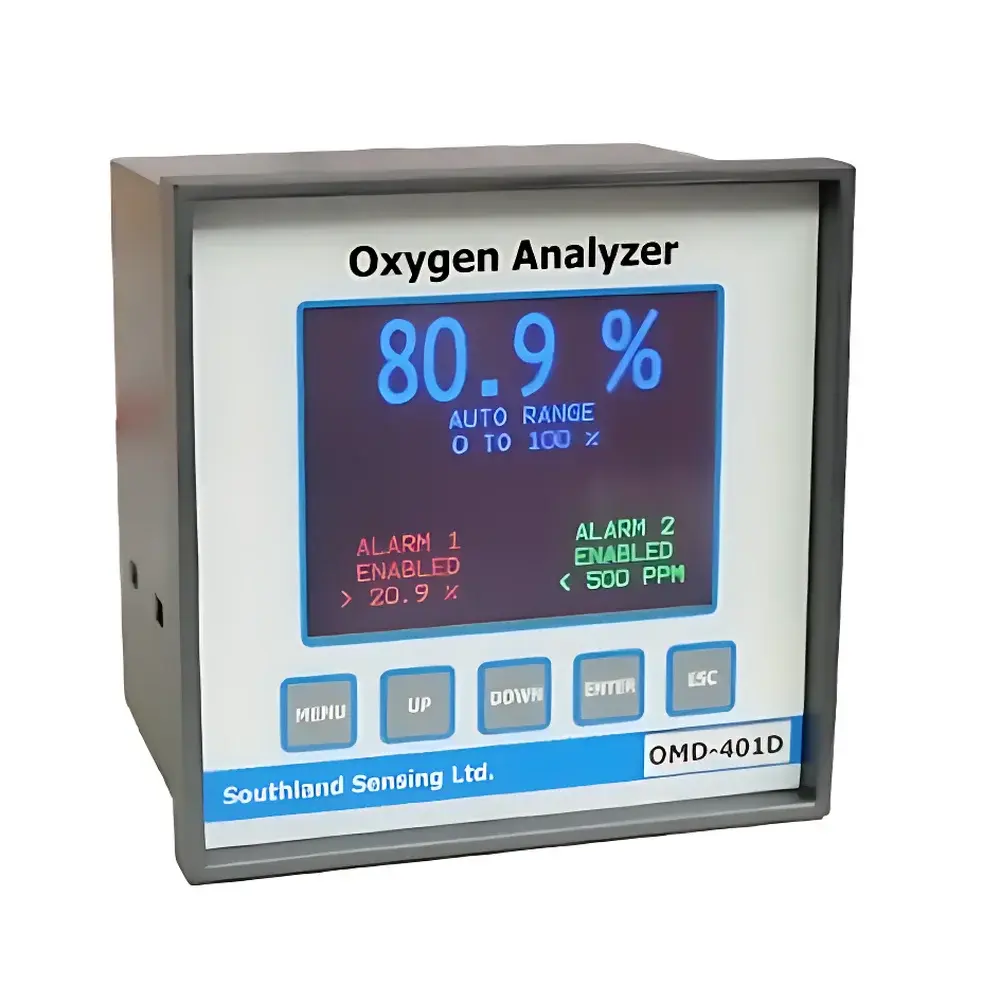
Southland OMD-401D Percent Oxygen Analyzer
| Origin | USA |
|---|---|
| Manufacturer Type | Authorized Distributor |
| Origin Category | Imported |
| Model | OMD-401D |
| Price Range | USD 1,400 – 4,200 |
| Measurement Ranges | 0–1%, 0–5%, 0–10%, 0–25%, 0–100% O₂ (selectable) |
| Accuracy | < ±1% FS |
| Certifications | CE |
| Dimensions | 241 × 165 × 96 mm |
| Operating Temperature | −10 to +50 °C |
| Temperature Compensation | Built-in |
| Sensor Type | Micro-fuel-cell electrochemical oxygen sensor |
| Warranty | 12 months |
| Power Supply | 12–24 VDC |
| Current Draw | 25 mA |
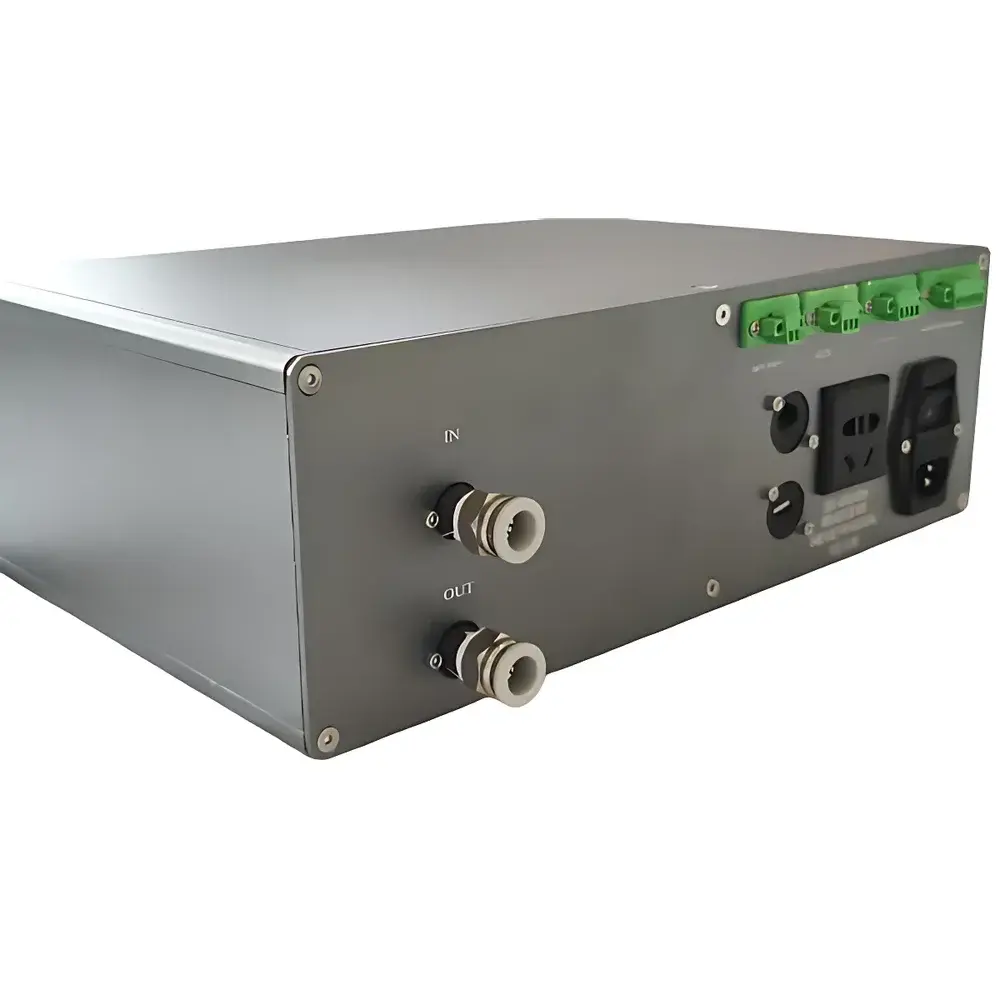
| Analog Outputs | 4–20 mA and 0–10 VDC (isolated, configurable) |
| Sample Flow Rate | 230–2500 mL/min |
| Compatible Media | N₂, Ar, He, H₂, hydrocarbon streams, and other inert or reducing gases |
| Acid-Gas Option | Available with acid-resistant sensor for CO₂, H₂S, or SO₂-containing streams |
| Enclosure Rating | IP65 (industrial-grade front panel) |
Overview
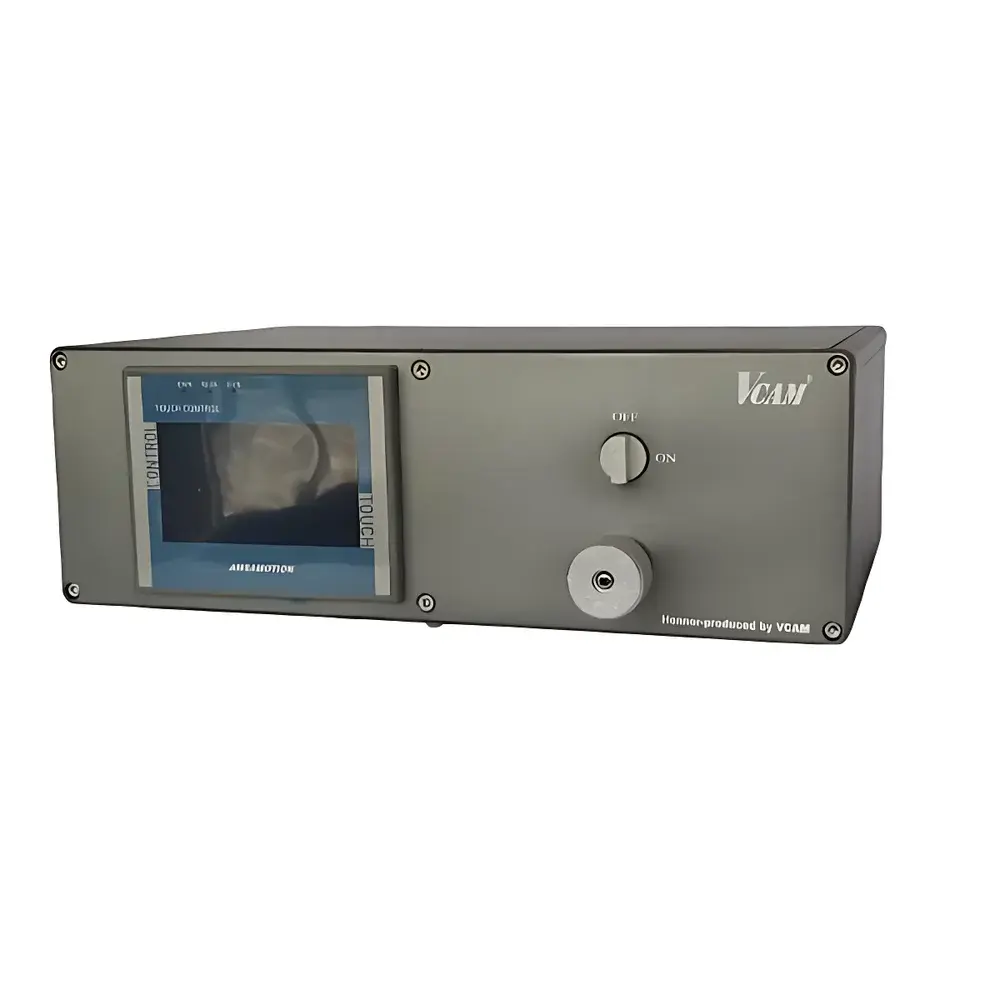
The Southland OMD-401D Percent Oxygen Analyzer is a compact, field-deployable electrochemical analyzer engineered for continuous, real-time measurement of oxygen concentration across a broad range of industrial process environments. Utilizing a proprietary micro-fuel-cell oxygen sensor, the OMD-401D operates on the principle of galvanic electrochemical reaction—where ambient O₂ diffuses through a selective membrane and undergoes reduction at the cathode, generating a current linearly proportional to partial pressure. This transduction mechanism delivers inherently stable zero and span characteristics, minimal drift over time, and immunity to background gas composition shifts in non-acidic, non-corrosive matrices. Unlike paramagnetic or zirconia-based analyzers, the fuel-cell design requires no reference gas, external heating, or complex calibration routines—making it ideal for unattended operation in gloveboxes, nitrogen generation skids, hydrogen purification loops, and semiconductor purge lines.
Key Features
- Five factory-configurable measurement ranges: 0–1%, 0–5%, 0–10%, 0–25%, and 0–100% O₂—each optimized for signal-to-noise ratio and resolution within its span.
- Integrated temperature compensation circuitry ensures measurement stability across the full operating range (−10 to +50 °C), eliminating manual correction factors.
- Low-power architecture (25 mA @ 24 VDC) enables deployment in intrinsically safe zones or battery-backed systems without thermal loading concerns.
- Dual analog outputs (4–20 mA and 0–10 VDC) support simultaneous connection to PLCs, DCS systems, and local display modules—both outputs are electrically isolated and field-configurable via DIP switches.
- Robust mechanical housing (241 × 165 × 96 mm) with IP65-rated front panel meets NEMA 4X requirements for dust and water ingress resistance in harsh plant environments.
- Modular sensor cartridge design allows field replacement without recalibration—reducing downtime and lifecycle maintenance cost.
Sample Compatibility & Compliance
The OMD-401D is validated for use with inert gases (N₂, Ar, He), reducing atmospheres (H₂, syngas), and saturated hydrocarbon streams—provided sample gas dew point remains below 10 °C and particulate load is filtered to 5%, H₂S > 1 ppm, or SO₂ > 0.5 ppm—the optional acid-resistant sensor variant must be specified; this version employs a chemically stabilized electrolyte and corrosion-inhibiting electrode architecture compliant with ASTM D4084-22 guidelines for sour-gas trace analysis. The analyzer carries CE marking per Directive 2014/30/EU (EMC) and 2014/35/EU (LVD). While not SIL-certified, its architecture supports integration into safety instrumented systems (SIS) when deployed per IEC 61511 Annex D verification protocols.
Software & Data Management
The OMD-401D operates as a standalone analog transmitter with no embedded firmware or digital communication interface. All configuration—including range selection, output scaling, and damping factor—is performed via hardware DIP switches and calibrated potentiometers during commissioning. As such, it requires no software installation, network connectivity, or cybersecurity hardening—making it suitable for air-gapped control networks governed by ISA/IEC 62443-3-3 Level 1 requirements. Output signals are traceable to NIST-traceable calibration standards, and full calibration documentation—including as-found/as-left data—can be generated manually per GLP-compliant lab practice. For audit readiness in regulated industries (e.g., pharmaceutical inerting or food packaging), users may pair the device with third-party data loggers supporting 21 CFR Part 11 electronic signature and audit trail functionality.
Applications
- Monitoring residual O₂ in nitrogen blanketing systems for chemical reactors and storage tanks (ASTM D3171 compliance).
- Verification of inert atmosphere integrity inside argon-purged gloveboxes used for lithium-ion battery electrode manufacturing.
- Real-time control of oxygen slip in pressure-swing adsorption (PSA) nitrogen generators serving semiconductor cleanrooms.
- Leak detection in high-purity hydrogen distribution manifolds—where sub-100 ppm O₂ deviations indicate seal degradation.
- Process validation of thermal oxidation furnaces in silicon wafer fabrication, ensuring controlled ambient O₂ during annealing cycles.
- Quality assurance of modified-atmosphere packaging (MAP) headspace gas composition in food processing facilities.
FAQ
Does the OMD-401D require periodic calibration? Why or why not?
Yes—annual calibration is recommended per ISO/IEC 17025 Clause 7.7. Calibration frequency may increase under high-flow or high-contaminant conditions. Fuel-cell sensors exhibit gradual sensitivity decay; calibration verifies linearity and offset against certified gas standards (e.g., NIST-traceable 1.00% O₂ in N₂).
Can the OMD-401D measure oxygen in flue gas or combustion exhaust?
No. Flue gas contains elevated CO₂, SOₓ, NOₓ, and moisture levels that rapidly poison standard fuel-cell sensors. Use only with the acid-resistant sensor option—and even then, only for low-temperature, filtered, and dried streams meeting ISO 14644-1 Class 8 particulate limits.
Is the 4–20 mA output intrinsically safe for Zone 1 hazardous areas?
The OMD-401D itself is not IS-certified. To deploy in Zone 1, it must be installed with an approved intrinsic safety barrier (e.g., Pepperl+Fuchs KFD2-STC4-Ex1) rated for Group IIC, T4 ambient temperature class.
What is the typical sensor lifetime under continuous operation?
Standard fuel-cell sensors last 24–36 months in clean, dry, inert gas streams at 25 °C. Lifetime reduces to 12–18 months in H₂-rich environments and further to 6–12 months in CO₂-laden streams—even with the acid-resistant variant.