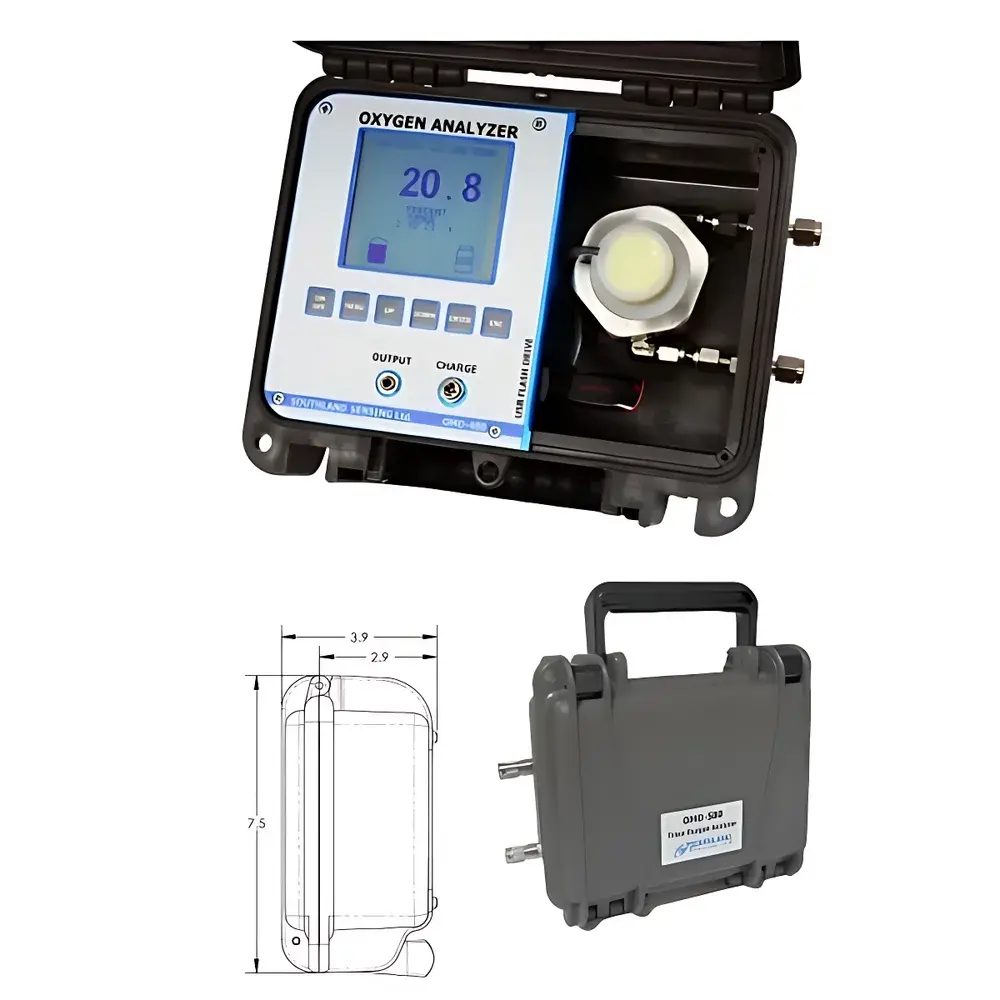
Southland Sensing OMD-580 Portable Trace Oxygen Analyzer
| Origin | USA |
|---|---|
| Manufacturer Type | Authorized Distributor |
| Origin Category | Imported |
| Model | OMD-580 |
| Price Range | USD 1,400 – 4,200 (FOB) |
| Measurement Principle | Electrochemical Fuel Cell (Micro-Fuel Cell) |
| Range Options | 0–1 ppm, 0–10 ppm, 0–100 ppm, 0–1,000 ppm, 0–1%, 0–25%, 0–100% O₂ |
| Accuracy | < ±1% FS |
| Operating Temp. | –10 to 50 °C |
| Output Signals | 4–20 mA, 0–10 VDC, MODBUS RTU over RS485 (ASCII bi-directional) |
| Power Supply | 12–24 VDC |
| Current Draw | 25 mA |
| Sample Flow Rate | 230–2500 mL/min |
| Enclosure Dimensions | 241 × 165 × 96 mm |
| Certifications | CE, RoHS |
| Temperature Compensation | Built-in |
| Sensor Lifetime | Typically >2 years (field-replaceable) |
| Compatible Gases | N₂, Ar, He, H₂, CH₄, CO₂ (with acid-resistant sensor option), C₂H₄, etc. |
| Optional Sensor Configurations | Standard fuel cell |
| Warranty | 12 months from shipment |
Overview
The Southland Sensing OMD-580 is a compact, portable trace oxygen analyzer engineered for high-stability electrochemical measurement of oxygen concentrations across an exceptionally wide dynamic range—from sub-part-per-trillion detectable limits (0–1 ppm) up to full-scale 100% O₂ in inert or reducing gas matrices. At its core, the instrument employs a proprietary micro-fuel cell oxygen sensor, a galvanic electrochemical transducer that generates a current proportional to the partial pressure of molecular oxygen diffusing through a selective membrane. Unlike paramagnetic or zirconia-based analyzers, this sensor requires no external power to operate, delivers inherently linear output, and exhibits negligible drift over extended deployment—making it ideal for unattended, long-term monitoring in critical process environments. The OMD-580 is not a laboratory benchtop unit but a field-deployable analyzer with industrial-grade enclosure integrity (IP65-rated front panel), designed for integration into nitrogen generation skids, glovebox purge loops, semiconductor fab gas delivery systems, and high-purity hydrogen production lines where real-time, maintenance-free oxygen verification is mandated by ISO 8573-1 Class 1 or SEMI F57 purity standards.
Key Features
- Multi-range electrochemical sensing architecture supporting user-selectable spans: 0–1 ppm, 0–10 ppm, 0–100 ppm, 0–1,000 ppm, 0–1%, 0–25%, and 0–100% O₂—configured via DIP switches or software calibration
- Integrated temperature compensation circuitry ensures measurement stability across –10 to 50 °C ambient operating conditions without manual recalibration
- Dual programmable alarm relays (SPDT, 2 A @ 24 VDC) support fail-safe shutdown protocols for inerting systems or purging validation sequences
- Backlit graphical LCD display with real-time concentration readout, unit selection (ppm/%), status indicators, and diagnostic codes
- Simultaneous analog outputs (4–20 mA and 0–10 VDC) plus bidirectional MODBUS RTU over RS485 for PLC/HMI integration and remote configuration
- Field-replaceable sensor cartridge design minimizes downtime; standard fuel cell sensors achieve >24 months typical service life under continuous operation in clean N₂ or Ar
- Optional acid-resistant sensor variant available for applications involving CO₂, H₂S, SO₂, or other corrosive trace components—validated per ASTM D1946 for hydrocarbon gas analysis
Sample Compatibility & Compliance
The OMD-580 is validated for continuous analysis of oxygen in non-corrosive and mildly acidic process gases including nitrogen, argon, helium, hydrogen, methane, ethylene, and synthetic air. When equipped with the optional acid-resistant sensor, it maintains metrological integrity in gas streams containing up to 2,000 ppm CO₂ or 50 ppm H₂S—critical for refinery off-gas monitoring or biogas upgrading processes. All configurations comply with CE marking requirements under Directive 2014/30/EU (EMC) and 2014/35/EU (LVD). While not intrinsically safe certified, the analyzer meets IEC 61000-4 immunity standards for industrial environments. Data logging and audit trail functionality—when integrated with compliant SCADA platforms—support adherence to FDA 21 CFR Part 11 and ISO/IEC 17025 documentation requirements for GLP/GMP-regulated facilities.
Software & Data Management
The OMD-580 operates autonomously without host software but supports full remote parameterization—including zero/span calibration, alarm thresholds, damping time, and output scaling—via MODBUS register mapping. ASCII command protocol enables seamless integration with Allen-Bradley, Siemens S7, and Mitsubishi Q-series PLCs. When connected to a supervisory system, the analyzer provides timestamped analog output values alongside diagnostic registers (e.g., sensor voltage, temperature, relay status), enabling predictive maintenance scheduling. No proprietary drivers or cloud dependencies are required; all communication adheres to open industrial protocols. Firmware updates are performed via serial interface using standard terminal emulation tools.
Applications
- Inert gas blanketing: Real-time O₂ verification in transformer oil nitrogen blankets, pharmaceutical fluidized bed dryers, and food packaging headspace
- Glovebox and controlled-atmosphere chambers: Continuous monitoring below 1 ppm O₂ during semiconductor wafer handling or lithium battery electrode manufacturing
- On-site hydrogen purity verification: Detection of oxidative contaminants in PEM electrolyzer output prior to fuel cell stack feeding
- Natural gas transmission: Monitoring O₂ ingress in pipeline pigging operations or compressor station vent streams per API RP 1173 guidelines
- High-temperature process control: In-situ oxygen measurement in annealing furnace atmospheres (N₂/H₂ blends) with optional high-temp sample conditioning
- Research & development labs: Quantitative evaluation of getter material performance, catalyst deactivation kinetics, and membrane selectivity testing
FAQ
What is the minimum detectable oxygen concentration with the OMD-580?
The lowest factory-configured range is 0–1 ppm, with resolution of 0.01 ppm and repeatability better than ±0.05 ppm under stable flow and temperature conditions.
Can the OMD-580 measure oxygen in hydrogen-rich gas streams?
Yes—its micro-fuel cell sensor is specifically designed for reducing atmospheres. It is routinely deployed in PEM electrolyzer H₂ output lines and ammonia synthesis purge gas streams.
Is sensor replacement possible in the field?
Absolutely. The sensor module is a plug-in cartridge with keyed connector and pre-aligned seal; replacement takes under 90 seconds and requires no calibration tools.
Does the analyzer require periodic zero or span calibration?
While inherently stable, annual verification against certified gas standards (e.g., NIST-traceable 10 ppm O₂ in N₂) is recommended per ISO 17025 Clause 7.7 for accredited laboratories.
How does the OMD-580 handle condensation or particulate in the sample stream?
A dedicated sample conditioning kit—including sintered stainless steel filter (5 µm), coalescing moisture trap, and flow regulator—is available to protect the sensor from liquid carryover and particulate fouling.
Related Products