
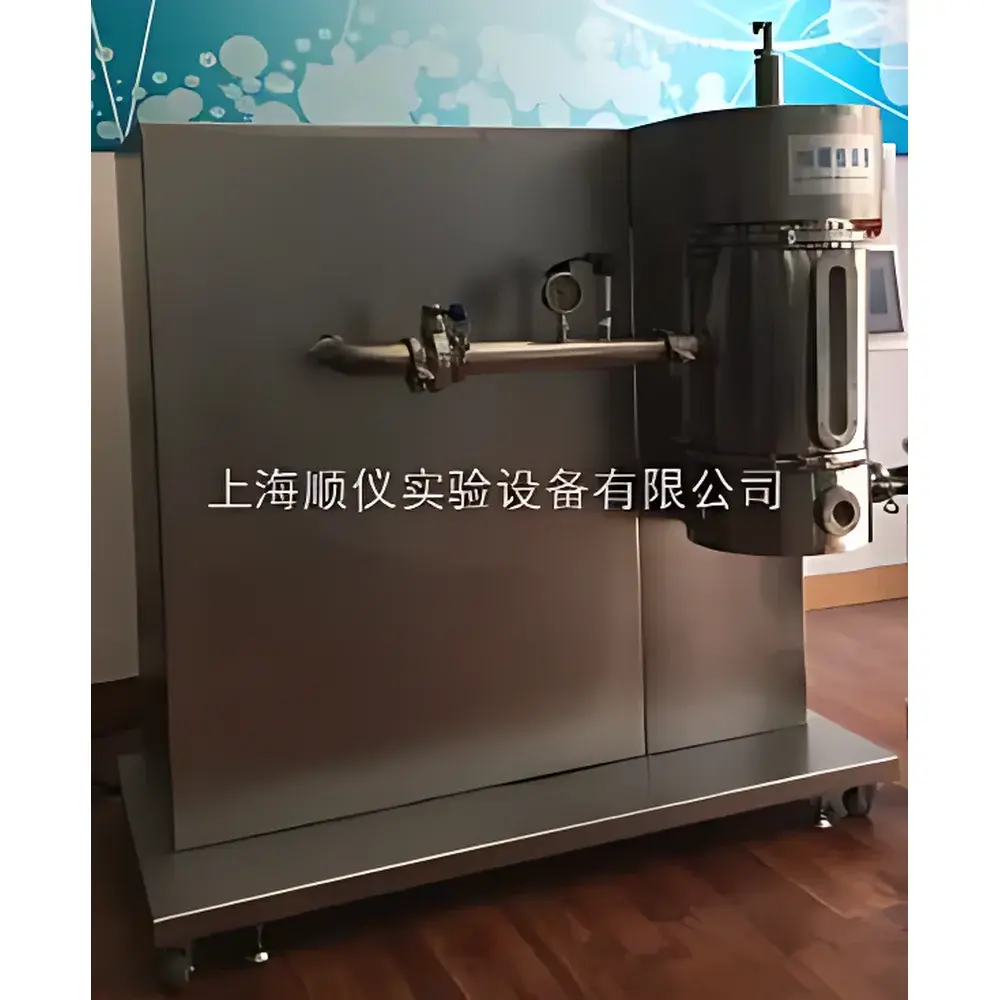
SP-30 Laboratory Spray Freeze Dryer
| Origin | Shanghai, China |
|---|---|
| Manufacturer Type | Authorized Distributor |
| Domestic Origin | Yes |
| Model | SP-30 |
| Price Range | USD 28,000 – 42,500 |
| Batch Capacity | 30–1000 mL per cycle |
| Spray Freezing Temperature | ≤ −15 °C |
| Cold Trap Temperature | ≤ −60 °C |
| Ultimate Vacuum (Empty Chamber) | < 20 Pa |
| Spray Pressure Range | 2–5 bar (adjustable) |
| Compressed Air Supply | Integrated oil-free air compressor (4.2 m³/h, 0.2 kW, <50 dB(A)) |
| Drying Air Flow Rate | 0–330 m³/h (max), 686 Pa static pressure |
| Jet Cleaner (Needle Sweeper) | Pneumatically actuated, frequency adjustable (2.3 bar internal supply) |
| Total Power | 9 kW, 380 V, 50 Hz |
| Dimensions (L×W×H) | 1150 × 770 × 1350 mm |
Overview
The SP-30 Laboratory Spray Freeze Dryer is an integrated benchtop system that merges spray atomization with low-temperature cryogenic solidification and vacuum sublimation drying—enabling rapid, gentle dehydration of thermolabile, viscous, or high-sugar solutions without structural collapse or denaturation. Unlike conventional lyophilizers that rely on slow conductive freezing followed by prolonged primary drying under deep vacuum, the SP-30 employs flash freezing via high-velocity cryogenic spray into a sub-zero drying chamber (<−15 °C), forming fine, uniformly frozen droplets. These micro-particles are then subjected to controlled vacuum升华 (sublimation) under ≤−60 °C cold trap conditions and <20 Pa ultimate vacuum, resulting in free-flowing, spherical powders with preserved bioactivity, solubility, and morphology. Engineered for research-scale process development, the system supports both spray freeze-drying (SFD) and optional conversion to standard hot-air spray drying—facilitating comparative studies across drying modalities while maintaining strict thermal control throughout the entire workflow.
Key Features
- Integrated all-in-one architecture: No external chillers, compressors, or vacuum pumps required—fully self-contained operation.
- Industrial-grade components: Hermetically sealed air-cooled refrigeration system with imported scroll compressor; precision-engineered stainless-steel nozzle assembly; corrosion-resistant drying chamber with reinforced viewport.
- Intuitive 10.1-inch color TFT touchscreen interface with bilingual (English/Chinese) navigation, real-time parameter logging, and dual-mode operation (fully automatic sequence or manual step-by-step control).
- Safety-critical interlocks: Heater activation disabled unless cooling fan is operational; automatic shutdown upon vacuum loss or temperature excursion beyond set thresholds.
- Modular design enables field upgrade to conventional thermal spray drying mode—supporting method transfer studies and formulation screening under varying thermal stress profiles.
- Low-noise integrated oil-free air compressor (<50 dB(A)), eliminating lubricant contamination risk and meeting ISO 8573-1 Class 0 purity requirements for pharmaceutical applications.
- Standardized ISO-KF vacuum fittings (DN25/DN40) ensure leak-tight connections, compatibility with third-party vacuum gauges, and repeatable disassembly for cleaning or maintenance.
Sample Compatibility & Compliance
The SP-30 demonstrates broad compatibility with complex biological and colloidal systems—including herbal extract suspensions, protein-rich dairy emulsions, enzyme solutions, polysaccharide gels, polymer nanoparticle dispersions, and fruit juice concentrates. Its ability to rapidly solidify droplets before ice crystal growth minimizes eutectic phase separation and preserves nanostructure integrity. The system conforms to core engineering safety standards (IEC 61010-1, EN 61326-1) and supports GLP-compliant documentation when paired with optional audit-trail-enabled software. While not certified for GMP manufacturing, its design aligns with FDA 21 CFR Part 11 principles for electronic records and signatures when used with validated data acquisition modules. All wetted surfaces are electropolished 316L stainless steel, facilitating cleanability per ASTM E2656 and supporting routine validation protocols (IQ/OQ/PQ).
Software & Data Management
The embedded control firmware records time-stamped values for drying chamber temperature, vacuum pressure, inlet/outlet air temperature, peristaltic pump speed (0–60 rpm), jet cleaner actuation frequency, and airflow rate—exportable via USB to CSV format. Optional PC-based software adds remote monitoring, multi-channel trend visualization, alarm history with timestamped event logs, and PDF report generation with digital signature fields. Data integrity safeguards include write-protected storage, cyclic redundancy check (CRC) validation, and user-access level management (Operator, Technician, Administrator). Raw datasets comply with FAIR principles (Findable, Accessible, Interoperable, Reusable) and integrate seamlessly with LIMS platforms via OPC UA or Modbus TCP interfaces.
Applications
- Rapid prototyping of inhalable dry powder formulations for pulmonary delivery (e.g., insulin, vaccines, monoclonal antibodies).
- Stabilization of labile natural products (e.g., curcuminoids, anthocyanins, catechins) without organic solvent residues.
- Production of uniform microparticles for controlled-release drug carriers, catalytic nanocomposites, or food-grade encapsulates.
- Process optimization studies comparing SFD vs. freeze-drying vs. spray drying for viscosity-sensitive biopolymers (e.g., hyaluronic acid, chitosan, alginate).
- Academic research in colloid science, soft matter physics, and cryomicroscopy sample preparation.
FAQ
What types of solvents or suspensions can be processed?
Aqueous solutions, water-miscible organic co-solvent blends (e.g., ethanol/water ≤30% v/v), colloidal suspensions, and low-viscosity emulsions (≤500 cP) are compatible. High-viscosity gels or non-aqueous solvents (e.g., hexane, chloroform) require pre-screening and nozzle modification.
Is the system suitable for sterile processing?
No. The SP-30 is designed for non-sterile R&D use only. Sterilization-in-place (SIP) or autoclaving is not supported. Aseptic handling must occur downstream using ISO Class 5 laminar flow hoods.
Can particle size distribution be controlled?
Yes—via modulation of feed concentration, spray pressure (2–5 bar), atomization gas flow rate, and drying air velocity. Typical median diameters range from 5–50 µm, verified by laser diffraction (e.g., Malvern Mastersizer) post-collection.
What maintenance intervals are recommended?
Cold trap defrosting every 5–10 cycles; vacuum pump oil change every 500 operating hours; nozzle inspection/cleaning after each batch; annual calibration of temperature and pressure sensors per ISO/IEC 17025 guidelines.
Does the system support PAT (Process Analytical Technology)?
Not natively—but analog 4–20 mA outputs are available for chamber pressure and temperature signals, enabling integration with third-party PAT tools (e.g., FTIR moisture probes, NIR spectrometers) via custom I/O modules.



