
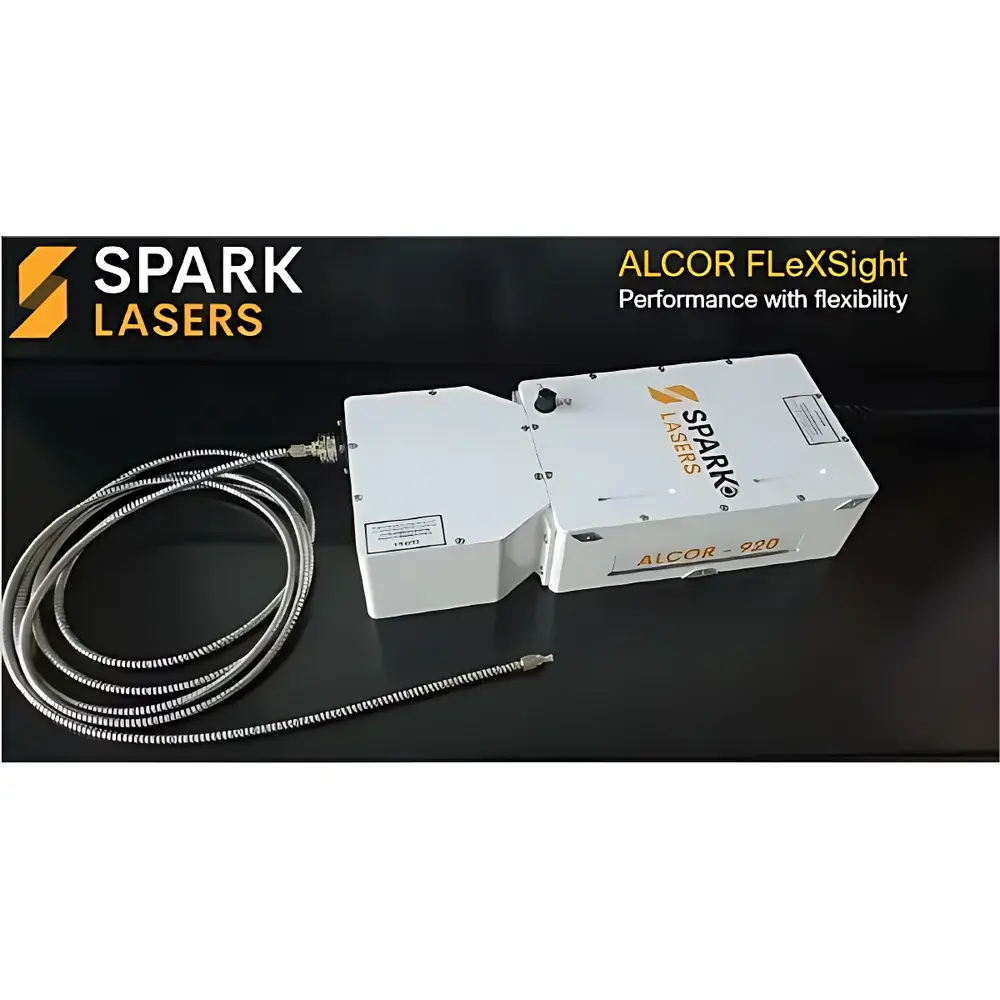
Spark Lasers ALCOR XSight / FLeXSight Dual-Wavelength Femtosecond Fiber Laser (920 nm & 1064 nm)
| Brand | Spark Lasers |
|---|---|
| Origin | France |
| Type | Solid-State Femtosecond Laser System |
| Wavelengths | 920 nm & 1064 nm |
| Output | Polarization-Maintaining Single-Mode Fiber (FC/APC) |
| Avg. Power | Up to 2.0 W per wavelength |
| Pulse Width | <100 fs |
| Repetition Rate | Fixed 80 MHz (custom options available) |
| Cooling | Air-cooled |
| Power Modulation | TTL and Analog via Integrated AOM |
| Compliance | CE, RoHS, IEC 60825-1 Class 4 Laser Product |
Overview
The Spark Lasers ALCOR XSight and FLeXSight are turnkey, air-cooled dual-wavelength femtosecond fiber lasers engineered for demanding nonlinear optical applications—particularly two-photon and multi-photon fluorescence microscopy in neuroscience and live-tissue imaging. Operating at biologically optimized wavelengths of 920 nm and 1064 nm, these lasers leverage mode-locked Yb-doped fiber oscillator-amplifier architecture to generate transform-limited pulses with sub-100 fs duration and high temporal coherence. The 920 nm output enables efficient excitation of common fluorescent indicators (e.g., GFP, GCaMP), while the 1064 nm channel supports deeper tissue penetration and reduced scattering—critical for in vivo imaging of cortical layers or thalamic structures. Both wavelengths are simultaneously available from a single, compact laser head, eliminating the need for external beam combining optics and minimizing alignment drift and pulse walk-off.
Key Features
- Dual-wavelength operation: Independent, simultaneous output at 920 nm and 1064 nm—each up to 2.0 W average power (ALCOR XSight: 1.5 W @ 920 nm, 1.7 W @ 1064 nm; ALCOR FLeXSight: 1.1 W per line)
- Integrated acousto-optic modulator (AOM): Enables fast, linear analog and TTL-compatible power modulation (<1 µs rise time) without external controllers—ideal for pixel-synchronized intensity control in resonant scanning or optogenetic stimulation protocols
- Fiber-coupled delivery: Polarization-maintaining, single-mode PM980 fiber output (FC/APC connector); 2 m standard length; compatible with third-party fiber launch systems and collimators
- Pre-compensated dispersion: Built-in chirp management ensures near-transform-limited pulses at the sample plane—no manual grating or prism compressor required
- Compact, rack-mountable design: Laser head dimensions ≤ 300 × 200 × 100 mm; designed for integration into commercial and custom microscope platforms (e.g., Bruker Ultima, Thorlabs Bergamo, Sutter MOM)
- Robust architecture: All-fiber seed + free-space amplifier configuration ensures long-term amplitude stability (<0.5% RMS over 8 h) and immunity to environmental vibration
Sample Compatibility & Compliance
The ALCOR series is compatible with standard two-photon microscope scan boxes, galvo-resonant scanners, and piezo-based objective positioners. Its fiber output interface supports seamless integration with fiber-coupled objectives and microendoscopes—including those used in freely moving animal studies (e.g., miniscope-compatible configurations). The system complies with IEC 60825-1:2014 (Class 4 laser product), CE marking under the EU Machinery Directive 2006/42/EC and EMC Directive 2014/30/EU, and RoHS 2011/65/EU. For GLP/GMP-aligned laboratories, optional audit-trail logging and user-access control can be implemented via third-party DAQ software interfacing with the analog modulation input and status monitoring pins.
Software & Data Management
The laser operates in standalone mode with front-panel controls and LED indicators for power, lock status, and fault conditions. Remote operation is supported via RS-232 and USB-C interfaces using ASCII command protocol (documentation provided). While no proprietary GUI is bundled, the device exposes real-time analog monitor outputs (0–5 V proportional to pump current and output power) and digital TTL triggers synchronized to the 80 MHz pulse train—enabling full synchronization with acquisition hardware (e.g., National Instruments DAQ, Becker & Hickl TCSPC modules). Integration with MATLAB, Python (PySerial), and LabVIEW is routinely deployed in academic and industrial labs for automated power ramping, shutter gating, and closed-loop feedback during functional imaging sessions.
Applications
- Two-photon calcium imaging in awake, head-fixed or freely behaving rodents (combined with FLeXSight fiber delivery)
- Multi-color deep-tissue imaging using spectrally distinct fluorophores excited selectively at 920 nm (e.g., tdTomato) and 1064 nm (e.g., IR-Dye800)
- Second-harmonic generation (SHG) and third-harmonic generation (THG) microscopy of collagen, myosin, and lipid membranes
- Optogenetic actuation with ChRmine, ChroME, or other red-shifted opsins requiring high-peak-power NIR excitation
- Time-resolved fluorescence lifetime imaging (FLIM) with TCSPC detection systems
- Nonlinear optical spectroscopy including CARS and SRS when combined with tunable OPOs or difference-frequency generation stages
FAQ
Is the 920 nm and 1064 nm output truly simultaneous and independently controllable?
Yes—both wavelengths are generated in parallel within the same amplifier chain and delivered via a polarization-maintaining fused-fiber combiner. Each channel features independent AOM-based power attenuation (0–100%) with analog voltage or TTL input.
Can the laser be synchronized to an external clock or scanner trigger?
The 80 MHz pulse train provides a clean RF output; optional division-by-N modules support synchronization to lower-frequency scanner clocks (e.g., 1–30 kHz) with sub-picosecond jitter.
What is the beam quality (M²) at the fiber output?
M² < 1.1 for both wavelengths, measured at the FC/APC connector face under standard operating conditions.
Does the system require water cooling or external chillers?
No—air cooling only; ambient temperature range: 15–30 °C, non-condensing environment.
Is FDA 21 CFR Part 11 compliance supported?
The laser itself does not store data or enforce electronic signatures; however, its analog/digital I/O signals are fully compatible with validated third-party LIMS or ELN platforms implementing Part 11 controls.





