
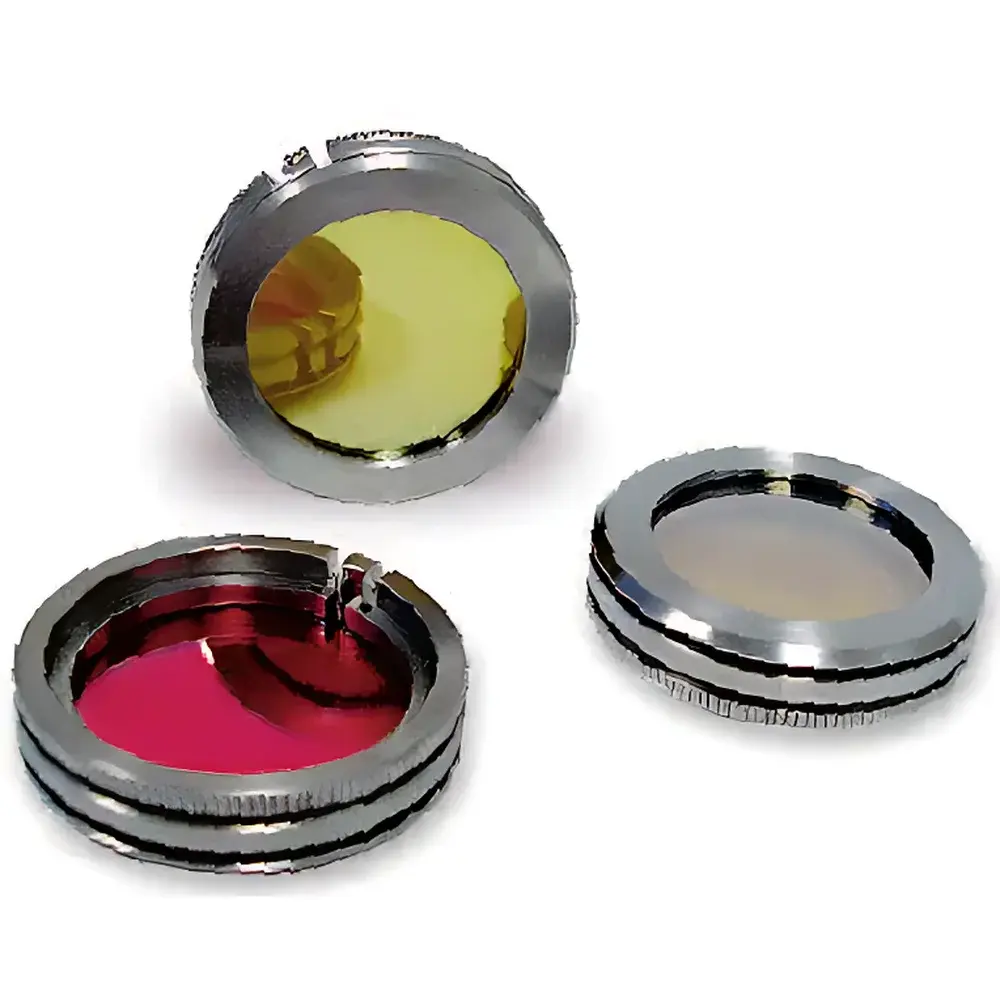
Specac GS12000 Series FT-IR Infrared Polarizers
| Brand | Specac |
|---|---|
| Origin | United Kingdom |
| Manufacturer Type | Authorized Distributor |
| Origin Category | Imported |
| Model | GS12000 |
| Price Range | USD 1,400 – 7,000 (FOB UK) |
| Substrate Options | BaF₂, CaF₂, KRS-5, Ge, ZnSe |
| Aperture | 25 mm clear aperture |
| Groove Density | 4000 lines/mm |
| Mounting | Elastic, kinematic-compatible flange mount |
Overview
The Specac GS12000 Series FT-IR Infrared Polarizers are high-precision wire-grid polarizing elements engineered for use in Fourier Transform Infrared (FT-IR) spectrometers and synchrotron-based IR beamlines. Developed in collaboration with the UK’s National Physical Laboratory (NPL), these polarizers operate on the principle of selective absorption and reflection governed by sub-wavelength metallic grating structures—optimized for consistent polarization extinction ratios across the mid- to far-infrared spectral range (typically 0.5–20 µm, dependent on substrate choice). Unlike dichroic or birefringent alternatives, the GS12000 series employs a robust, vacuum-compatible, evaporated metal-on-dielectric grating architecture deposited onto optically polished infrared-transmitting substrates. This design ensures minimal thermal drift, high damage threshold under intense broadband IR sources, and long-term stability under continuous operation in both laboratory and industrial analytical environments.
Key Features
- High-fidelity polarization performance: >300:1 extinction ratio (typical) at design wavelengths, validated per ISO 15382:2017 for polarimetric calibration components
- Five substrate options—BaF₂ (0.15–12 µm), CaF₂ (0.13–9 µm), KRS-5 (0.5–40 µm), Ge (2–16 µm), and ZnSe (0.5–20 µm)—enabling application-specific spectral coverage and environmental resilience
- Precision 4000 lines/mm gold-coated nickel grating fabricated via holographic lithography and electroforming, ensuring groove uniformity <±0.5% across full 25 mm clear aperture
- Elastic, stress-free mounting system compatible with standard 25 mm optical bore housings and kinematic baseplates (e.g., Thorlabs KM100, Newport UMB series)
- Designed for integration into commercial FT-IR systems (e.g., Thermo Nicolet iS50, Bruker Vertex 80v, PerkinElmer Frontier) without optical realignment or custom adapters
- Optional NIST-traceable certification available for metrology-grade installations requiring GLP-compliant documentation
Sample Compatibility & Compliance
The GS12000 polarizers are fully compatible with transmission-mode FT-IR measurements of solid films, liquid cells, gas-phase samples, and microfluidic flow cells. Their low-autofluorescence substrates and minimal scatter profile support quantitative Mueller matrix polarimetry and angle-resolved IR dichroism studies. All units comply with RoHS 2011/65/EU and CE marking requirements for laboratory instrumentation. When used within certified FT-IR platforms, the GS12000 series supports regulatory workflows aligned with ASTM E1421 (Standard Practice for Describing and Measuring Performance of FT-IR Spectrometers) and USP <1119> (Infrared Absorption Spectrophotometry). Each batch undergoes spectral verification using NPL-calibrated reference detectors and is supplied with a certificate of conformance listing measured transmittance, polarization contrast, and angular acceptance (±2.5° full width at half maximum).
Software & Data Management
While the GS12000 is a passive optical component, its integration enables advanced polarization-resolved data acquisition in conjunction with vendor software suites—including OMNIC (Thermo), OPUS (Bruker), and Spectrum (PerkinElmer). When paired with motorized rotation stages (e.g., Newport CONEX-AG-PS100), users can automate sequential acquisition of s- and p-polarized spectra for real-time linear dichroism mapping. All calibration data and spectral metadata generated during polarized measurements are stored in vendor-native formats (.spa, .0, .spc) and remain fully compliant with FDA 21 CFR Part 11 when deployed in regulated QA/QC laboratories operating under electronic record retention policies.
Applications
- Quantitative analysis of molecular orientation in polymer thin films and stretched plastics (e.g., PET, polyethylene)
- In situ monitoring of protein secondary structure changes under shear or electric field stimulation
- Far-IR characterization of phonon modes in 2D materials (e.g., MoS₂, h-BN) via polarized reflectance spectroscopy
- Calibration of ellipsometers and Mueller matrix polarimeters used in semiconductor process control
- Time-resolved polarized IR studies of photoinduced charge transfer in organic photovoltaic blends
- Standards traceability for national metrology institutes performing IR polarimetric intercomparisons
FAQ
What is the recommended cleaning procedure for GS12000 polarizers?
Use only spectroscopic-grade methanol or isopropanol applied with nitrogen-purged lens tissue; avoid ultrasonic baths or abrasive wipes.
Can the GS12000 be used in vacuum environments?
Yes—gold-coated gratings and low-outgassing substrates (e.g., Ge, ZnSe) are rated for UHV conditions (<1×10⁻⁷ mbar) when properly baked.
Is custom groove density available?
Specac offers limited customization (e.g., 2000 or 6000 lines/mm) for OEM integrators under NDA; lead time extends to 12 weeks.
Does the elastic mount accommodate thermal expansion mismatch?
Yes—the silicone-elastomer interface accommodates differential expansion between substrate and aluminum housing over −20 °C to +60 °C.
How is polarization extinction ratio verified?
Measured using a calibrated rotating analyzer setup referenced to NPL’s IR polarimetry facility, with uncertainty <±1.2% (k=2) at 10.6 µm.




