
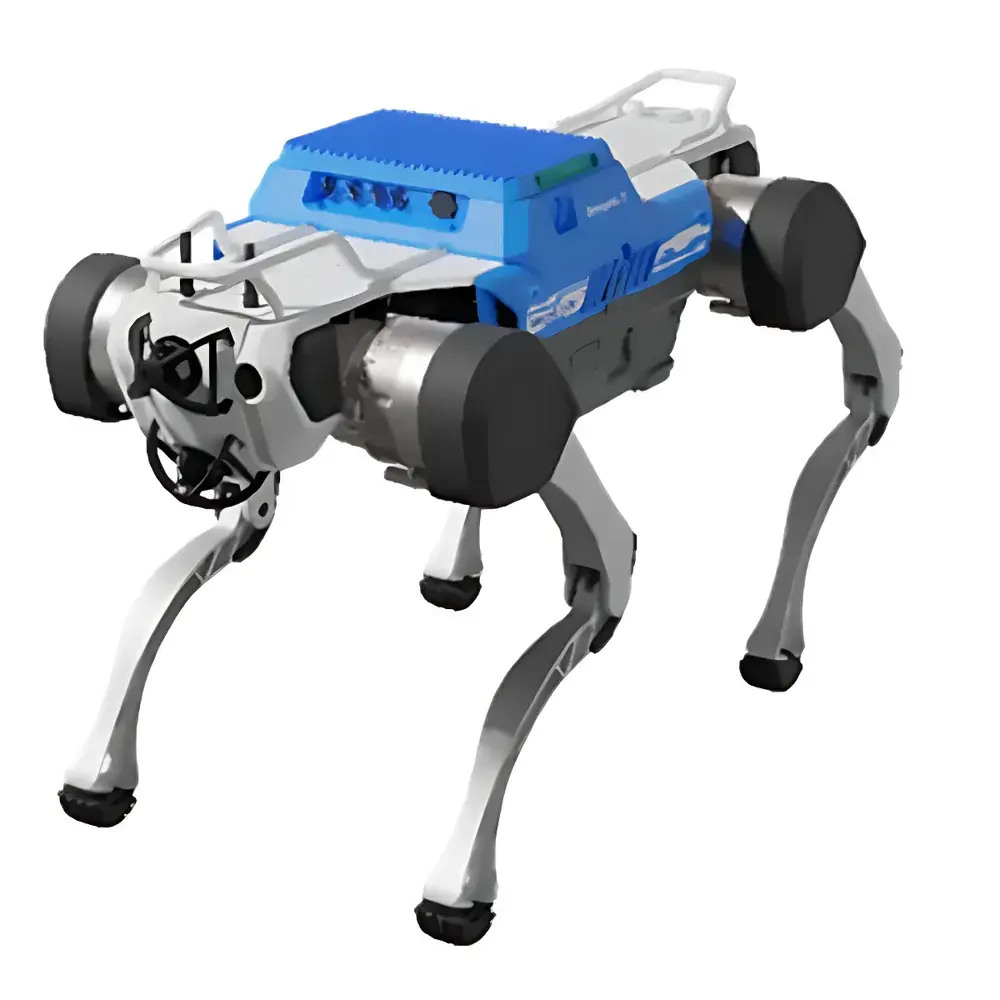
SpecBotics-30 Quadruped Robot — Zealquest AI Netherlands Industrial Inspection & Rescue Platform
| Brand | Zealquest AI Netherlands |
|---|---|
| Origin | Shanghai, China |
| Manufacturer Type | Authorized Distributor |
| Regional Classification | Domestic (PRC) |
| Model | SpecBotics-30 |
| Pricing | Available Upon Request |
Overview
The SpecBotics-30 is an industrial-grade quadruped robot engineered for autonomous mobile inspection, hazard reconnaissance, and mission-critical intervention in unstructured, non-permissive environments. Unlike consumer or research-oriented legged platforms, the SpecBotics-30 implements a torque-controlled, real-time dynamic locomotion architecture grounded in model-predictive control (MPC) and whole-body motion planning. Its mechanical design adheres to power industry operational constraints—specifically optimized for substation perimeters, underground cable tunnels, confined utility vaults, and post-disaster structural zones where wheeled or tracked systems fail due to step discontinuities, grating surfaces, debris fields, or unstable footing. The platform operates under a deterministic real-time OS (RTOS), enabling sub-10 ms sensor-to-actuator latency for reactive obstacle negotiation and fall recovery—critical for maintaining operational continuity in high-stakes infrastructure monitoring.
Key Features
- Extended environmental resilience: Validated operational range of −20 °C to +55 °C, with IP67 ingress protection certified per IEC 60529—ensuring reliable function during ice accumulation, monsoon rainfall, or high-humidity subterranean deployments.
- Dynamic terrain traversal: Capable of ascending and descending 45° solid stairs and traversing open-grid industrial staircases with ≥60 mm spacing without loss of stability; employs adaptive foot placement via stereo-vision + IMU fusion and compliant joint control.
- Multispectral perception stack: Integrates low-light CMOS global-shutter cameras, thermal imaging (uncooled VOx microbolometer, 320 × 240 res), and time-of-flight (ToF) depth sensors—enabling robust SLAM and navigation under 0.1 lux illumination, strobing industrial lighting, or total darkness.
- Human-robot collaborative safety system: Features dual-mode emergency stop—hardware-level cut-off triggered by physical button press or software-initiated command—and dynamic object detection with velocity-aware stopping distance calculation (per ISO/TS 15066 guidelines).
- Modular battery architecture: Hot-swappable lithium-ion packs deliver up to 2.5 hours nominal runtime at 1.2 m/s walking speed (25% increase vs. prior-gen SpecBotics platforms); battery interface conforms to UL 2271 and includes contactless charge coupling alignment verification.
- Autonomous docking system: Proprietary vision-inertial-landmark fusion algorithm enables repeatable <±15 mm positioning accuracy at charging station interface—even under dust deposition, ambient light variation, or partial occlusion.
Sample Compatibility & Compliance
The SpecBotics-30 is designed for integration into regulated industrial workflows governed by DL/T 5729–2016 (Chinese Power Industry Standard for Intelligent Patrol Robots), IEC 61850-90-12 (Communication for Distributed Energy Resources), and ISO 13849-1:2015 (Safety-related parts of control systems). Its onboard data acquisition subsystem complies with IEEE 1451.2 transducer electronic data sheet (TEDS) format for sensor metadata traceability. All firmware and controller logs support GLP/GMP-aligned audit trails, including timestamped event logging, user session tracking, and cryptographic signature of configuration changes—meeting baseline requirements for FDA 21 CFR Part 11 readiness in critical infrastructure documentation pipelines.
Software & Data Management
The SpecBotics-30 runs Deep Robotics’ proprietary ROS 2-based middleware (Foxy LTS fork), extended with custom drivers for real-time joint control, sensor synchronization, and secure telemetry transport over TLS 1.3. Mission orchestration is managed through the cloud-native SpecControl Suite—a web-based dashboard supporting fleet scheduling, route programming (via georeferenced LiDAR map import), anomaly tagging (with configurable threshold rules for thermal delta, gas concentration, or acoustic spectral deviation), and automated report generation in PDF/CSV formats. All raw sensor streams—including synchronized 1080p video, thermal radiometry, 3D point clouds, and IMU quaternion trajectories—are stored locally on encrypted eMMC and optionally streamed to on-premise NAS or AWS S3-compatible endpoints with configurable retention policies.
Applications
- Power infrastructure inspection: Autonomous patrols inside GIS substations, transformer yards, and cable tunnel networks—detecting thermal anomalies, oil leaks, SF₆ gas dispersion, and structural corrosion using multi-modal sensor correlation.
- Emergency response robotics: Entry into collapsed buildings, chemical spill zones, or radiologically contaminated areas where human access is prohibited; equipped with optional H₂S/CH₄/CO₂ electrochemical gas sensors and radiation dosimetry modules.
- Water resource management: Monitoring dam face integrity, sluice gate mechanisms, and levee erosion patterns across seasonal flood cycles—leveraging waterproof chassis and long-range UWB localization in GPS-denied tunnels.
- Environmental compliance auditing: Odor source localization in wastewater treatment plants, landfill perimeter monitoring, and agricultural irrigation canal inspection—supported by wind-aware plume modeling integrations.
- Academic and standards development use: Validated as a testbed for ISO/IEC JTC 1/SC 42 AI Trustworthiness benchmarking, particularly in robustness testing under distribution shift (e.g., snow-covered terrain, smoke-laden air, or high-EMI substation environments).
FAQ
Does the SpecBotics-30 support third-party sensor integration?
Yes—via standardized M12 Ethernet/IP and CAN FD interfaces, with published device driver templates for common industrial sensors (e.g., SICK LMS111, Bosch BME688, FLIR Boson).
Is remote operation possible over cellular networks?
Yes—configured for LTE Cat-M1/NB-IoT fallback with QoS prioritization for control channel traffic; end-to-end encryption enforced via DTLS 1.2.
What maintenance intervals are recommended for field-deployed units?
Preventive servicing every 500 operational hours or 6 months—whichever occurs first—with full diagnostic log upload required prior to service window initiation.
Can the platform operate in ATEX Zone 2 environments?
No—current configuration is non-certified for explosive atmospheres; intrinsically safe variants (ATEX II 3G Ex nA IIC T4 Gc) are under development and scheduled for Q4 2025 release.
How is firmware updated in offline deployment scenarios?
Through authenticated USB-C firmware bundles signed with ECDSA-P384 keys; update integrity verified via SHA-384 hash comparison pre-installation.



