
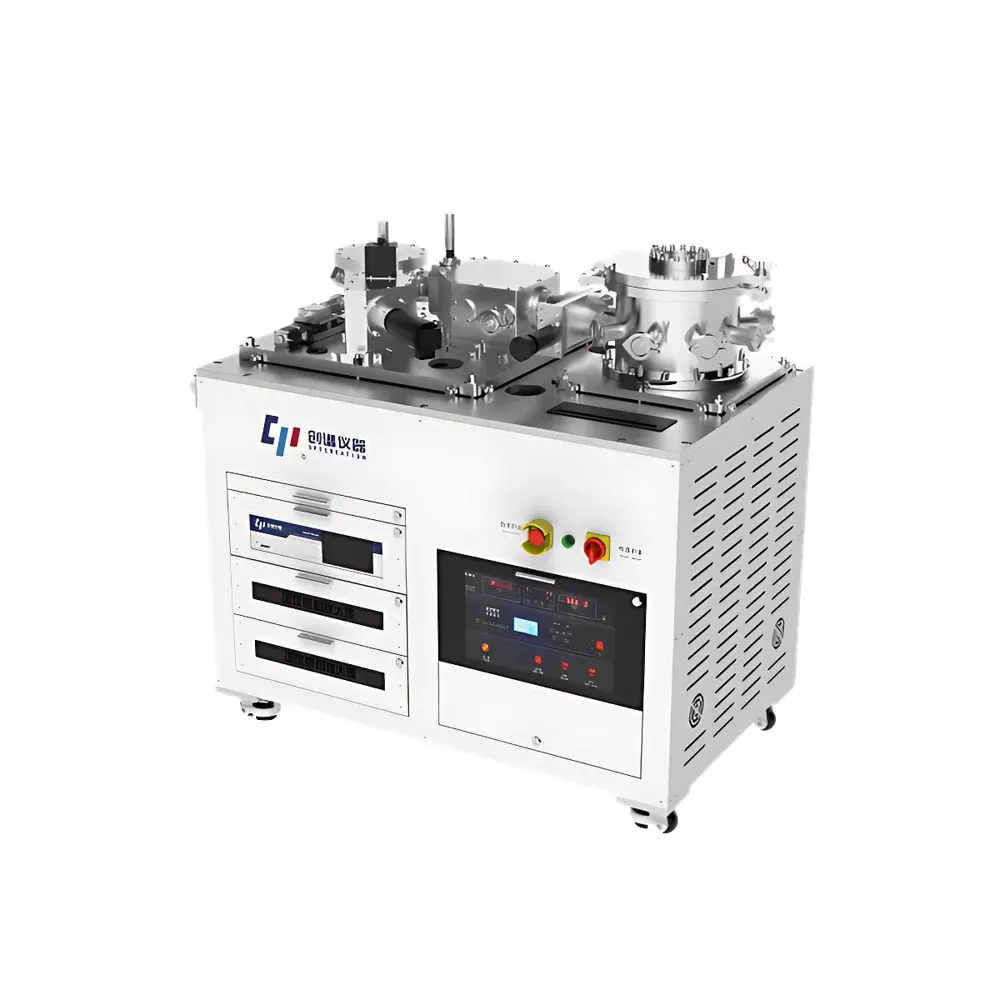
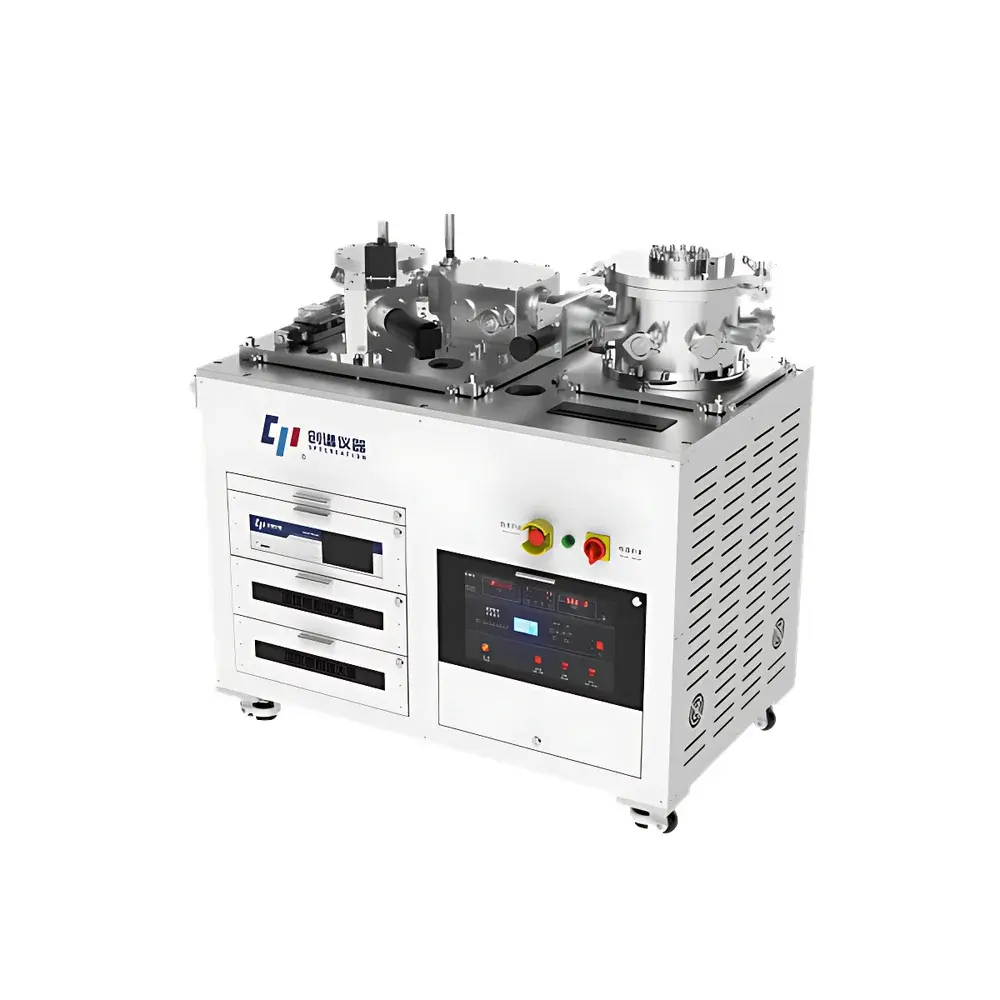
SPECREATION CP-EFlat Vacuum Ultraviolet Spectrophotometer
| Brand | SPECREATION |
|---|---|
| Origin | Anhui, China |
| Manufacturer Type | Authorized Distributor |
| Origin Category | Domestic |
| Model | CP-EFlat |
| Price Range | USD 70,000 – 125,000 |
| Optical Design | Grazing-Incidence Concave Varied-Line-Spacing (VLS) Flat-Field Spectrograph |
| Detector Type | CCD (Charge-Coupled Device) |
| Wavelength Range | 1–200 nm |
| Wavelength Accuracy | ±0.3 nm |
| Wavelength Repeatability | ±0.05 nm |
| Spectral Bandwidth | 0.1–5.0 nm (adjustable) |
| Stray Light | ≤0.01% T |
| Slit Width | 0.05–0.5 mm (motorized, continuous adjustment) |
| Flat-Field Imaging Area | 25 mm |
| Vacuum Performance | ≤1×10⁻⁴ Pa (UHV option available: ≤1×10⁻⁸ Pa) |
| Grating Options | 120, 300, 1200, 2400 g/mm (dual-grating vacuum-compatible turret mount) |
| Resolution (FWHM) | 0.01–0.3 nm (grating-dependent) |
| Zero-Order Blocker | Standard |
| Filter Holder | Standard |
| Laser Alignment Aid | Integrated visible (635 nm) alignment diode |
| Software Control | LabVIEW-based platform with wavelength calibration traceability to NIST-traceable emission lines |
Overview
The SPECREATION CP-EFlat Vacuum Ultraviolet (VUV) Spectrophotometer is a high-performance grazing-incidence spectrograph engineered for precision spectral analysis in the extreme ultraviolet (EUV) and soft X-ray regimes (1–200 nm, or 6.2–1240 eV). Unlike conventional UV-Vis instruments based on transmission optics and fused silica components, the CP-EFlat employs a rigorously optimized concave varied-line-spacing (VLS) grating operating at ~87° grazing incidence. This optical architecture enables aberration-corrected flat-field imaging without refocusing optics—eliminating chromatic and geometric distortions that compromise resolution and photometric fidelity in traditional Czerny–Turner or Rowland-circle configurations. The system is fully UHV-compatible (base pressure ≤1×10⁻⁴ Pa, optional ≤1×10⁻⁸ Pa), ensuring stable operation with photon-hungry detectors such as back-illuminated CCDs, microchannel plate (MCP) intensifiers, and EUV-sensitive CMOS sensors. Its design adheres to metrological principles established in ISO 14644 (cleanroom-class vacuum environments) and supports traceable wavelength calibration via well-characterized atomic emission lines (e.g., He I at 58.4 nm, Ne I at 73.6 nm, Ar II at 112.8 nm), enabling compliance with GLP and preclinical EUV source qualification protocols.
Key Features
- Grazing-incidence VLS flat-field spectrograph architecture delivering diffraction-limited performance across the full 1–200 nm range without reconfiguration.
- Motorized, continuously adjustable entrance slit (0.05–0.5 mm) with integrated encoder feedback for reproducible spectral resolution control.
- Integrated 635 nm visible laser alignment module—enabling rapid, non-invasive beam path verification and source-spectrometer co-alignment without breaking vacuum.
- Standard zero-order blocker and filter holder accommodating metal mesh, thin-film, and multilayer filters (e.g., Al, Zr, SiC) to suppress visible/IR leakage and higher-order diffractions.
- Dual-grating vacuum turret mount supporting up to two VLS gratings (120–2400 g/mm); automated switching preserves alignment integrity and eliminates manual realignment.
- Multi-axis kinematic stage (optional) with micrometer-driven pitch/yaw/roll/translation for sub-arcsecond optical axis registration—critical for plasma diagnostics and HHG beamline integration.
- Factory-applied NIST-traceable wavelength calibration delivered with certificate of conformance; includes line identification table and residual error map.
Sample Compatibility & Compliance
The CP-EFlat is designed for direct coupling to pulsed and CW EUV sources including laser-produced plasmas (LPP), discharge-produced plasmas (DPP), high-harmonic generation (HHG) setups, synchrotron beamlines, and EUV lithography pilot sources. Its all-metal, low-outgassing construction (316L stainless steel vacuum body, Ti-6Al-4V optical mounts) meets ASTM E595 outgassing specifications for space-qualified instrumentation. Detector interfaces comply with IEEE 1394b (FireWire) and Camera Link standards for synchronized readout with pump-probe delays <100 ps. Data acquisition workflows support 21 CFR Part 11-compliant audit trails when operated with validated LabVIEW RT modules and encrypted database logging.
Software & Data Management
Control and analysis are performed via a modular LabVIEW-based application suite featuring real-time spectrum preview, motorized component orchestration, and automated calibration sequence execution. All raw detector frames include embedded metadata (slit width, grating ID, vacuum pressure, timestamp, temperature drift compensation flags). Spectral processing includes background subtraction using dual-reference dark frames, pixel-to-wavelength mapping via cubic spline interpolation, and intensity normalization against calibrated deuterium lamp spectra (traceable to NIST SRM 2032). Export formats include HDF5 (with NeXus-compatible schema), ASCII tab-delimited, and CSV—ensuring compatibility with Python (SciPy/NumPy), MATLAB, and Igor Pro workflows. Optional add-ons include batch-processing pipelines for time-resolved plasma emission series and spectral deconvolution using Richardson–Lucy algorithms.
Applications
- High-harmonic generation (HHG) and attosecond pulse characterization—resolving individual harmonic orders with <0.02 nm resolution at 13.5 nm (EUV lithography wavelength).
- Laser-driven and Z-pinch plasma diagnostics—measuring ionization balance, electron temperature (via line ratios), and transient opacity in dense plasmas.
- EUV source metrology—quantifying spectral purity, out-of-band radiation, and debris-induced transmission degradation in EUV lithography tools.
- Optical component testing—calibrating reflectance/transmittance of Mo/Si multilayer mirrors, Zr-coated filters, and EUV photodiodes per ISO 13406-2 and SEMI F70 standards.
- Soft X-ray absorption spectroscopy (XAS)—probing L-edge transitions in transition metals (e.g., Fe, Ni) and K-edge features in light elements (C, N, O) under laboratory-scale conditions.
FAQ
Is the CP-EFlat compatible with time-resolved measurements?
Yes—the system supports external TTL triggering (<10 ns jitter) and gated detector readout, enabling synchronization with femtosecond lasers and plasma initiation signals.
Can it operate outside ultra-high vacuum environments?
No—optical throughput below 115 nm requires vacuum conditions ≤1×10⁻⁴ Pa to prevent atmospheric O₂ and N₂ absorption; optional UHV configuration extends operational stability for long-duration spectral mapping.
What calibration standards are included?
Each unit ships with a certified wavelength calibration report referencing He, Ne, and Ar emission lines, plus a set of reference spectra acquired using a NIST-traceable deuterium lamp.
Is remote operation supported?
Yes—Ethernet-enabled motion controllers and detector interfaces allow full functionality via secure SSH or TLS-encrypted web dashboard; no local Windows station required.
Does it support single-monochromator output mode?
Yes—an optional exit slit and focusing mirror assembly converts the spectrograph into a scanning monochromator with programmable bandwidth and step resolution down to 0.01 nm.
Related Products





