
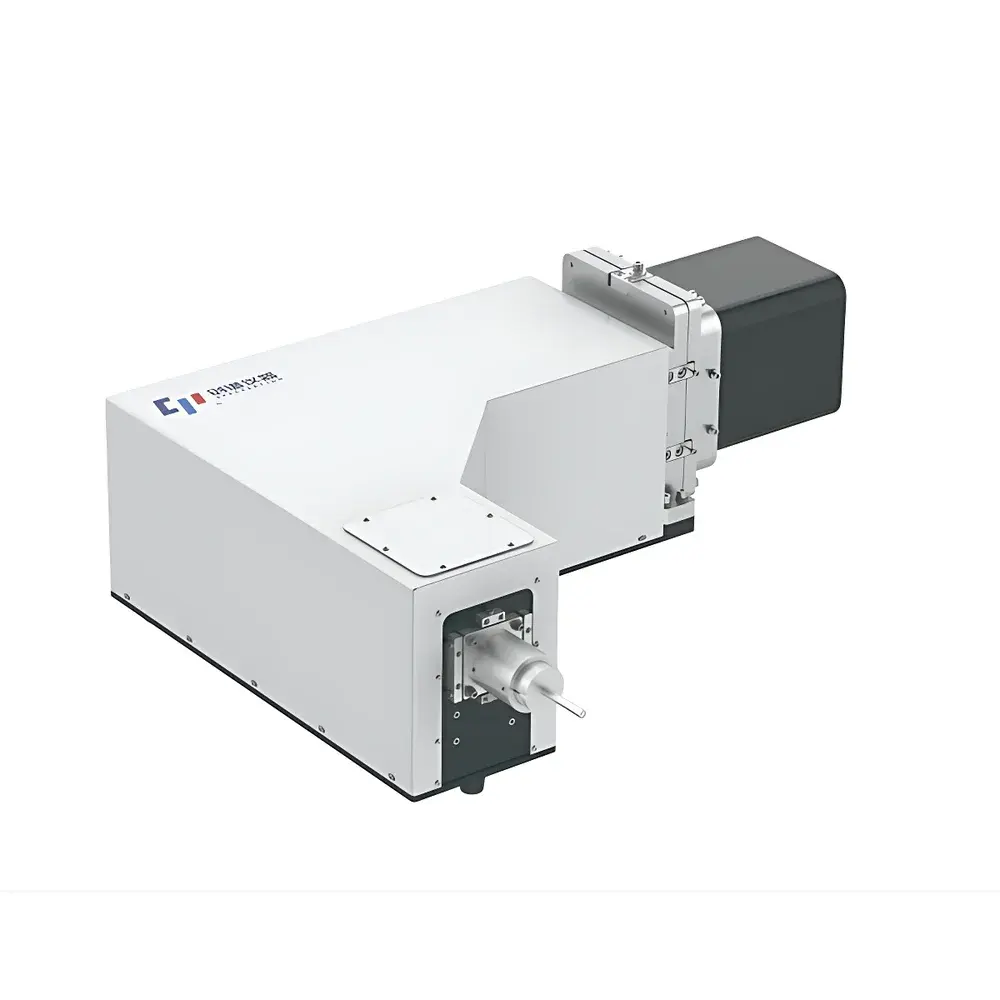
SPECREATION Transmission Grating Spectrometer
| Brand | SPECREATION |
|---|---|
| Origin | Anhui, China |
| Manufacturer Type | Authorized Distributor |
| Product Origin | Domestic (China) |
| Model | Custom Configurable |
| Price | Upon Request |
| Spectral Resolution | 0.07 nm @ 50 µm Slit Width |
Overview
The SPECREATION Transmission Grating Spectrometer is a high-efficiency optical spectrometer engineered for precision spectral analysis in research and industrial laboratories. It employs Volume Phase Holographic (VPH) transmission gratings as its core dispersive element—distinct from traditional reflective blazed gratings—enabling superior light throughput, minimal polarization sensitivity, and reduced stray light. The instrument operates on the principle of angular dispersion via diffraction, where incident polychromatic light is spatially separated into its constituent wavelengths at the detector plane following transmission through the VPH grating. Its optimized Czerny–Turner or modified Littrow optical layout supports second-order imaging, permitting high-fidelity spectral isolation without reliance on interference filters. This architecture delivers exceptional signal-to-noise ratio (SNR), making it particularly suitable for low-light applications such as photoluminescence decay measurements, Raman spectroscopy with weak scattering cross-sections, and time-resolved emission spectroscopy.
Key Features
- High optical throughput enabled by VPH transmission grating design—typically >85% peak diffraction efficiency across visible to NIR ranges (400–1000 nm)
- Spectral resolution of 0.07 nm at 50 µm input slit width, scalable with slit adjustment and detector pixel binning
- Second-image optical configuration eliminates need for external bandpass filters while achieving narrowband spectral selection (<0.1 nm FWHM)
- Modular optomechanical platform compatible with multiple entrance slits (25–200 µm), interchangeable grating mounts, and optional fiber-coupled input
- Thermally stable aluminum alloy housing with passive thermal management, minimizing wavelength drift during extended acquisitions
- Support for both CCD and scientific CMOS detectors with 16-bit digitization and programmable integration times (1 ms–60 s)
Sample Compatibility & Compliance
The spectrometer accepts free-space collimated beams or fiber-optic inputs (SMA905 or FC/PC connectors), enabling seamless integration with lasers, LEDs, plasma sources, or microscope ports. It accommodates standard 1/4″ or 1/2″ format detectors with 2048–4096 pixel linear arrays or area sensors up to 4.2 MP. All optical coatings and VPH grating substrates comply with ISO 9022-3 (Environmental testing – Mechanical shocks) and RoHS Directive 2011/65/EU. While not certified as medical or IVD equipment, the system meets general laboratory instrumentation requirements per IEC 61326-1:2013 (EMC for measurement/control equipment) and supports GLP-compliant data acquisition when paired with validated software.
Software & Data Management
The spectrometer interfaces via USB 3.0 or GigE Vision to Windows/Linux-based host systems. Included SDK supports C/C++, Python (via ctypes or PyVISA), and MATLAB bindings for custom automation. Acquisition software provides real-time spectrum preview, dark current subtraction, pixel-to-wavelength calibration using Hg/Ne/Ar lamp lines, and export in CSV, HDF5, or vendor-neutral JCAMP-DX formats. Audit-trail functionality—including operator ID, timestamp, instrument configuration hash, and raw frame metadata—is available under optional FDA 21 CFR Part 11 compliance mode. Data integrity is preserved through checksummed frame headers and optional encrypted local storage.
Applications
- Low-intensity photoluminescence characterization of quantum dots, perovskites, and 2D materials
- Resonance Raman spectroscopy of biological chromophores and catalytic intermediates
- Plasma emission diagnostics in semiconductor process chambers and fusion research
- Calibration reference source validation against NIST-traceable standards
- Time-gated spectral detection in fluorescence lifetime imaging (FLIM) setups
- Educational use in advanced optics laboratories for diffraction theory and spectral calibration exercises
FAQ
What grating types are supported beyond the standard VPH transmission grating?
Standard configurations include 1200–2400 l/mm VPH gratings optimized for 400–1000 nm; custom ruled or holographic reflective gratings can be integrated upon request with recalibrated optical alignment.
Is vacuum or purged operation available for UV-VIS extension below 200 nm?
The base model is air-path only; however, optional nitrogen-purged or evacuated housings with MgF₂ windows are available for operation down to 185 nm.
Can this spectrometer be synchronized with pulsed laser sources?
Yes—TTL-compatible trigger input/output ports support external gating, delay control, and multi-channel lock-in acquisition with sub-microsecond timing resolution.
Does the system include wavelength calibration certification?
Each unit ships with a factory-generated calibration report traceable to NIST SRM 2035a (Mercury-Argon emission lamp), valid for 12 months under normal operating conditions.
What maintenance is required for long-term spectral stability?
No routine optical alignment is needed; periodic verification using onboard calibration lamp (optional) every 6 months is recommended for critical metrology applications.





