
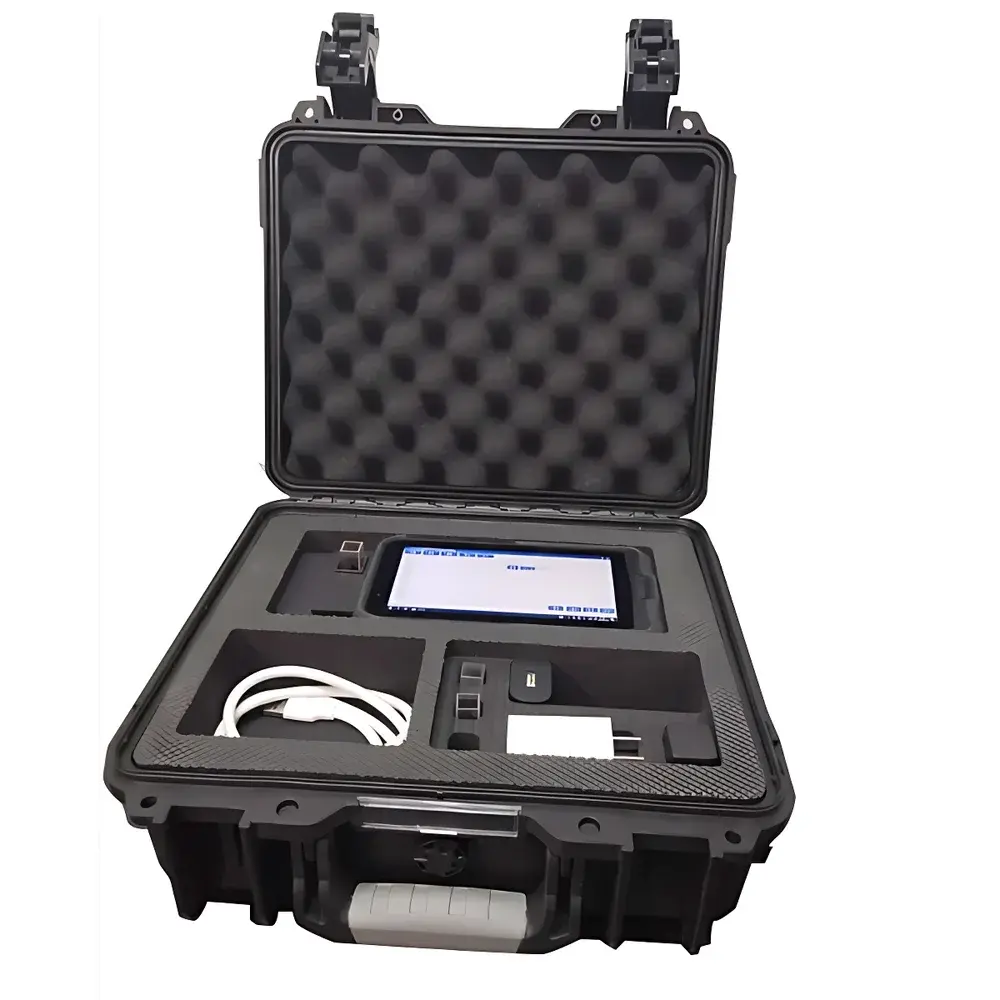
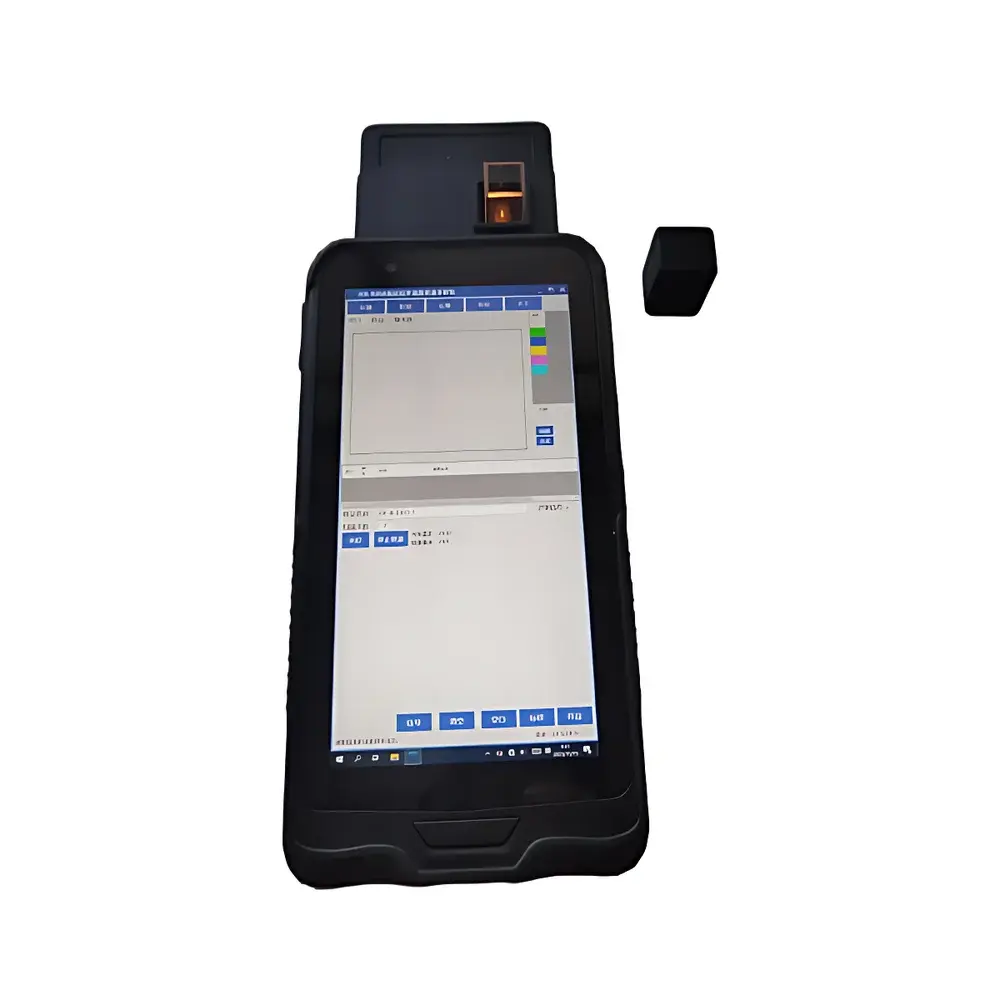
SPECTRA INVENT HX-910A Portable Near-Infrared Petroleum Component Analyzer
| Brand | SPECTRA INVENT |
|---|---|
| Origin | Beijing, China |
| Manufacturer Type | Authorized Distributor |
| Country of Manufacture | China |
| Model | HX-910A |
| Pricing | Available Upon Request |
Overview
The SPECTRA INVENT HX-910A is a handheld, field-deployable near-infrared (NIR) spectrometer engineered for rapid, non-destructive quantitative analysis of petroleum products and diverse organic materials. Operating in the 900–1700 nm spectral range, the instrument employs diffuse reflectance and transmittance measurement modes to capture characteristic absorption bands associated with C–H, O–H, and N–H functional groups. Its optical architecture integrates a thermoelectrically cooled InGaAs detector, fixed grating monochromator, and integrated tungsten-halogen light source—ensuring stable spectral acquisition under variable ambient conditions. Designed for on-site use at refineries, fuel depots, quality control labs, and agricultural processing facilities, the HX-910A delivers real-time predictive models for density, distillation endpoints (T10, T50, T90), hydrocarbon class distribution (paraffins, naphthenes, aromatics), and oxygenate content (e.g., ethanol, MTBE) in gasoline, kerosene, and diesel fuels—without sample preparation or solvent use.
Key Features
- True portable form factor: Weighs <2.1 kg with integrated rechargeable Li-ion battery supporting >6 hours continuous operation.
- Robust industrial housing rated IP54 for dust and splash resistance—validated for operation across –10 °C to +50 °C ambient temperatures.
- Pre-calibrated chemometric models embedded in firmware for ASTM D7462-compliant gasoline and diesel analysis; user-customizable PLS and PCR regression models via PC software.
- Integrated touchscreen interface with guided workflow navigation—enabling untrained personnel to perform measurements with <30-second cycle time per sample.
- Onboard spectral library storage (>500 reference spectra) and automatic outlier detection based on Mahalanobis distance metrics.
- USB-C and Bluetooth 5.0 connectivity for secure data export and remote calibration validation.
Sample Compatibility & Compliance
The HX-910A accommodates liquid, semi-solid, and finely ground solid samples—including bulk fuels, filtered crude fractions, milled tobacco leaf powder, ground coffee, cereal flours, pelleted animal feed, and homogenized dairy or meat extracts. For liquids, a 3-mL minimum volume is required in standard quartz cuvettes (10-mm pathlength); for solids, a reproducible 1–2 g sample is placed in the integrated rotating sample cup to minimize particle size effects. All factory-installed calibration models are traceable to NIST SRM 2723b (gasoline), SRM 2724a (diesel), and AOAC-certified reference materials for agricultural matrices. The device supports audit-ready data logging compliant with GLP and ISO/IEC 17025 requirements, including operator ID, timestamp, environmental sensor readings (temperature/humidity), and spectral QC flags.
Software & Data Management
The companion SpectraLink Desktop Suite (v4.2+) provides full method development, model validation (RMSECV, R², bias analysis), and report generation per ASTM E1655 guidelines. Raw spectra are stored in ASTM E131-compliant JCAMP-DX format; processed results export to CSV, PDF, or LIMS-compatible XML. Role-based access control (administrator/operator) enforces data integrity, while electronic signatures and full audit trail functionality satisfy FDA 21 CFR Part 11 requirements for regulated environments. Cloud synchronization (optional) enables centralized calibration management across multi-site deployments.
Applications
- Petroleum QA/QC: Field verification of fuel blending accuracy, detection of adulteration (e.g., diesel in gasoline), and real-time monitoring of reformulated gasoline (RFG) oxygenate levels.
- Tobacco science: Quantification of nicotine, total sugar, reducing sugar, total nitrogen, chloride, and potassium in cured leaf powders—correlating directly with ISO 22662 and CORESTA Recommended Methods.
- Food & feed analytics: Rapid assessment of moisture, protein, fat, and starch in grains, flour, and compound feeds—aligned with AACC and ICC standard protocols.
- Pharmaceutical manufacturing: In-process verification of tablet composition uniformity and excipient concentration using transmission-mode NIR—supporting ICH Q5A and USP <857> spectroscopic validation principles.
- Research applications: High-throughput screening of biofuel blends, catalyst performance evaluation, and botanical fingerprinting for origin authentication.
FAQ
What spectral resolution does the HX-910A achieve?
The instrument delivers nominal resolution of 8 nm FWHM across its operational range, optimized for robustness and signal-to-noise ratio rather than ultra-high resolution—consistent with routine industrial NIR applications.
Can the HX-910A be used for regulatory submissions?
Yes—when operated with validated methods and documented calibration history, data meets evidentiary requirements for ASTM, ISO, and pharmacopeial compliance when supported by full system suitability testing.
Is method transfer between instruments possible?
Yes—via SpectraLink’s standardized model packaging protocol (.spm files), enabling seamless deployment across HX-910A units without revalidation if hardware verification (wavelength accuracy, photometric linearity) is performed.
Does it require annual recalibration by the manufacturer?
No—end users perform daily performance qualification using supplied NIST-traceable ceramic standards; factory recalibration is recommended every 24 months or after physical impact.
How is temperature drift compensated during field measurements?
Real-time internal temperature monitoring feeds into a dynamic spectral correction algorithm that adjusts baseline and peak intensity parameters based on thermal drift profiles recorded during factory characterization.






