
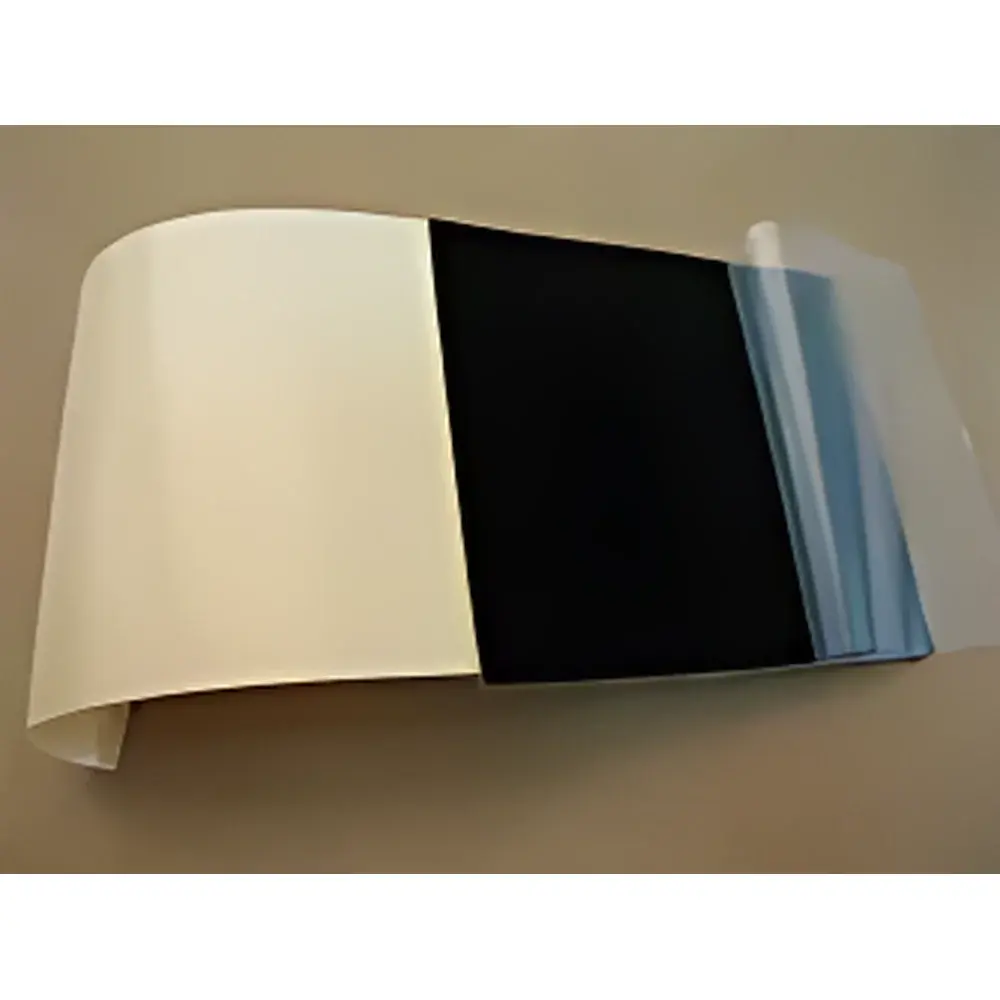
Spectral Black Stray Light Absorbing Coating Film by Acktar
| Brand | Acktar |
|---|---|
| Origin | Israel |
| Model | Spectral Black |
| Component Category | Optical Element |
| Substrate | Aluminum Foil (standard), Optional Metals/Plastics |
| Coating Thickness | 5 μm ± 2 μm |
| Operating Temperature (coated, no adhesive) | Long-term −196 °C to +350 °C, Short-term up to +400 °C |
| With Hi-Temp Adhesive | Long-term −40 °C to +180 °C, Short-term up to +300 °C |
| Humidity Resistance | MIL-STD-810G Method 507.5 Cycle B1, ISO/CD 12592.2 Task 10, MIL-C-48497A |
| Abrasion Resistance | Moderate |
| Chemical Composition | Fully Inorganic |
| Width | Up to 300 mm |
| Standard Thickness | 125 μm (foil) |
| Optional Adhesive Layer | 25–60 μm |
| Storage | 21 °C / 50% RH |
| Standard Shelf Life | 6 months from shipment |
Overview
Spectral Black is a high-performance, fully inorganic stray light absorbing coating film engineered by Acktar — an Israeli manufacturer with decades of heritage supplying optical black coatings to defense and aerospace programs in Israel and the United States. Unlike conventional carbon-based or polymer-bound black paints, Spectral Black employs a proprietary physical vapor deposition (PVD) process to produce a micro-structured, non-porous, ultra-low-reflectance surface optimized for broadband absorption across UV-VIS-NIR-SWIR spectral ranges (typically <0.5% reflectance from 250 nm to 14 µm). Its core function is to suppress parasitic reflections, ghost images, and thermal background noise in precision optical systems — critical for applications including spaceborne telescopes, laser cavities, interferometers, spectrometers, and vacuum-compatible beam dumps.
Key Features
- Ultra-Low Reflectance: Achieves industry-leading bidirectional reflectance distribution function (BRDF) performance, minimizing scatter-induced signal contamination in high-dynamic-range imaging and metrology setups.
- Thermal Stability: Maintains structural and optical integrity under extreme thermal cycling: long-term operation from −196 °C (liquid nitrogen) to +350 °C without adhesive; compatible with cryogenic vacuum environments and high-temperature bake-out protocols common in UHV optics.
- Humidity & Environmental Robustness: Certified per MIL-STD-810G Method 507.5 (Cycle B1) and ISO/CD 12592.2 Task 10, ensuring reliable performance in high-humidity, salt-fog, and condensing conditions — validated for military-grade optical enclosures.
- No Electrostatic Charge Buildup: Inherently static-dissipative due to its conductive inorganic matrix, eliminating electrostatic attraction of particulates in cleanroom and semiconductor lithography tooling environments.
- Flexible Integration Options: Available as self-adhesive foil (with standard or high-temperature acrylic adhesives), loose-coated substrates, or direct-on-part PVD coating services — enabling retrofitting of existing optical mounts, baffles, and housing interiors without disassembly.
- Non-Outgassing & Vacuum Compatible: Compliant with ASTM E595 low outgassing requirements (<1.0% TML, <0.1% CVCM), making it suitable for use in ultra-high vacuum (UHV) and space-qualified instrumentation.
Sample Compatibility & Compliance
Spectral Black films are supplied on standard 125 µm aluminum foil substrates (widths up to 300 mm), with custom options available on stainless steel, titanium, polyimide, and other thermally matched substrates. The coating itself contains no organic binders, solvents, or volatile components — ensuring compliance with NASA/ESA outgassing specifications and EU RoHS directives. Its inert chemical composition eliminates risk of corrosion or interfacial delamination when bonded to aluminum, copper, or nickel-plated surfaces. All production batches undergo traceable quality control per ISO 9001:2015 and are documented with material certificates verifying thickness uniformity (±2 µm), reflectance mapping, and environmental test reports.
Software & Data Management
While Spectral Black is a passive optical component, Acktar provides comprehensive technical documentation packages supporting integration into regulated workflows. These include full traceability records (batch number, deposition date, substrate lot ID), reflectance spectral data files (ASCII format, 250–14000 nm), and environmental test summaries aligned with MIL-STD-810G and ISO 12592. For customers operating under FDA 21 CFR Part 11 or EU Annex 11 requirements, Acktar supports audit-ready documentation delivery and can supply electronic certificates of conformance (eCoC) with digital signatures upon request. Shelf-life tracking is maintained via serialized packaging labels compliant with GS1 standards.
Applications
- Stray light suppression in Fourier-transform infrared (FTIR) spectrometers and monochromators
- Internal baffling and aperture lining in space-based optical sensors (e.g., Earth observation, star trackers)
- Beam dump surfaces and cavity lining in high-power pulsed laser systems (Nd:YAG, Ti:Sapphire, CO₂)
- Cryogenic optical benches and dilution refrigerator-mounted detectors
- Reference black standards for radiometric calibration laboratories (NIST-traceable validation support available)
- UV lithography tooling and EUV mask handling fixtures requiring zero particulate generation
FAQ
Can Spectral Black be applied to curved or complex geometries?
Yes — the flexible foil format allows conformal application to radii down to 3 mm; for non-planar surfaces unsuitable for lamination, Acktar offers direct PVD coating services on customer-supplied parts.
Is Spectral Black compatible with solvent cleaning protocols used in Class 100 cleanrooms?
Yes — the inorganic coating withstands IPA, acetone, and oxygen plasma cleaning without degradation; however, abrasive wiping should be avoided to preserve surface microstructure.
What is the typical turnaround time for custom-sized foil orders?
Standard sheet orders ship within 5 business days; coil orders and custom substrate integrations require 2–3 weeks lead time, subject to dimensional and adhesive specification review.
Does the adhesive layer affect optical performance at cryogenic temperatures?
Hi-temp acrylic adhesives retain bond strength down to −40 °C; for sub-40 °C applications, mechanical clamping or direct PVD coating is recommended to eliminate adhesive-related thermal contraction mismatch.
Are reflectance measurements provided per order or batch?
Yes — each production batch includes a certified spectral reflectance report measured using a PerkinElmer Lambda 1050+ with integrating sphere, covering 250–14000 nm at 1 nm resolution.



