
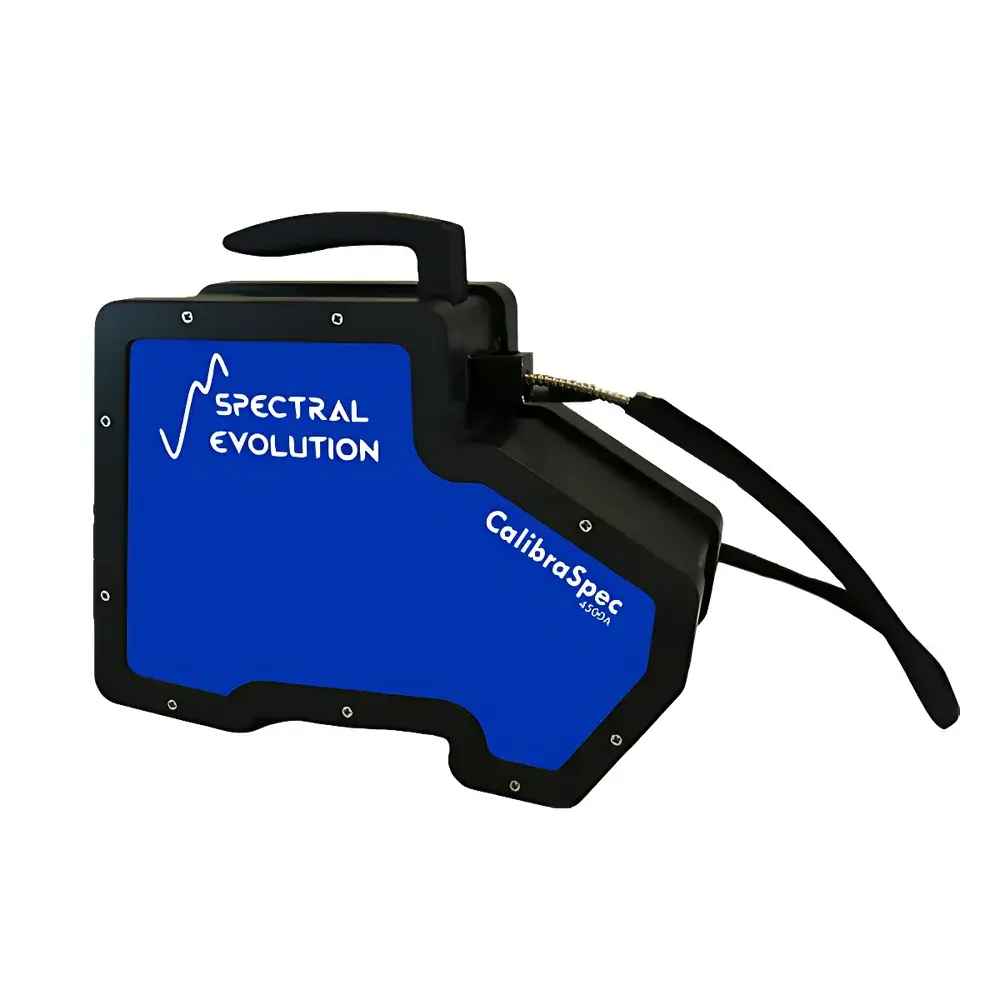
Spectral Evolution CalibraSpec 4500A Cryogenically Cooled Spectroradiometer
| Brand | SEI |
|---|---|
| Origin | USA |
| Manufacturer Status | Authorized Distributor |
| Import Status | Imported |
| Model | CalibraSpec 4500A |
| Spectral Range | 350–2500 nm |
| Resolution | 3 nm @ 350–1000 nm |
| Detector Cooling | Triple TE-cooled linear array detectors (Si, extended InGaAs ×2) |
| Radiometric Stability | ±0.1% (CalibraSpec 4500A) |
| ENR (1.2 m fiber) | 0.2×10⁻⁹ W/cm²/nm/sr @ 400 nm |
Overview
The Spectral Evolution CalibraSpec 4500A is a high-precision, cryogenically cooled spectroradiometer engineered for radiometric calibration transfer and absolute spectral irradiance/reflectance measurements under variable ambient conditions. Unlike conventional fiber-optic spectrometers, the CalibraSpec 4500A implements a triple-detector architecture with thermoelectric (TE) cooling across all spectral bands—350–1000 nm (512-pixel Si), 1000–1900 nm (256-pixel extended InGaAs), and 1900–2500 nm (256-pixel extended InGaAs)—ensuring thermal stabilization of dark current, reduced pixel-to-pixel noise, and long-term radiometric fidelity. Its fixed holographic grating design eliminates mechanical drift, while the integrated bidirectional temperature control system maintains detector junction temperatures within ±0.1°C, achieving radiometric stability of ±0.1% over 8 hours—critical for primary standard transfer, satellite sensor validation, and inter-laboratory reference comparisons.
Key Features
- Triple TE-cooled linear array detectors optimized for seamless spectral coverage from 350 to 2500 nm
- Bidirectional thermal regulation system enabling ±0.1% radiometric stability—over 20× improvement versus non-temperature-controlled counterparts
- Fixed holographic grating optics eliminating wavelength calibration drift and mechanical hysteresis
- Low-noise analog front-end and 16-bit digitization with hardware-based dark subtraction and auto-exposure control
- Compliance-ready architecture supporting audit trails, user access levels, and metadata embedding per ISO/IEC 17025 and FDA 21 CFR Part 11 requirements
- Pre-calibrated NIST-traceable radiometric response delivered with each unit, including full uncertainty budgets per ASTM E275 and ISO 15312-1
Sample Compatibility & Compliance
The CalibraSpec 4500A interfaces with standard 1.2 m SMA-905 optical fibers (optional quartz-tipped or cosine-corrected input optics) and supports both collimated beam and diffuse illumination geometries (e.g., integrating spheres, goniometers). It meets essential compliance frameworks for metrology-grade instrumentation: traceability to NIST SRM 2030 (spectral irradiance standards), conformance with ASTM E275 (describing spectroradiometer performance evaluation), ISO 15312-1 (radiometric calibration of remote sensing instruments), and USP (for photometric characterization in pharmaceutical light stability testing). Its firmware enforces GLP/GMP-aligned data integrity protocols—including immutable timestamping, operator ID logging, and electronic signature support—making it suitable for regulated environments requiring audit readiness.
Software & Data Management
The bundled SpectralEvolution SpectraWiz® software provides a validated, Windows-based platform for instrument control, real-time spectral acquisition, radiometric correction, and report generation. It supports batch processing of calibration files (irradiance, reflectance, transmittance), automatic application of NIST-matched correction coefficients, and export to industry-standard formats (CSV, HDF5, JCAMP-DX). All raw and processed spectra retain embedded EXIF-style metadata—including integration time, detector temperature, calibration date, and uncertainty propagation flags. The software architecture complies with FDA 21 CFR Part 11 through role-based access control, electronic signatures, and tamper-evident audit logs—enabling use in quality control laboratories operating under ISO 9001 or ICH Q5C guidelines.
Applications
- Radiometric standard transfer between national metrology institutes (NMIs) and secondary calibration labs
- On-ground validation of Earth observation sensors (e.g., VIIRS, OLI, MSI) using solar diffusers and lamp-based reference sources
- Quantitative characterization of LED luminaires, OLED displays, and automotive lighting per CIE S 025/E:2015
- Spectral responsivity mapping of photovoltaic cells and concentrator modules under AM1.5G and customized spectral conditions
- Mineral identification and geological surveying via field-deployable reflectance spectroscopy (350–2500 nm)
- Color science research requiring absolute spectral power distribution (SPD) data compliant with CIE 15:2018 and ISO/CIE 13655:2017
FAQ
What distinguishes the CalibraSpec 4500A from the SR-4500 model?
The CalibraSpec 4500A integrates a bidirectional thermal control system that actively stabilizes detector temperature against ambient fluctuations, reducing long-term radiometric drift from ±2.0% (SR-4500) to ±0.1%. It also includes factory-applied NIST-traceable calibration certificates with full uncertainty analysis.
Is the instrument compatible with third-party integrating spheres or goniometers?
Yes—the CalibraSpec 4500A accepts standard SMA-905 fiber inputs and supports custom optical coupling via optional adapter plates. Integration with Labsphere, SphereOptics, or Goniometric Systems Ltd. hardware is routinely validated during installation.
Does the system support automated calibration routines per ISO/IEC 17025?
Yes—SpectraWiz® includes preconfigured workflows for daily verification using internal shutter and reference lamps, with automatic pass/fail reporting aligned to ISO/IEC 17025 clause 7.7.2 on measurement traceability and uncertainty management.
Can raw spectral data be exported for external uncertainty propagation modeling?
Yes—all acquired spectra include embedded metadata fields for integration time, detector temperature, dark current offset, and calibration coefficient covariance matrices—enabling full Monte Carlo–based uncertainty propagation in MATLAB, Python (SciPy), or R environments.
What maintenance is required to sustain NIST-traceable performance?
Annual recalibration at an accredited laboratory (e.g., NIST, PTB, or A2LA-accredited providers) is recommended. The instrument’s self-diagnostic suite monitors detector health, thermal stability, and grating alignment—flagging deviations beyond ISO 15312-1 acceptance thresholds.




