
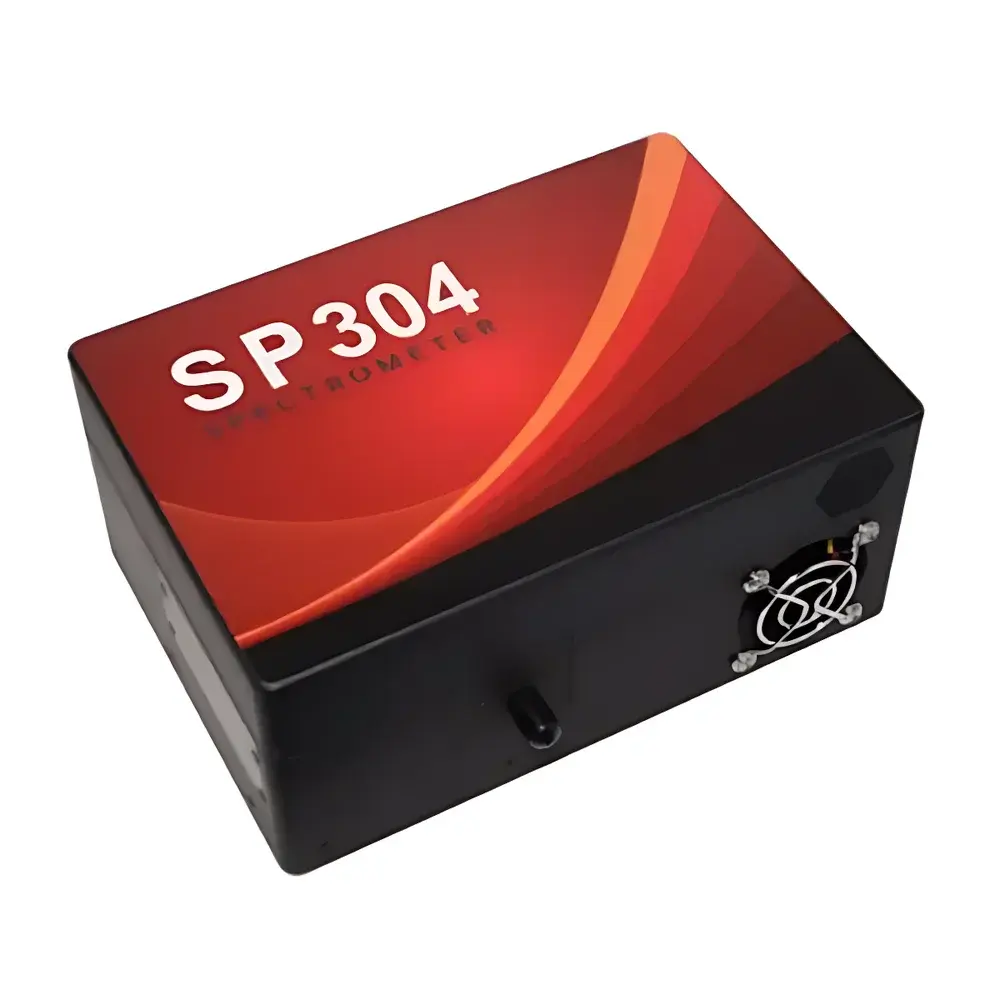
Spectral Products SP304 High-Performance Short-Wave Infrared (SWIR) Spectrometer
| Brand | AERO |
|---|---|
| Origin | Beijing, China |
| Manufacturer Type | Authorized Distributor |
| Product Category | Domestic |
| Model | SP304 |
| Instrument Class | Optical Photothermal Infrared Spectrometer |
| Form Factor | Portable |
| Wavelength Ranges | 0.9–1.7 µm, 0.9–2.05 µm, 0.9–2.2 µm, 0.9–2.5 µm |
| Spectral Resolution | >3 nm (overall, depending on configuration) |
| Signal-to-Noise Ratio | >15,000:1 @ 100 ms integration time |
| Detector Types | 256- and 512-pixel TE-cooled InGaAs linear arrays |
| Pixel Dimensions | 25 × 250 µm or 25 × 500 µm (model-dependent) |
| Compliance | CE, RoHS, ISO 9001-aligned manufacturing & calibration protocols |
Overview
The Spectral Products SP304 is a research-grade, portable short-wave infrared (SWIR) spectrometer engineered for high-fidelity spectral acquisition in the 0.9–2.5 µm range. It operates on the principle of dispersive spectroscopy using a fixed-grating optical bench and thermoelectrically (TE) cooled InGaAs photodiode array detection. Unlike scanning-based IR systems, the SP304 captures full spectra simultaneously—enabling rapid, non-scanning spectral acquisition with inherent temporal stability and minimal moving-part wear. Its optical architecture minimizes stray light through optimized baffling and anti-reflection coatings, while the TE cooling system stabilizes detector dark current to sub-nA levels, ensuring low-noise performance essential for weak-signal applications such as remote sensing, agricultural phenotyping, pharmaceutical raw material verification, and semiconductor wafer inspection.
Key Features
- Four selectable spectral coverage options: 0.9–1.7 µm, 0.9–2.05 µm, 0.9–2.2 µm, and 0.9–2.5 µm—optimized for distinct application domains including moisture analysis, polymer identification, and mineral mapping.
- Two detector configurations: 256-pixel and 512-pixel TE-cooled InGaAs linear arrays (Hamamatsu G9204/G9206/G9208 series), enabling trade-offs between resolution, sensitivity, and frame rate.
- High dynamic range (>10⁴) and exceptional signal-to-noise ratio (>15,000:1 at 100 ms integration), achieved via low-noise analog front-end electronics and correlated double sampling (CDS) readout architecture.
- Compact, ruggedized aluminum housing rated IP54 for field-deployable operation; integrated USB 3.0 interface and 12 V DC power input for battery or vehicle-powered use.
- No moving parts in the optical path—ensuring long-term calibration stability and mechanical robustness under vibration or thermal cycling conditions typical in industrial or airborne platforms.
Sample Compatibility & Compliance
The SP304 supports both fiber-coupled and free-space optical input configurations, compatible with standard SMA-905 or FC/PC connectors. It integrates seamlessly with common illumination sources—including tungsten-halogen, supercontinuum lasers, and LED-based SWIR illuminators—and accepts external trigger signals for synchronized acquisition in process monitoring or time-resolved experiments. All SP304 units undergo factory calibration traceable to NIST-traceable standards, with optional certificate of calibration available per ISO/IEC 17025 requirements. The instrument complies with CE Directive 2014/30/EU (EMC), 2014/35/EU (LVD), and RoHS 2011/65/EU. Firmware and data output formats adhere to ASTM E131-22 (Standard Terminology Relating to Molecular Spectroscopy) and support GLP/GMP audit trails when used with validated third-party software environments.
Software & Data Management
The SP304 ships with SpectralView™ SDK (Windows/Linux/macOS), providing low-level API access for custom integration into LabVIEW, Python (via PyVISA or ctypes), MATLAB, and C/C++ applications. Raw spectral data is output in IEEE 754-compliant 32-bit floating-point format (.csv or binary .spc), preserving full dynamic range without lossy compression. Optional SpectraSuite Pro software enables real-time spectral averaging, baseline correction (asymmetric least squares), peak deconvolution (Gaussian/Lorentzian fitting), and multivariate analysis (PCA, PLS regression). All spectral acquisitions include embedded metadata: timestamp (UTC), integration time, detector temperature, serial number, and calibration file hash—supporting FDA 21 CFR Part 11 compliance when deployed in regulated environments with appropriate electronic signature workflows.
Applications
- Agricultural science: Non-destructive quantification of leaf water content, nitrogen concentration, and starch-to-sugar ratios in fruit and grain.
- Pharmaceutical QC: Identification of active pharmaceutical ingredients (APIs) and excipients in solid dosage forms via spectral fingerprint matching against USP-NF reference libraries.
- Geoscience & mining: Discrimination of clay minerals (e.g., kaolinite vs. smectite), hydrocarbon-bearing rocks, and hydrated silicates using diagnostic absorption features near 1.4 µm, 1.9 µm, and 2.2–2.3 µm.
- Industrial process control: Real-time monitoring of polymer melt index, coating thickness, and solvent drying kinetics on production lines.
- Defense & security: Standoff detection of explosives residues, camouflage materials, and chemical agent simulants based on characteristic overtone and combination bands.
FAQ
Is the SP304 suitable for laboratory-grade quantitative analysis?
Yes—the SP304 meets the photometric stability and linearity requirements outlined in ISO 17025 for routine quantitative SWIR spectroscopy when operated within its specified temperature and humidity ranges (15–30 °C, <70% RH non-condensing) and calibrated annually.
Can the SP304 be integrated into an automated OEM system?
Yes—its SDK provides deterministic timing control, hardware triggering (TTL-compatible), and memory-mapped I/O registers, enabling deterministic synchronization with motion stages, lighting controllers, or PLCs.
What calibration options are available?
Factory calibration includes wavelength accuracy verification using rare-earth oxide filters and radiometric calibration using NIST-traceable tungsten halogen sources. Custom calibrations (e.g., reflectance, transmittance, or absorbance) can be commissioned pre-delivery.
Does the SP304 support spectral averaging across multiple acquisitions?
Yes—software-controlled averaging (up to 65,535 scans) reduces random noise proportionally to √N, improving effective SNR without hardware modification.
Is firmware upgradable in the field?
Yes—firmware updates are delivered via signed .bin files and applied through the SpectralView™ utility, with rollback capability and checksum validation to ensure integrity.




