
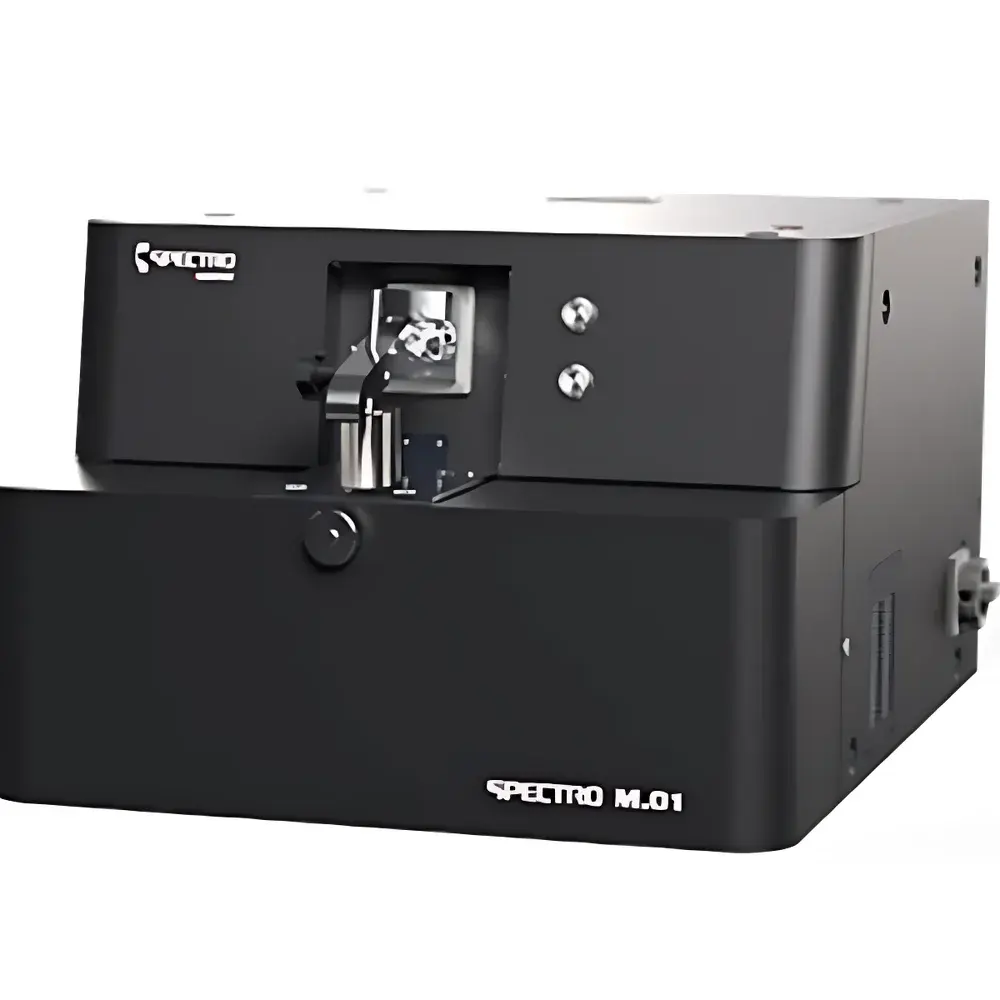
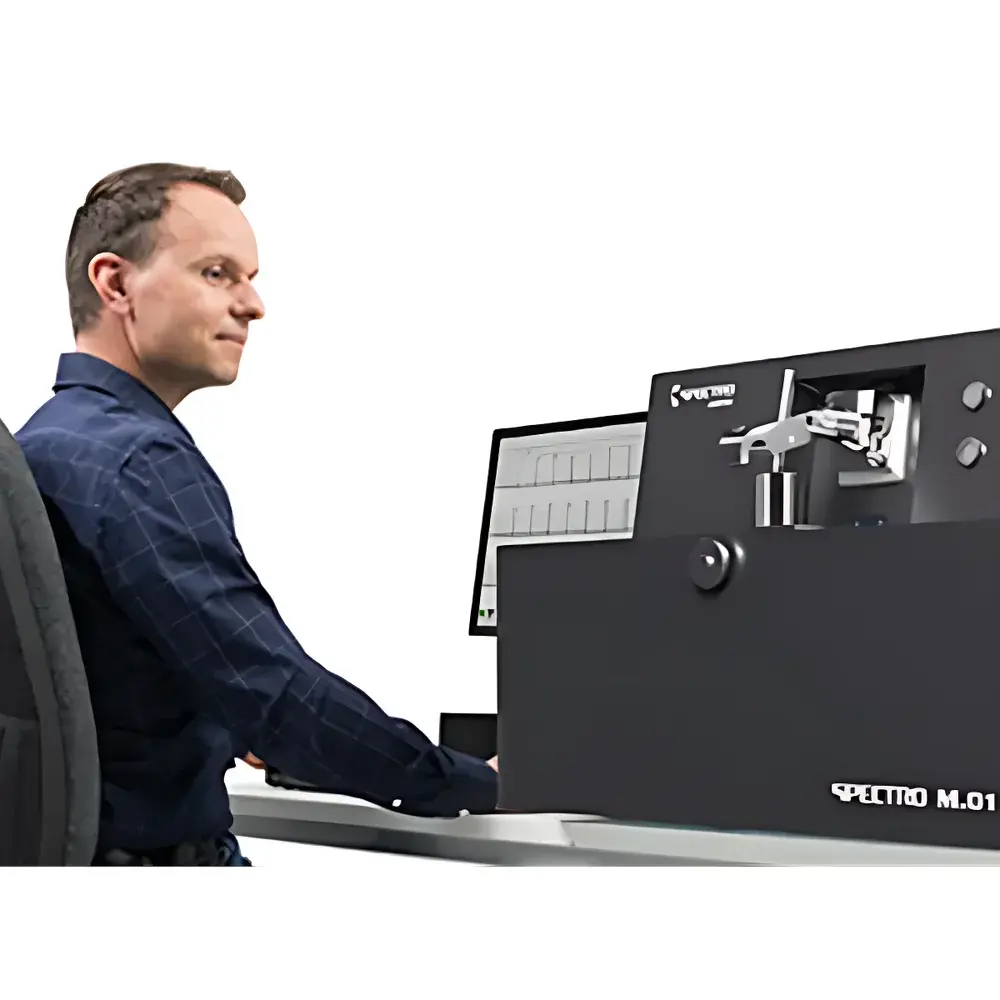
SPECTRO M.01 Benchtop Spark Optical Emission Spectrometer
| Brand | SPECTRO |
|---|---|
| Origin | Germany |
| Model | SPECTRO M.01 |
| Instrument Type | Benchtop |
| Technology | Spark Optical Emission Spectrometry (OES) |
| Target Matrix | Ferrous Alloys |
| Compliance | ISO/IEC 17025 compatible, ASTM E415, ASTM E1086, EN 10315, DIN 51008 |
| Software | SPECTRO AnalyzeNet v3.x with ICAL 2.0 calibration technology |
| Gas Requirement | High-purity argon (≥99.996%) |
| Cooling | Air-cooled |
| Safety | CE, UL 61010-1 compliant |
| Data Management | Audit trail, user access levels, GLP/GMP-ready reporting |
Overview
The SPECTRO M.01 Benchtop Spark Optical Emission Spectrometer is a high-performance, cost-optimized analytical instrument engineered for routine elemental analysis of ferrous metals in foundries, steel mills, and metal service centers. It operates on the principle of spark optical emission spectrometry (OES), where a controlled high-voltage spark ablates a micro-volume of solid metallic sample surface, generating excited atoms and ions. These species emit characteristic wavelengths of light upon relaxation, which are dispersed by a fixed polychromator system and detected by high-stability CCD/PMT hybrid detectors. The resulting spectral intensities are quantitatively correlated to elemental concentrations via matrix-matched calibrations. Designed specifically for iron-based alloys—including carbon steels, low-alloy steels, stainless steels, cast irons, and tool steels—the SPECTRO M.01 delivers laboratory-grade precision in an industrial benchtop footprint. Its compact architecture integrates robust optical alignment, thermally stabilized spectrometer housing, and real-time plasma monitoring to ensure measurement stability across shifts and ambient temperature fluctuations.
Key Features
- ICAL 2.0 Intelligent Calibration System: Enables rapid, single-point recalibration without certified reference materials—reducing standardization time by up to 70% while maintaining traceable accuracy per ISO/IEC 17025 requirements.
- Optimized Argon Economy: Patented purge optimization algorithm reduces argon consumption by ≥40% versus previous-generation benchtop OES systems, lowering operational cost without compromising spectral signal-to-noise ratio or inter-element interference correction.
- Enhanced Plasma Stability Control: Real-time spark parameter feedback loop dynamically adjusts energy, frequency, and integration time to compensate for electrode wear, surface oxide layers, or minor sample geometry variations.
- Benchtop Industrial Design: Fully enclosed spark stand with integrated fume extraction interface, IP54-rated electronics enclosure, and vibration-damped optical baseplate—certified for continuous operation in foundry floor environments (EN 60068-2 environmental testing).
- Self-Diagnostic Hardware Monitoring: Continuous health checks of high-voltage generator, detector gain, argon pressure, optical path cleanliness, and cooling airflow—with predictive alerts logged in system event history for preventive maintenance planning.
Sample Compatibility & Compliance
The SPECTRO M.01 accepts flat, cylindrical, or irregularly shaped solid metal samples (diameter ≥10 mm, thickness ≥4 mm) with machined or ground surfaces meeting ASTM E415 surface finish specifications (Ra ≤ 0.8 µm). It supports direct analysis of as-cast, hot-rolled, cold-finished, and heat-treated ferrous components without dissolution or digestion. Calibration sets cover major alloying elements (C, Si, Mn, P, S, Cr, Ni, Mo, Cu, V, Nb, Ti, Al, Co, B, N) and trace impurities (Sn, As, Pb, Zn, Bi) at detection limits ranging from 1–10 ppm depending on element and matrix. All measurement protocols comply with ASTM E1086 (stainless steels), ASTM E415 (carbon and low-alloy steels), EN 10315 (cast irons), and DIN 51008 (spectral analysis quality assurance). System validation documentation supports GLP and GMP audit readiness, including full 21 CFR Part 11-compliant electronic records when paired with optional SPECTRO AnalyzeNet secure mode.
Software & Data Management
SPECTRO AnalyzeNet v3.x provides intuitive workflow-driven operation—from sample registration and spark sequence execution to multi-level result review and certificate generation. The software features role-based user permissions (administrator, analyst, operator), configurable report templates (PDF/CSV/XLSX), and automated data archiving with SHA-256 hash verification. Integrated audit trail logs all critical events: method changes, calibration updates, user logins, result modifications, and instrument status transitions. Data export supports LIMS connectivity via ASTM E1382-compliant XML schema or OPC UA protocol. Optional cloud backup and remote diagnostics modules enable secure off-site data redundancy and expert support escalation without onsite intervention.
Applications
- Raw material acceptance testing of scrap, pig iron, ferroalloys, and master alloys prior to charge preparation.
- In-process melt analysis during ladle metallurgy and continuous casting—enabling real-time chemistry adjustments to meet specification windows.
- Final product certification for structural steels, pipeline grades, automotive components, and pressure vessel materials per ASTM A6/A6M, EN 10027, or ASME II Part A.
- Scrap sorting and recycling grade identification using multivariate classification algorithms trained on industry-standard reference libraries.
- Failure analysis laboratories performing comparative compositional profiling of fracture surfaces, weld zones, and heat-affected regions.
FAQ
What sample preparation is required for the SPECTRO M.01?
Flat, clean, and conductive surfaces are mandatory. Samples must be ground or milled to Ra ≤ 0.8 µm per ASTM E415; no acid etching or coating is permitted.
Does the SPECTRO M.01 require external water cooling?
No—its air-cooled optical and electronic subsystems eliminate dependency on chilled water circuits, reducing infrastructure complexity and installation footprint.
Can the instrument analyze non-ferrous metals such as aluminum or copper?
The SPECTRO M.01 is factory-optimized for ferrous matrices only. Non-ferrous applications require dedicated calibrations and hardware configurations not supported in this model.
How frequently must the optical system be cleaned or aligned?
Under normal operating conditions (≤8 hrs/day), optical path inspection is recommended every 6 months; full alignment is typically required only after mechanical shock or extended downtime (>30 days).
Is remote software update capability available?
Yes—secure over-the-air firmware and software updates can be scheduled via SPECTRO’s authenticated update portal, with rollback functionality and version-controlled change logs.




