
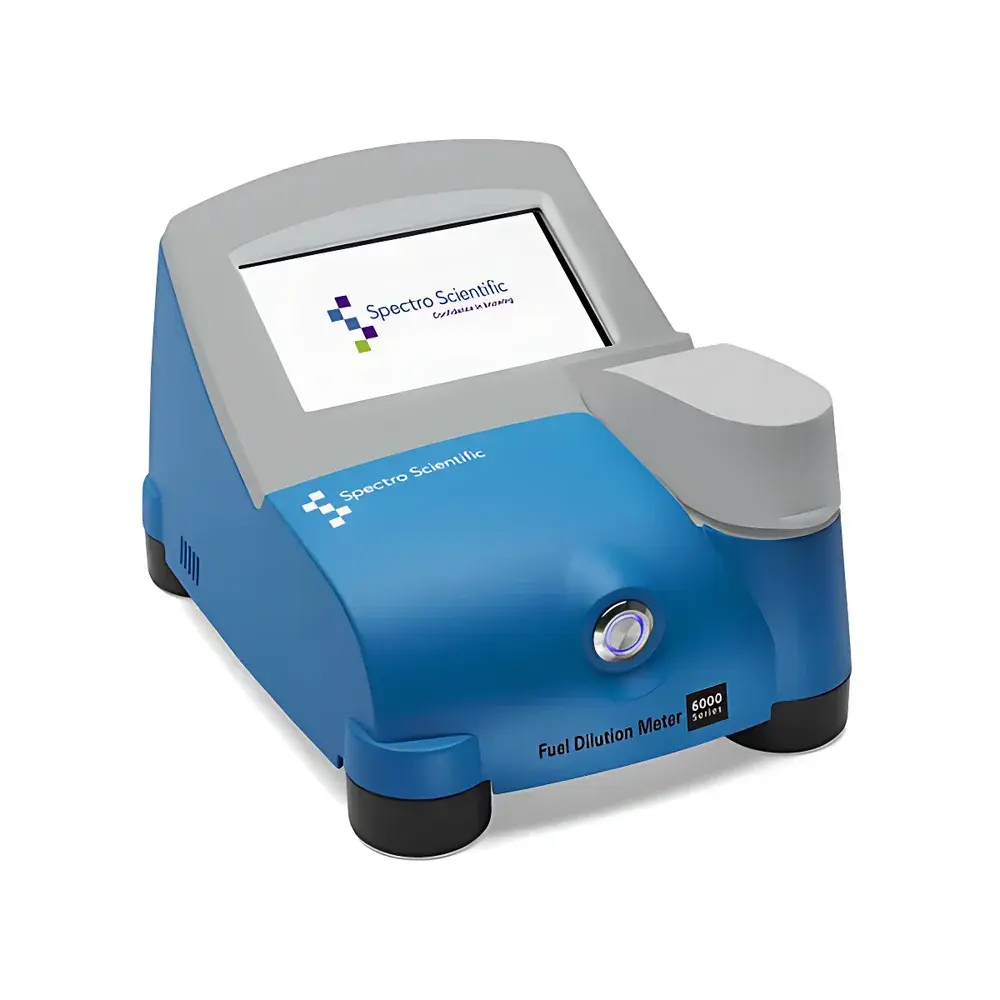
Spectro Scientific FDM 6000 Portable Fuel Dilution Analyzer
| Brand | Spectro Scientific |
|---|---|
| Origin | USA |
| Manufacturer Type | Original Equipment Manufacturer (OEM) |
| Product Origin | Imported |
| Model | FDM 6000 |
| Instrument Type | Portable Analyzer |
| Detection Parameter | Fuel Dilution in Engine Oil |
| Measurement Principle | Surface Acoustic Wave (SAW) Sensor Analysis of Head-Space Vapor |
| Detection Range | 0.2–15% v/v Fuel Dilution |
| Repeatability | ≤5% RSD |
| Analysis Time | ≤120 seconds per sample |
| Sample Volume Required | <1 mL |
| Power Source | Rechargeable Lithium-Ion Battery |
| Data Storage | Up to 3 Calibration Curves |
| Interface | Color Touchscreen with Audio Guidance (Multilingual, including English) |
Overview
The Spectro Scientific FDM 6000 Portable Fuel Dilution Analyzer is an engineered solution for rapid, on-site quantification of fuel contamination in engine lubricating oils. It employs surface acoustic wave (SAW) sensor technology to detect volatile hydrocarbon vapors in the head-space above an oil sample—enabling direct, solvent-free measurement without chemical reagents or chromatographic separation. This physics-based detection method correlates vapor-phase fuel concentration with liquid-phase dilution levels, delivering results traceable to ASTM D7918 (Standard Test Method for Determination of Fuel Dilution in Used Diesel Engine Oils by Gas Chromatography) and aligned with ISO 3496 and SAE J1889 practices for field-deployable oil condition monitoring. Developed in collaboration with the U.S. Navy, the FDM 6000 meets stringent operational requirements for reliability under variable environmental conditions—including temperature fluctuations, vibration, and limited power availability—making it suitable for marine, military, mining, and heavy-duty transportation applications where real-time maintenance decisions are critical.
Key Features
- SAW-Based Head-Space Sensing: Measures fuel-derived volatile organic compounds (VOCs) in the sealed vial head-space, eliminating matrix interference from base oil oxidation products or additive depletion.
- Dual-Range “Sawtooth” Sensor Architecture: Patented geometric optimization of the SAW delay line improves signal-to-noise ratio and extends linear dynamic range up to 15% v/v fuel dilution—exceeding conventional infrared or FTIR methods in upper-range accuracy.
- Field-Ready Portability: Compact form factor (24 × 15 × 8 cm), integrated lithium-ion battery (≥8 hours continuous operation), and IP54-rated enclosure enable deployment in engine rooms, service bays, or remote depots without AC infrastructure.
- Minimal Sample Handling: Requires only 0.8–1.0 mL of used oil in standard 20-mL glass vials; no solvent addition, filtration, or pre-treatment required.
- Intuitive Human Interface: 5-inch color capacitive touchscreen with context-sensitive prompts, multilingual audio guidance (English, Spanish, Mandarin), and real-time pass/fail flagging based on user-defined thresholds.
- Calibration Flexibility: Stores up to three independent calibration curves—each configurable for diesel, gasoline, or biodiesel blends—to accommodate diverse fleet compositions and OEM specifications.
Sample Compatibility & Compliance
The FDM 6000 is validated for use with mineral, synthetic, and semi-synthetic engine oils meeting API SP, CJ-4, CK-4, and ACEA E9/E7 specifications. It maintains measurement integrity across viscosity grades from SAE 0W-20 to 20W-50 and is unaffected by common additives such as ZDDP, detergents, or dispersants. All firmware and calibration data adhere to GLP-compliant audit trails per 21 CFR Part 11 when connected to Spectro’s SpectroTrack™ LIMS interface. The instrument conforms to IEC 61000-4 electromagnetic compatibility standards and carries CE, UKCA, and RoHS certifications for global deployment.
Software & Data Management
Data export is supported via USB-C and Bluetooth 5.0 to SpectroLink™ Desktop Software (Windows 10/11), enabling batch reporting, trend analysis, and integration into CMMS platforms such as IBM Maximo or SAP PM. Each test record includes timestamp, GPS coordinates (optional external module), operator ID, vial lot number, and raw SAW phase-shift values. Audit logs retain all calibration events, parameter changes, and firmware updates—supporting ISO/IEC 17025 laboratory accreditation requirements. Firmware updates are delivered via signed .bin files with SHA-256 verification to ensure chain-of-custody integrity.
Applications
- Rapid triage of diesel generator sets exhibiting abnormal wear metal trends or viscosity loss
- Pre-deployment screening of naval auxiliary engines prior to sea trials
- On-the-spot verification of fuel injector performance in Class 8 over-the-road trucks
- Condition-based maintenance scheduling for off-highway construction equipment operating in cold climates
- Verification of crankcase ventilation system integrity in natural gas-fueled reciprocating compressors
- Supporting ISO 4406 particulate cleanliness assessments when combined with Spectro’s FluidScan® IR analyzers
FAQ
How does the FDM 6000 differentiate between diesel and gasoline dilution?
The instrument uses a multi-point calibration approach: separate curves are generated using reference oils spiked with known concentrations of each fuel type, leveraging distinct volatility profiles captured by the SAW sensor’s frequency response.
Can the FDM 6000 be used with biofuel-blended oils?
Yes—calibration curves for B5, B20, and hydrotreated vegetable oil (HVO) blends are available upon request and validated per ASTM D7467 Annex A3 protocols.
Is periodic recalibration required?
Factory calibration remains stable for 12 months under normal use; however, Spectro recommends annual verification using certified reference materials (CRM-FD-01 through CRM-FD-03).
Does the analyzer require routine maintenance?
No consumables or moving parts are present; only periodic cleaning of the vial chamber and sensor port with lint-free swabs and isopropyl alcohol is advised.
What happens if the oil sample contains water or antifreeze contamination?
Water content below 1,000 ppm has negligible impact; ethylene glycol and propylene glycol do not interfere with SAW response at typical coolant leak concentrations (<3% v/v).







