
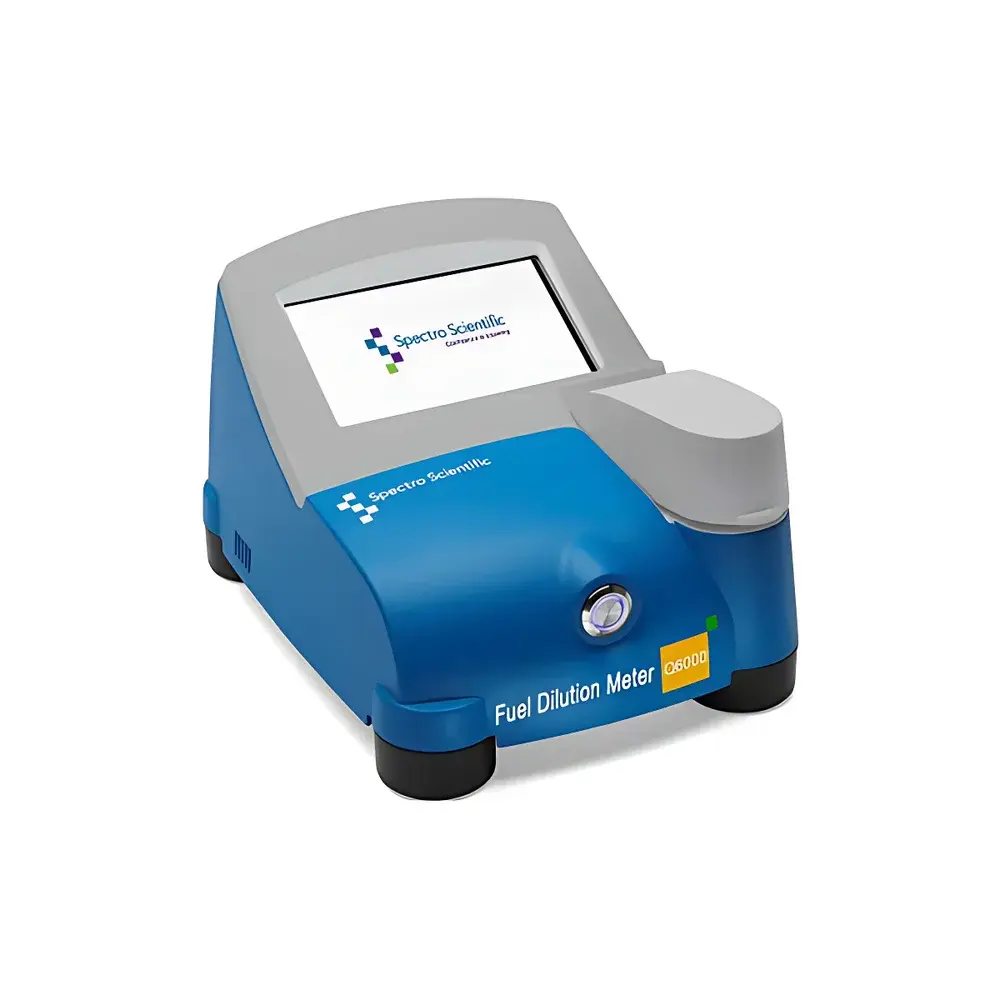
Spectro Scientific FDM 6000 Series Portable Fuel Dilution Analyzer
| Brand | Spectro Scientific |
|---|---|
| Origin | USA |
| Manufacturer Type | Authorized Distributor |
| Origin Category | Imported |
| Model | FDM 6000 Series |
| Product Type | Portable Instrument |
| Detection Parameter | Fuel Dilution in Engine Oil |
| Detection Principle | Surface Acoustic Wave (SAW) Sensor + Headspace Vapor Analysis per Henry’s Law |
| Detection Range | 0.2–15% v/v |
| Repeatability | ≤5% RSD |
| Analysis Time | ≤120 s |
| Sample Volume | <1 mL |
| Power Supply | Rechargeable Li-ion Battery |
| Operating Temperature | 10–40 °C |
| Storage Temperature | −30–85 °C |
| Relative Humidity | 10–90% RH (non-condensing) |
| Weight | >3 kg |
| Dimensions | 17 × 20 × 13 cm |
| Environmental Rating | IP34, NEMA Enclosure |
| Shock & Vibration Compliance | MIL-STD-810G |
| Electrical Safety Certifications | FCC Class B, CE |
Overview
The Spectro Scientific FDM 6000 Series Portable Fuel Dilution Analyzer is an engineered solution for rapid, quantitative determination of fuel contamination in engine lubricating oils—directly in the field or within a laboratory environment. Unlike traditional chromatographic methods, the FDM 6000 employs a surface acoustic wave (SAW) sensor coupled with headspace vapor analysis, grounded in Henry’s Law: the equilibrium concentration of hydrocarbon vapors above an oil sample is directly proportional to the dissolved fuel concentration within the oil matrix. This physical principle enables non-destructive, solvent-free measurement without sample preparation or consumables. Developed jointly with the U.S. Navy, the instrument delivers lab-grade accuracy with field-deployable robustness—making it ideal for predictive maintenance programs across marine, military, power generation, and heavy-duty transportation fleets.
Key Features
- SAW-based headspace vapor detection ensures high specificity for hydrocarbon fuels (diesel, gasoline, jet fuel) without cross-sensitivity to water, glycol, or oxidation byproducts.
- “Sawtooth” sample introduction design enhances vapor-phase mass transfer consistency, achieving ≤5% relative standard deviation (RSD) across repeated measurements—a performance benchmark validated against ASTM D7918 reference methodology.
- Full-range quantification from 0.2% to 15% v/v fuel dilution, covering both early-stage contamination and severe degradation scenarios requiring immediate intervention.
- Integrated micro-pump system draws headspace vapor at controlled flow rates, ensuring stable sensor exposure and minimizing operator-dependent variability.
- 120-second total assay time—including auto-calibration check, vapor sampling, and result computation—enabling real-time decision-making during routine oil sampling rounds.
- Rechargeable lithium-ion battery supports ≥8 hours of continuous operation; device remains fully functional during charging.
- IP34-rated enclosure with NEMA-compliant gasketing provides protection against dust ingress and incidental water splashing—suitable for shop floor, vessel engine rooms, and remote field sites.
Sample Compatibility & Compliance
The FDM 6000 is validated for use with conventional mineral, synthetic, and semi-synthetic engine oils—including API SP, CJ-4, FA-4, and ACEA A3/B4 formulations—as well as turbine oils and hydraulic fluids where fuel carryover may occur. It complies with MIL-STD-810G for mechanical shock and vibration resistance, meeting U.S. Department of Defense deployment requirements. Electrical safety conforms to FCC Class B and CE directives for electromagnetic compatibility and low-voltage operation. While not a GLP/GMP-regulated instrument per se, its built-in calibration traceability (three user-storable calibration curves), audit-ready timestamped results, and firmware-locked measurement algorithms support alignment with ISO 17025–accredited laboratory quality systems when used as part of a documented condition monitoring protocol.
Software & Data Management
The embedded touchscreen interface runs Spectro’s proprietary firmware v3.2+, supporting English and simplified Chinese language modes with voice-guided operation—including spoken prompts for sample loading, pump activation, and result confirmation. All measurements are stored locally with date/time stamps, sample ID fields, and operator tags. Data export is supported via USB-C to CSV format for integration into CMMS platforms (e.g., IBM Maximo, SAP PM) or Spectro’s FluidScan® cloud analytics suite. Firmware updates are delivered offline via encrypted SD card, ensuring secure version control in air-gapped environments common in naval and critical infrastructure applications.
Applications
- Early detection of fuel dilution in diesel and gasoline engine oils—identifying root causes such as faulty injectors, incomplete combustion, excessive idling, or cold-start enrichment.
- Routine condition monitoring for marine propulsion engines, locomotive prime movers, and emergency generator sets where unplanned downtime carries operational or safety consequences.
- Verification of oil change intervals in high-fuel-consumption equipment (e.g., construction machinery, agricultural tractors) to prevent catastrophic wear from viscosity loss.
- Supporting ISO 4406 and ASTM D7684-based oil health assessments by isolating fuel-related viscosity depression from other degradation modes (oxidation, soot loading, nitration).
- Field verification of repair effectiveness post-fuel system overhaul—ensuring no residual leakage or misalignment persists before recommissioning.
FAQ
How does the FDM 6000 differ from gas chromatography (GC) for fuel dilution analysis?
The FDM 6000 uses SAW-based headspace sensing rather than GC separation, eliminating the need for carrier gases, columns, ovens, or trained chromatographers—while maintaining comparable accuracy (±0.3% v/v) for typical diesel/gasoline contaminants.
Can the FDM 6000 detect biodiesel or renewable diesel blends?
Yes—it responds to all C5–C15 hydrocarbons regardless of origin; validation data includes B5–B20 biodiesel and HRD (hydroprocessed renewable diesel) in base oils.
Is calibration required before each test?
No—factory-calibrated sensors retain stability for ≥6 months under normal use; users may run optional daily zero-checks using blank oil vials.
Does ambient temperature affect measurement accuracy?
The internal thermal management system maintains sensor temperature within ±0.5 °C across the 10–40 °C operating range; compensation algorithms correct for minor vapor pressure shifts.
What sample container types are compatible?
Standard 15-mL glass or PET vials with crimp-top seals; aluminum crimp caps are recommended to minimize vapor leakage during equilibration.



