
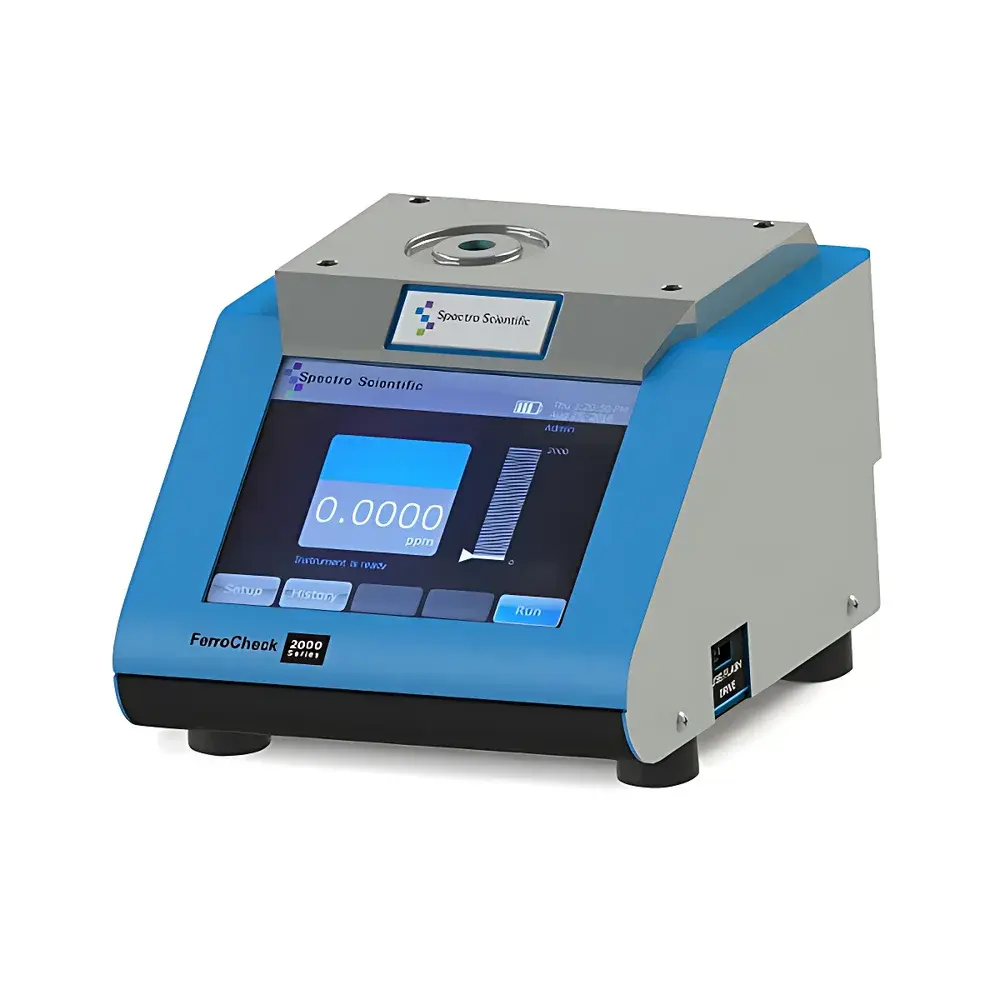
Spectro Scientific FerroCheck 2000 Portable Ferrographic Particle Quantifier
| Brand | Spectro Scientific |
|---|---|
| Origin | USA |
| Manufacturer Type | Authorized Distributor |
| Origin Category | Imported |
| Model | FerroCheck 2000 |
| Price | Upon Request |
| Operating Temperature | 10–40 °C |
| Storage Temperature | −30–85 °C |
| Relative Humidity | 10–90% RH (non-condensing) |
| Weight | >3 kg |
| Dimensions | 17 cm × 20 cm × 13 cm |
| Shock & Vibration Certification | MIL-STD-810G |
| Electrical Safety | FCC Class B, CE |
| Environmental Rating | NEMA 3R, IP34 |
| Sample Type | In-service lubricating oils and hydraulic fluids |
| Measurement Principle | Magnetic susceptibility-based ferrous particle quantification |
| Response Time | ≤30 seconds per sample |
| Detectable Ferrous Particle Size Range | ~1 µm to >1 mm |
Overview
The Spectro Scientific FerroCheck 2000 is a field-deployable, quantitative ferrographic particle analyzer engineered for rapid, on-site assessment of ferromagnetic wear debris concentration in in-service lubricants and hydraulic fluids. Unlike optical emission spectroscopy (OES) or inductively coupled plasma (ICP) techniques—which rely on atomized elemental analysis and exhibit diminished sensitivity for particles exceeding 3–8 µm—the FerroCheck 2000 directly measures the collective magnetic susceptibility of ferrous particles across a broad size spectrum (from sub-micron aggregates to millimeter-scale fragments). This capability makes it uniquely suited for early-stage wear detection in high-load components such as gearboxes, journal bearings, and hydraulic pumps, where initial fatigue wear often generates coarse (>10 µm), magnetically active debris that escapes conventional spectrometric detection.
Key Features
- Real-time ferrous mass quantification: Delivers repeatable, linear response to total ferromagnetic particle load—reported in relative units calibrated against traceable iron oxide standards.
- No sample preparation required: Accepts neat oil samples directly from drain ports or sampling valves; eliminates need for dilution, filtration, solvent extraction, or centrifugation.
- Ruggedized field architecture: Complies with MIL-STD-810G for shock, vibration, and thermal cycling; sealed enclosure meets NEMA 3R and IP34 specifications for dust resistance and limited water ingress protection.
- Regulatory-ready design: Certified to FCC Class B and CE directives for electromagnetic compatibility and safety; supports GLP/GMP-aligned documentation workflows via timestamped digital output.
- Operational flexibility: Functions reliably across ambient temperatures from 10 °C to 40 °C and relative humidity up to 90% non-condensing—enabling use in hangars, turbine halls, offshore platforms, and mobile maintenance vans.
Sample Compatibility & Compliance
The FerroCheck 2000 is validated for use with mineral-based, synthetic, and semi-synthetic lubricants—including turbine oils, gear oils, engine oils, and phosphate-ester and polyalphaolefin (PAO)-based hydraulic fluids. It is insensitive to non-ferromagnetic contaminants (e.g., copper, aluminum, silicon) and unaffected by base oil chemistry, additive package composition, or oxidation state. While not a replacement for elemental spectroscopy or analytical ferrography, its data complements ASTM D5185 (multi-element oil analysis), ISO 4406 (particle count), and ISO 11500 (ferrous density measurement) protocols. The instrument’s output supports trending per SAE ARP5583 and aligns with predictive maintenance frameworks referenced in ISO 17359 and ISO 20816-3.
Software & Data Management
Data acquisition and reporting are managed through the integrated LCD interface with onboard memory for ≥500 test records. Each entry includes date/time stamp, operator ID (user-defined), sample ID, and raw signal amplitude. Optional USB export enables direct integration into CMMS (Computerized Maintenance Management Systems) or enterprise LIMS platforms. Audit trails meet FDA 21 CFR Part 11 requirements when used with validated third-party software extensions—supporting electronic signatures, user access controls, and immutable record retention for regulated environments including power generation, aerospace, and marine propulsion sectors.
Applications
- Early detection of abnormal wear in wind turbine gearboxes prior to catastrophic pitting or spalling.
- Routine monitoring of diesel engine crankcase oils to differentiate between normal piston ring wear and incipient bearing failure.
- Condition-based triage of hydraulic systems in mining equipment—identifying abrasive wear modes associated with contaminated fluid ingress.
- Verification of filter efficiency during commissioning or after element replacement in critical lube systems.
- Field validation of laboratory ferrography results, reducing turnaround time for root-cause analysis in remote or time-sensitive operations.
FAQ
Does the FerroCheck 2000 quantify individual particle sizes or only total ferrous mass?
It reports total magnetic particle load as a single integrated value—not size distribution. For morphological analysis, coupling with analytical ferrography (e.g., using Spectro’s MiniLab series) is recommended.
Can it be used with highly viscous oils, such as ISO VG 680 gear oils?
Yes—flow dynamics are optimized for kinematic viscosities up to 1000 cSt at 40 °C; pre-warming viscous samples to ≥30 °C ensures consistent laminar flow through the sensing zone.
Is calibration traceable to national standards?
Calibration is performed using NIST-traceable iron oxide suspensions; annual verification kits and certified reference materials (CRM-FERRO-2000) are available through Spectro authorized service centers.
How does it handle air bubbles or water contamination in the sample?
Air entrainment must be minimized via gentle de-gassing prior to loading; free water (>0.1% v/v) may attenuate signal amplitude and should be removed via centrifugation or coalescing prior to analysis.
What maintenance is required beyond routine cleaning of the sample path?
No consumables or scheduled recalibration are needed; periodic verification using control oil (provided with each unit) is recommended before each shift or after transport-induced shock events.



