
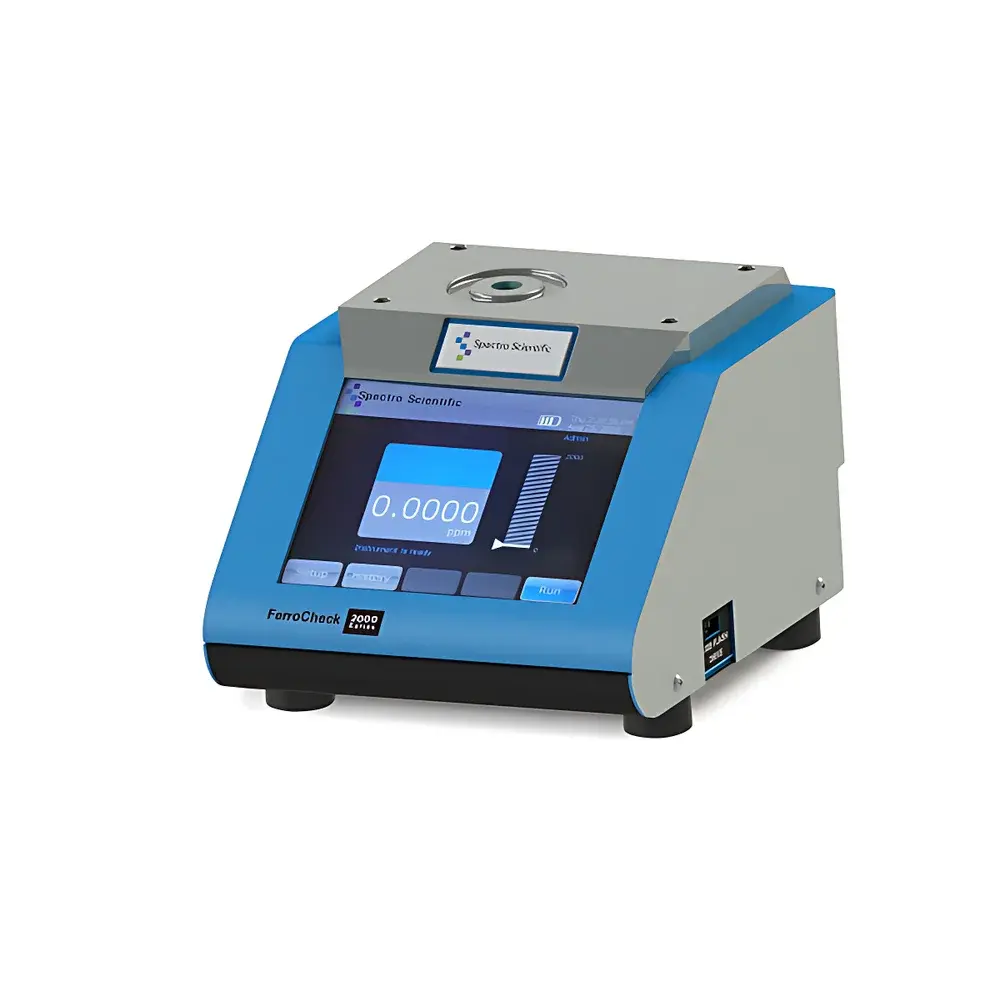
Spectro Scientific FerroCheck 2000 Portable Ferrography Analyzer
| Brand | Spectro Scientific |
|---|---|
| Origin | USA |
| Model | FerroCheck 2000 |
| Type | Portable Instrument |
| Compliance | ASTM D8120 |
| Detection Principle | Magnetic Susceptibility-Based Impedance Measurement |
| Sample Volume | 1.5 mL (oil), 0.75 mL (grease) |
| Analysis Time | ≤30 s |
| Detection Limit | <3 ppm Fe |
| Repeatability | ±2% RSD |
| Power | Rechargeable Li-ion battery (4 h runtime) |
| Data Output | CSV, AMS OilView-compatible |
| Calibration | Pre-loaded with certified calibration standards |
| Temperature Compensation | Automatic real-time coil current balancing |
Overview
The Spectro Scientific FerroCheck 2000 Portable Ferrography Analyzer is an engineered solution for rapid, field-deployable quantification of ferromagnetic wear debris concentration in lubricating oils and greases. Operating on the principle of magnetic susceptibility–induced impedance shift, the instrument employs a precision-wound detection coil that generates a stable, controlled magnetic field. When a representative sample is introduced into the optimized sample tube—positioned concentrically within the coil—ferromagnetic particles (primarily elemental iron, nickel, and cobalt) perturb the magnetic flux, resulting in a measurable change in coil impedance. This impedance delta is linearly proportional to the total volumetric concentration of ferromagnetic material in the sample. Unlike optical or spectroscopic methods, FerroCheck 2000 does not require spectral deconvolution or particle sizing; instead, it delivers a direct, calibrated reading of ferromagnetic mass concentration (ppm Fe-equivalent), with sensitivity down to sub-3 ppm and repeatability under ±2% RSD. Its design prioritizes operational robustness in non-laboratory environments—fully independent of external power grids, solvent handling, or sample dilution—making it suitable for routine condition monitoring aboard marine vessels, wind turbine nacelles, remote compressor stations, and mobile maintenance fleets.
Key Features
- Quantitative measurement of total ferromagnetic debris concentration (ppm Fe-equivalent) in under 30 seconds per sample
- Minimal sample requirement: 1.5 mL for liquid lubricants; 0.75 mL for greases—no filtration, centrifugation, or solvent extraction required
- Integrated real-time temperature compensation via auto-balanced coil current control, eliminating drift from ambient thermal fluctuations
- Rechargeable lithium-ion battery supporting up to 4 hours of continuous operation; AC adapter included for benchtop or vehicle-mounted use
- Pre-calibrated with NIST-traceable reference standards; full calibration verification performed automatically during startup
- Lightweight (≤1.8 kg) and ruggedized housing with IP54-rated enclosure; supplied with custom-fit transit case for shock- and dust-resistant transport
- Onboard memory stores >1,000 test records with timestamp, operator ID, and sample ID; exportable via USB as CSV or native AMS OilView format
Sample Compatibility & Compliance
The FerroCheck 2000 is validated for use with mineral-based, synthetic, and bio-based lubricating oils—including hydraulic fluids, turbine oils, gear oils, engine oils, and compressor lubricants—as well as NLGI #0 to #3 greases. It accommodates samples with viscosities up to 1000 cSt at 40 °C without dilution or heating. The analyzer conforms fully to ASTM D8120, “Standard Test Method for Determination of Ferromagnetic Wear Debris Concentration in Lubricants Using a Portable Ferrography Analyzer,” and supports compliance with ISO 4406 (contamination code reporting), SAE ARP5983 (oil analysis program guidelines), and MIL-STD-2104G (naval machinery lubricant specifications). All firmware and data logging routines are structured to support GLP/GMP audit trails, including user authentication, electronic signature fields, and immutable timestamping—enabling traceability in regulated industrial maintenance programs.
Software & Data Management
Data acquisition and reporting are managed through the embedded firmware interface and the optional Spectro AMS OilView desktop software suite. Each measurement captures raw impedance delta, compensated signal amplitude, ambient temperature, battery voltage, and operator-assigned metadata (equipment ID, sampling point, date/time). Exported CSV files contain column headers compliant with LIMS ingestion protocols (e.g., “Sample_ID”, “Fe_ppm”, “Test_Date”, “Operator”, “Instrument_Serial”). AMS OilView enables trend charting across multiple assets, statistical process control (SPC) limit setting, automated alert generation upon threshold exceedance, and integration with CMMS platforms via ODBC or REST API. Audit logs record all configuration changes, calibration events, and user logins—meeting requirements for FDA 21 CFR Part 11–compliant environments where electronic records must be attributable, legible, contemporaneous, original, and accurate (ALCOA+ principles).
Applications
The FerroCheck 2000 serves as a frontline diagnostic tool in predictive maintenance programs across energy, transportation, and manufacturing sectors. It is routinely deployed for early detection of abnormal wear modes—including gear tooth spalling, bearing cage fracture, piston ring scuffing, and journal bearing fatigue—by identifying sudden increases in large-particle ferromagnetic debris (>5 µm equivalent). In wind energy, it supports gearbox health assessment during scheduled turbine climbs. In rail and marine applications, it enables same-shift decision-making on oil drain intervals or component inspection scheduling. Within refinery rotating equipment reliability programs, it complements elemental spectroscopy (ICP-OES) by detecting ferrous wear that may otherwise be masked by high base oil iron content or diluted below ICP detection limits. Its portability and speed make it especially valuable for tier-1 oil analysis service providers conducting multi-site surveys under tight SLAs.
FAQ
Does FerroCheck 2000 differentiate between particle size distributions?
No—it reports total ferromagnetic mass concentration only. Particle morphology and size distribution require laboratory ferrography (ASTM D5185) or scanning electron microscopy.
Can it measure non-ferrous wear metals such as copper, aluminum, or chromium?
No. FerroCheck 2000 is specifically optimized for ferromagnetic elements (Fe, Ni, Co). Non-ferrous metals require ICP-OES or XRF analysis.
Is recalibration required after each measurement?
No. The instrument performs automatic zero-reference compensation before every test using its internal reference coil and maintains calibration stability for ≥12 months under normal operating conditions.
What is the shelf life of the calibration standard oil?
Certified calibration standards are supplied with a 24-month expiration date from manufacture when stored unopened at 15–25 °C, away from magnetic fields and direct sunlight.
How does ambient humidity affect measurement accuracy?
Humidity has no measurable impact—the detection coil is hermetically sealed, and sample tubes are designed to prevent condensation ingress during typical field conditions (up to 95% RH, non-condensing).






