
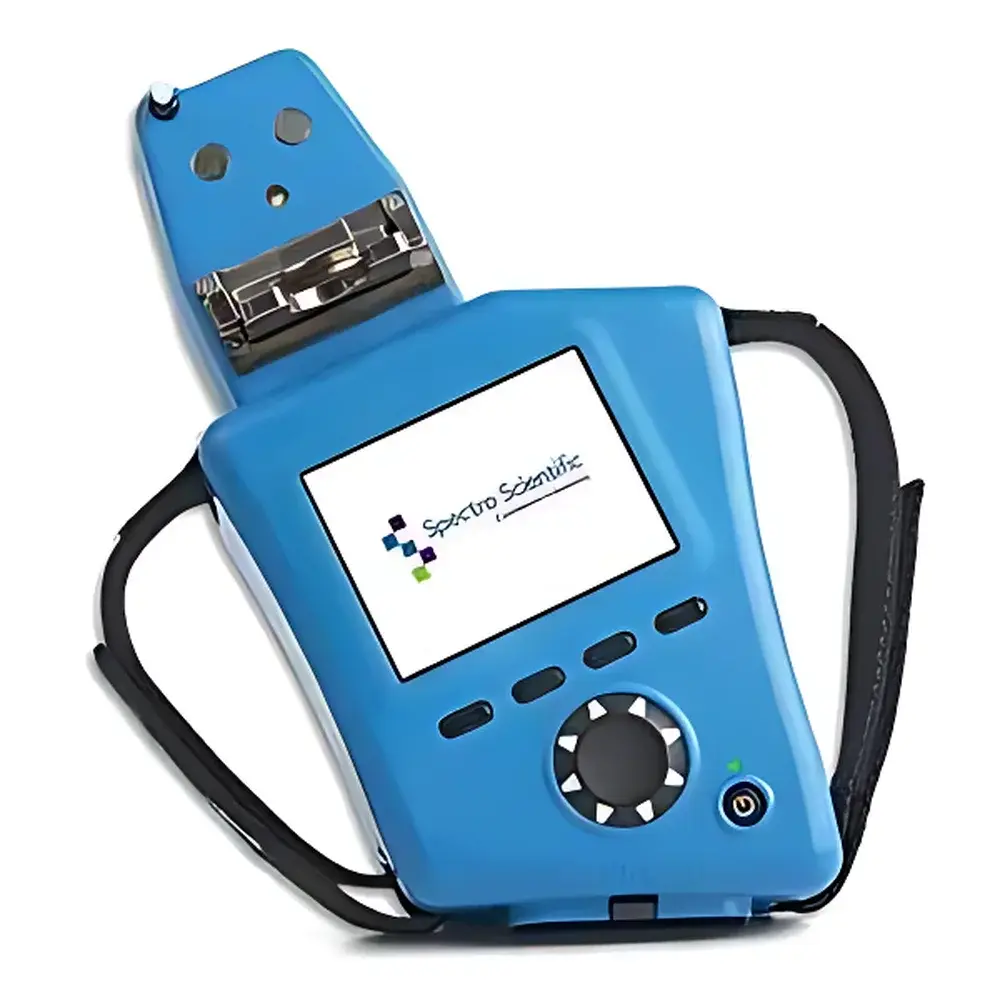
Spectro Scientific FluidScan 1000 Portable Oil Condition Analyzer
| Brand | Spectro Scientific |
|---|---|
| Origin | USA |
| Model | FluidScan 1000 |
| Instrument Type | Portable Infrared Spectrometer |
| Compliance | ASTM D7889, ASTM E2412, ASTM E1655 |
| Detection Targets | Water, TAN (Total Acid Number), TBN (Total Base Number), Oxidation, Nitration, Sulfation, Glycol, Soot, Additive Depletion, Contamination Index |
| Sample Volume | 1 drop (~50 µL) |
| Analysis Time | < 60 seconds per sample |
| Calibration Database | > 850 reference oils |
| Lubricant Compatibility | Mineral & synthetic engine oils, gear oils, turbine oils, hydraulic fluids, transmission fluids, greases, biodiesel, and fuel blends |
| Cleaning Method | Solvent-free |
| Measurement Principle | Attenuated Total Reflectance Fourier Transform Infrared (ATR-FTIR) Spectroscopy |
Overview
The Spectro Scientific FluidScan 1000 is a field-deployable, ATR-FTIR-based oil condition analyzer engineered for quantitative, real-time assessment of in-service lubricants. Unlike qualitative screening tools, the FluidScan 1000 delivers trace-level quantification of critical chemical degradation markers—including oxidation, nitration, sulfation, and additive depletion—as well as contamination species such as water, glycol, and soot. Its core measurement principle relies on attenuated total reflectance (ATR) infrared spectroscopy, eliminating the need for solvent dilution or complex sample preparation. This enables direct, reproducible analysis of undiluted used oils with minimal operator training. Designed specifically for predictive maintenance programs in industrial, power generation, marine, and transportation sectors, the instrument supports condition-based oil change decisions—reducing unnecessary oil waste while preventing equipment failure due to degraded or contaminated lubricants. It is fully compliant with ASTM D7889 (“Standard Test Method for Field Determination of Physical and Chemical Properties of Used Lubricating Oils Using Infrared Spectroscopy”), ensuring field results are directly comparable to laboratory-grade FTIR data.
Key Features
- Single-drop analysis (≈50 µL) with no solvent required—eliminates hazardous waste and reduces consumable costs
- Quantitative ATR-FTIR measurement validated against ASTM E2412 (standard practice for FTIR analysis of used lubricants) and ASTM E1655 (standard for infrared multivariate quantitative analysis)
- Preloaded spectral library of >850 reference oils covering mineral and synthetic formulations for engines, gearboxes, turbines, hydraulics, transmissions, greases, and biofuels
- User-configurable alarm thresholds with color-coded pass/fail indicators (green/yellow/red) for rapid go/no-go decisions in the field
- Integrated performance index algorithm that synthesizes multiple chemical parameters into a single, normalized Oil Health Index (OHI) score
- Patented total water detection method—differentiates free, emulsified, and dissolved water without Karl Fischer titration
- Ruggedized IP54-rated enclosure with lithium-ion battery supporting >8 hours of continuous operation in ambient temperatures from –10 °C to 50 °C
Sample Compatibility & Compliance
The FluidScan 1000 accommodates a broad spectrum of lubricant types and viscosities—from low-viscosity turbine oils (ISO VG 32) to high-viscosity gear oils (ISO VG 680) and semi-solid greases. It has been validated for use with conventional and advanced synthetic base stocks (PAO, ester, PAG), as well as bio-based lubricants and blended fuels. All quantitative calibrations adhere to ASTM D7889 protocols for field-use IR spectrometers, including rigorous linearity, precision (repeatability ≤ ±0.05 mg KOH/g for TAN/TBN), and interference testing. The instrument meets GLP-aligned data integrity requirements: each analysis record includes timestamp, operator ID, instrument serial number, calibration version, and full spectral metadata—supporting audit readiness under ISO/IEC 17025 and FDA 21 CFR Part 11 when paired with Spectro’s optional secure software suite.
Software & Data Management
Data acquisition and reporting are managed via Spectro’s proprietary Fluid Manager™ desktop software (Windows-compatible), which provides traceable workflow control, customizable report templates (PDF/CSV), and trend analytics across fleets or asset groups. The software enforces electronic signature workflows, automatic backup to network drives or cloud storage (AWS S3-compatible), and full audit trail logging per ASTM E2412 Annex A1. Raw interferograms and processed spectra are stored in open-format .spc files, enabling third-party chemometric analysis. Firmware updates and spectral library expansions are delivered through secure over-the-air (OTA) channels, ensuring ongoing alignment with evolving OEM specifications and industry standards.
Applications
- On-site verification of new oil quality prior to commissioning (e.g., verifying base stock identity, additive package integrity, and absence of moisture or glycol)
- Rotating equipment monitoring: early detection of oxidation onset in turbine oils, TBN depletion in diesel engine crankcases, and glycol intrusion in coolant-lubricant crossover scenarios
- Maintenance optimization for wind turbine gearboxes, marine propulsion systems, and mining haul trucks where oil sampling logistics are constrained
- Grease condition assessment—including water ingress quantification in bearing greases—using a dedicated grease interface module
- Fuel blending verification and biodiesel oxidation stability tracking in distributed energy applications
- Root-cause analysis during failure investigations by correlating spectral degradation patterns (e.g., nitration-to-oxidation ratio) with operational history
FAQ
Does the FluidScan 1000 require annual recalibration by the manufacturer?
No—its solid-state ATR crystal and laser-referenced interferometer ensure long-term wavelength stability. Users perform daily verification using the built-in reference standard; full calibration validation is recommended every 12 months or after 1,000 analyses, per ASTM D7889 Section 8.3.
Can it analyze oils with suspended wear metals?
Yes—the ATR geometry minimizes scattering effects from particulates. For heavily contaminated samples (>100 ppm ferrous debris), pre-filtration through a 5-µm membrane is advised to prevent crystal fouling.
Is the database updatable for new OEM-specific lubricants?
Yes—Spectro offers custom calibration development services, and users may import validated spectral models via Fluid Manager™ following ASTM E1655 guidelines.
How does its water measurement compare to Karl Fischer titration?
Independent interlaboratory studies per ASTM D7889 Appendix X1 confirm correlation coefficients >0.99 for total water across 10–1,000 ppm range, with bias < ±5% relative to coulometric KF methods.
What environmental certifications does the device hold?
It complies with IEC 61326-1 (EMC for industrial environments), RoHS 2011/65/EU, and carries CE marking for electromagnetic compatibility and safety.






