
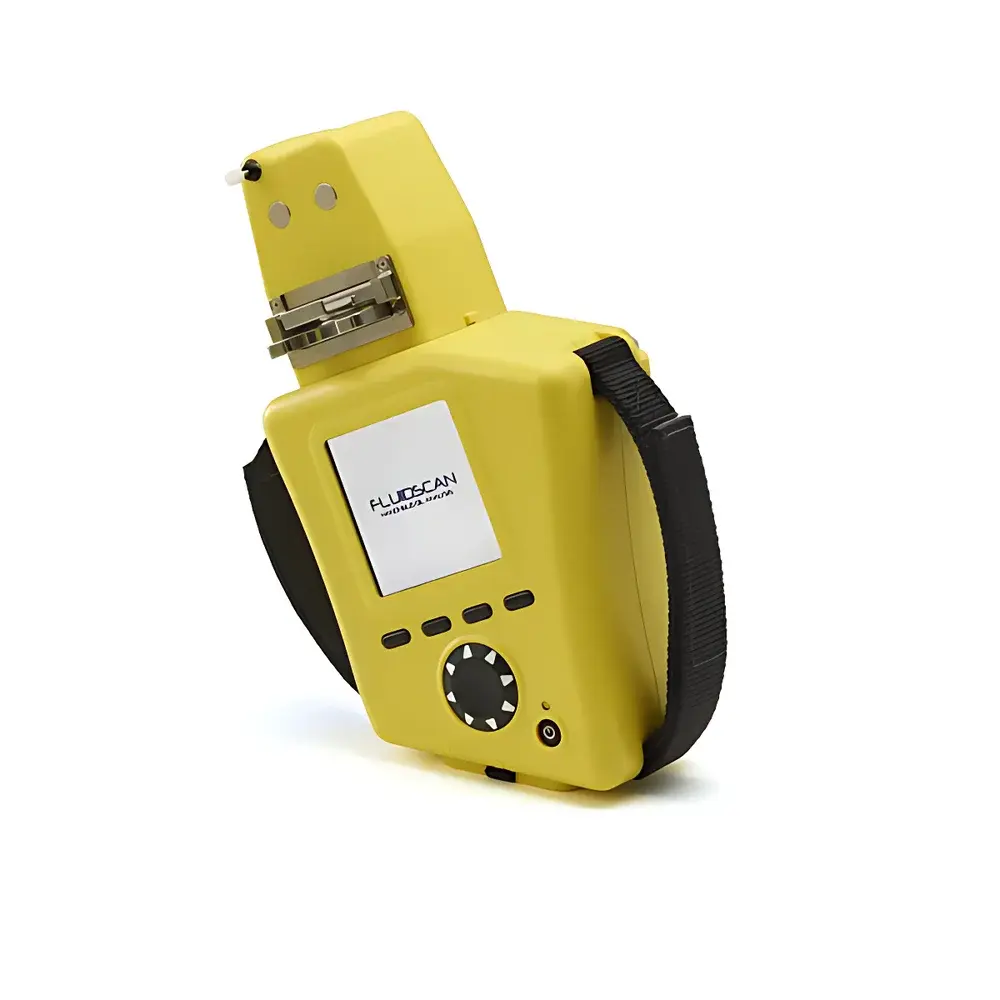
Spectro Scientific FluidScan 1000 Portable Oil Condition Analyzer
| Brand | Spectro Scientific |
|---|---|
| Origin | USA |
| Model | FluidScan 1000 |
| Product Type | Portable Instrument |
| Detection Principle | Direct Reading Infrared (DIR) Spectroscopy |
| Compliance | ASTM D7889, ASTM E2412, ASTM D4739, ASTM D664, ASTM E1655 |
| Key Parameters | TAN (mg KOH/g), TBN (mg KOH/g), Oxidation (Abs/0.1 mm), Nitration (Abs/mm²), Sulfation (Abs/mm²), Water (ppm), Glycol (%), Soot (%), FAME (%), Residual Carbon, Additive Depletion, Fuel Dilution, Oil Mismatch Index, FFA (%), Total Glycerin, Antioxidant Content (%) |
| Sample Volume | 1–2 drops |
| Measurement Time | ~60 seconds |
| Power | Rechargeable Li-ion battery (≥6 h operation) |
| Dimensions | 240 × 140 × 70 mm |
| Weight | 1.4 kg |
| Software | FluidScan Manager (PC-based, with trend analysis, asset management, automated reporting, audit trail, and data synchronization) |
Overview
The Spectro Scientific FluidScan 1000 Portable Oil Condition Analyzer is an engineered field-deployable instrument designed for real-time, laboratory-grade condition monitoring of lubricants and fuels across industrial, aviation, marine, and power generation applications. It employs patented Direct Reading Infrared (DIR) spectroscopy — a robust, non-dispersive optical technique that isolates and quantifies molecular absorption signatures in the mid-infrared region (specifically optimized for used oil analysis between 1700–1200 cm⁻¹ and 800–600 cm⁻¹). Unlike conventional FTIR systems requiring spectral preprocessing or external calibration, the FluidScan 1000 integrates fixed-wavelength optical waveguide architecture with embedded reference compensation, enabling direct quantification without solvent dilution, sample preparation, or operator interpretation. Its measurement physics aligns with ASTM D7889 — the standard test method for field-based infrared analysis of in-service oils — ensuring regulatory acceptability for predictive maintenance programs operating under ISO 55000 or API RP 5CM frameworks.
Key Features
- Patented DIR spectroscopy platform delivering quantitative results traceable to ASTM D4739 (TAN), D664 (TBN), and E2412 (FTIR repeatability)
- Fixed-band optical path with integrated background subtraction and self-diagnostic cell cleanliness verification
- Flip-top micro-cell design requiring only 1–2 drops (≤50 µL) of undiluted oil per analysis
- No solvents, no consumables, no purge gases — fully compliant with OSHA and EPA field-sampling guidelines
- Onboard rechargeable lithium-ion battery supporting ≥6 hours of continuous operation in ambient temperatures from –10 °C to 50 °C
- High-contrast graphical display with intuitive Chinese and English language interface (configurable at setup)
- Real-time color-coded status indicators (green/yellow/red) aligned with OEM-defined alarm thresholds
- Embedded spectral library containing calibrated models for over 500 commercial lubricants and fuels
Sample Compatibility & Compliance
The FluidScan 1000 supports quantitative analysis across diverse fluid classes including mineral and synthetic turbine oils, hydraulic fluids (including phosphate ester and Skydrol®), engine oils (gasoline, diesel, natural gas, HFO), gear oils, heat transfer fluids, biofuels (B100–B20), aviation lubricants (MIL-PRF-23699, MIL-PRF-2304), and coolant-contaminated samples. All calibrations are developed and validated per ASTM E1655 guidelines for multivariate calibration modeling and are subject to GLP-aligned documentation protocols. The instrument meets electromagnetic compatibility requirements per IEC 61326-1 and carries CE marking for portable instrumentation. Data integrity complies with FDA 21 CFR Part 11 principles via FluidScan Manager’s electronic signature, audit trail, and secure user authentication layers.
Software & Data Management
FluidScan Manager is a Windows-based desktop application providing full lifecycle oil analysis management. It synchronizes measurement records automatically via USB or Bluetooth, enforces version-controlled calibration updates, and supports hierarchical asset tagging (equipment ID, location, sampling point). Trend analysis employs statistically weighted moving averages and slope-based degradation rate estimation per ISO 4406 and ASTM D7889 Annex A2. Reporting modules generate PDF/CSV outputs compliant with ISO 17025 documentation standards, including uncertainty statements derived from instrument precision studies (RSD ≤ 3.2% for TAN, ≤ 4.1% for oxidation). Backups are encrypted and timestamped; database schema supports SQL Server integration for enterprise CMMS or EAM system interoperability (e.g., SAP PM, IBM Maximo).
Applications
- Condition-based maintenance of critical rotating equipment (turbines, compressors, gearboxes) in power plants and CCGT facilities
- On-wing oil verification for commercial and military aircraft hydraulic and engine systems
- Marine engine oil trending aboard vessels operating under IMO MARPOL Annex VI sulfur cap compliance
- Renewable fuel quality assurance in biodiesel production and blending terminals
- Preventive diagnostics of hydraulic contamination in mobile off-highway machinery (mining, construction)
- Field validation of lubricant replenishment intervals per OEM service bulletins (e.g., Caterpillar SOS, Siemens SIS)
- Root cause analysis of premature bearing failure linked to oxidation-induced varnish formation
FAQ
Does the FluidScan 1000 require annual recalibration?
No — its optical architecture is drift-compensated via internal reference channels and does not require scheduled recalibration. However, users must perform daily verification using the supplied control oil standard per ASTM D7889 Section 8.3.
Can it distinguish between water emulsified versus free water in oil?
The instrument reports total water content (ppm) via O–H stretch band integration at ~3400 cm⁻¹ but does not differentiate physical states. For phase-specific quantification, complementary Karl Fischer titration remains necessary.
Is the spectral library updatable by end users?
Yes — authorized users may import new reference spectra and build custom calibrations using FluidScan Manager’s Advanced Modeling Module, subject to validation per ASTM E1655 Section 7.
What is the minimum detectable TAN value?
The lower limit of quantitation (LLOQ) is 0.15 mg KOH/g with a signal-to-noise ratio ≥10:1, verified against NIST-traceable reference materials.
How is data security handled during wireless transmission?
Bluetooth communication uses AES-128 encryption; all local database files are encrypted at rest using Windows BitLocker-compatible protocols.





