
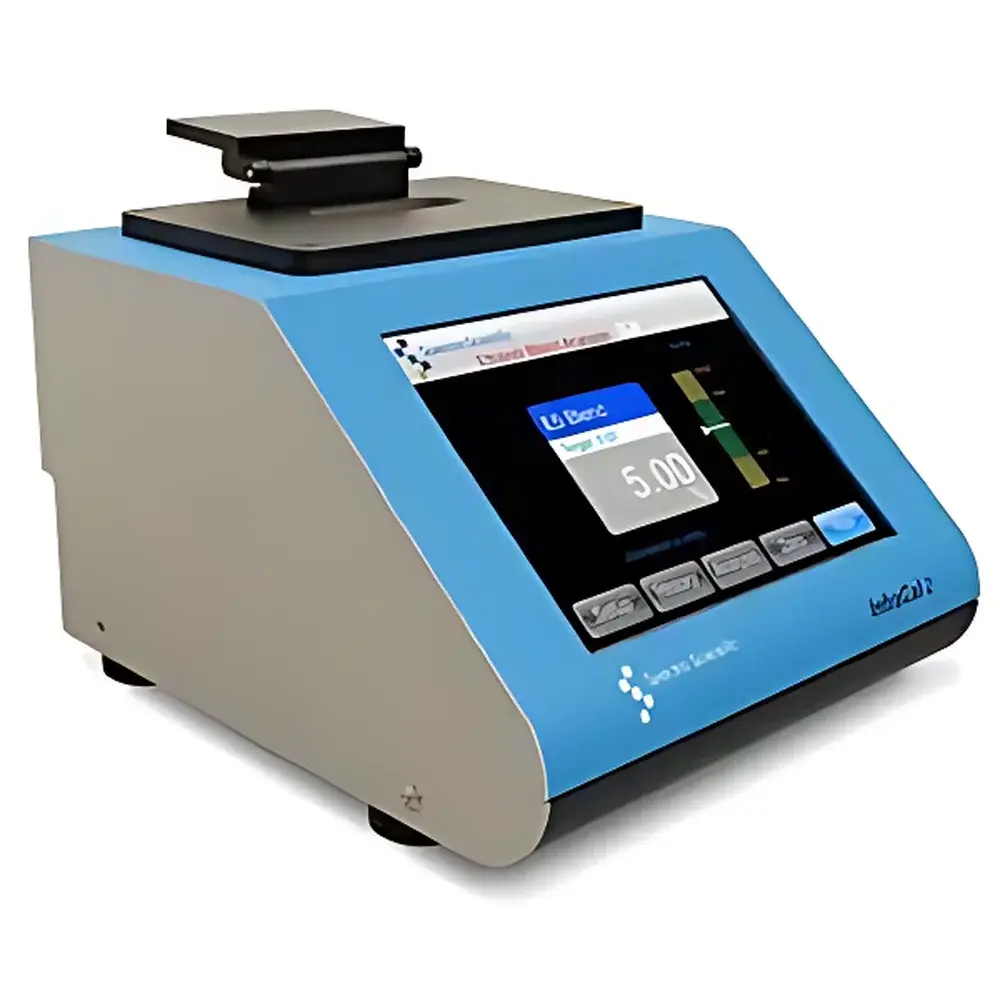
Spectro Scientific InfraCal 2 ATR-E Ethanol-in-Gasoline Analyzer
| Brand | Spectro Scientific |
|---|---|
| Origin | USA |
| Model | InfraCal 2 ATR-E |
| Portability | Portable |
| Compliance | ASTM D4815 |
| Detection Range | 0–20% and 70–98% ethanol in gasoline |
| Repeatability | ±0.2% (0–20%), ±1.0% (70–98%) |
| Analysis Time | <30 seconds |
| Wavelength | 9.6 µm (1045 cm⁻¹) |
| Power | 18 V DC, 3.3 A |
| Battery Life | >12 hours (rechargeable Li-ion) |
| Weight | 2.6 kg (net), 3.2 kg (with battery) |
| Dimensions | 17 × 19.8 × 13.2 cm |
| Operating Temperature | 5–40 °C |
| Interface | USB, RS-232 |
| Data Storage | Internal, password-protected |
| Display | Touchscreen LCD |
| Language Support | English, Spanish, French, Arabic |
Overview
The Spectro Scientific InfraCal 2 ATR-E Ethanol-in-Gasoline Analyzer is a field-deployable, mid-infrared (MIR) spectrophotometer engineered for rapid, quantitative determination of ethanol concentration in gasoline blends. It operates on the principle of Attenuated Total Reflectance (ATR) Fourier-transform infrared (FTIR)-compatible spectroscopy at a fixed wavelength of 9.6 µm (1045 cm⁻¹), where ethanol exhibits strong, distinct C–O and O–H vibrational absorption bands. This targeted spectral region enables highly selective detection without interference from hydrocarbon matrix components—eliminating the need for sample dilution, solvent extraction, or chromatographic separation. Designed for regulatory compliance and operational robustness, the instrument delivers ASTM D4815–conformant results in under 30 seconds per measurement. Its compact form factor (17 × 19.8 × 13.2 cm), integrated rechargeable lithium-ion battery (>12 h runtime), and ruggedized enclosure support continuous use across diverse environments—including fuel terminals, refinery loading racks, retail service stations, and mobile quality assurance units.
Key Features
- ATR-based optical architecture: Eliminates solvent consumption, waste generation, and cleaning solvents; sample residue removed with lint-free tissue only.
- Field-ready portability: Net weight of 2.6 kg; operates independently of AC mains via internal battery or external 18 V DC supply.
- Regulatory-grade accuracy: Certified repeatability of ±0.2% v/v for low-range (0–20%) and ±1.0% v/v for high-range (70–98%) ethanol concentrations—fully aligned with ASTM D4815 performance criteria.
- Intuitive human interface: Full-color touchscreen display with multi-language support (English, Spanish, French, Arabic); on-device calibration management and user-level password protection.
- Traceable data governance: Internal non-volatile memory stores timestamped results with operator ID, location tag, and measurement metadata; exportable via USB or RS-232 to LIMS or QA databases.
- Minimal maintenance footprint: No consumables beyond certified calibration standards; no optical alignment, lamp replacement, or fluidic servicing required over typical service intervals.
Sample Compatibility & Compliance
The InfraCal 2 ATR-E is validated exclusively for ethanol quantification in finished gasoline and E85/E100 fuel blends. It accommodates neat gasoline samples as received—no pre-filtration or conditioning is necessary. The ATR crystal surface tolerates minor particulate presence and residual water droplets without signal degradation. All factory calibrations are traceable to NIST-traceable reference materials prepared by ISO/IEC 17025–accredited laboratories. The analyzer meets ASTM D4815 requirements for precision, linearity, and interference rejection. While not certified for GLP or 21 CFR Part 11 out-of-the-box, its audit-ready data logging—featuring immutable timestamps, user authentication, and exportable CSV/Excel-compatible files—supports integration into GMP-compliant fuel quality control workflows when paired with documented SOPs and change control procedures.
Software & Data Management
Onboard firmware supports up to two independent calibration curves—typically configured for low-range (0–20% ethanol) and high-range (70–98% ethanol) applications. Each curve may be loaded from USB or programmed directly via touchscreen using certified standard sets (e.g., 403-1026 for 0/5/10/15/20% v/v; 403-1027 for 70/80/90/95/100% v/v). All calibration parameters—including slope, intercept, and correlation coefficient—are viewable and editable only by authorized users with administrative credentials. Measurement data includes date/time stamp, operator ID, GPS coordinates (if externally enabled), and raw absorbance values. Export formats include plain-text CSV and Excel-compatible .xlsx. Firmware updates are delivered via USB and include version-controlled release notes compliant with IEC 62304 software lifecycle standards.
Applications
- Real-time verification of ethanol content at fuel blending terminals and rack loading facilities
- In-field compliance screening for EPA RFG, CARB, and EU EN 228 specifications
- Quality assurance testing during gasoline distribution and retail dispensing
- Forensic analysis of suspected adulterated or mislabeled fuel batches
- Process validation and troubleshooting in ethanol production and denaturing operations
- Training and demonstration use in petroleum technology education programs
FAQ
Does the InfraCal 2 ATR-E require routine optical recalibration?
No. The fixed-wavelength ATR design eliminates drift-prone broadband optics; only periodic verification against certified standards (e.g., quarterly or per ASTM D4815 Section 8.2) is recommended.
Can the instrument measure other oxygenates besides ethanol?
No. It is specifically optimized for ethanol quantification at 1045 cm⁻¹; methanol, ETBE, or MTBE produce overlapping but non-quantifiable absorbance and are outside its validated scope.
Is temperature compensation built into the measurement algorithm?
Yes. An integrated thermistor monitors sample/crystal interface temperature and applies real-time correction to maintain accuracy across the specified 5–40 °C operating range.
What is the expected lifetime of the ATR crystal?
The diamond-coated ZnSe ATR element is rated for ≥10,000 measurements under normal handling; abrasion resistance exceeds that of standard germanium or KRS-5 crystals.
Can historical data be retrieved after battery depletion?
Yes. All stored measurements reside in non-volatile flash memory and persist through full power loss or firmware reset.
Related Products






