
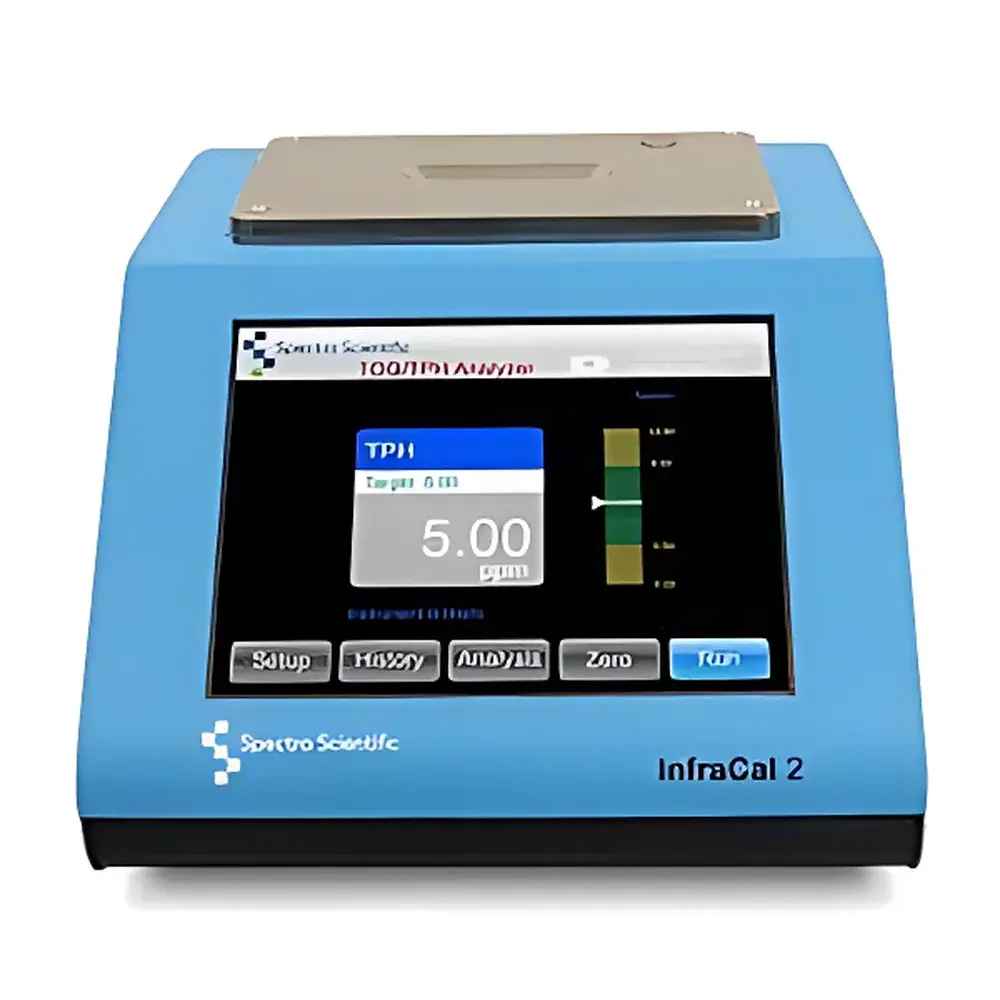
Spectro Scientific InfraCal 2 ATR-SP Oil-in-Water and Total Petroleum Hydrocarbons (TPH) Analyzer
| Brand | Spectro Scientific |
|---|---|
| Origin | USA |
| Model | InfraCal 2 ATR-SP |
| Detection Limit (Water) | 0.3 ppm |
| Detection Limit (Soil) | 3 ppm |
| Wavelength | 3.4 μm (2930 cm⁻¹) |
| Power | 18 V DC, 3.3 A |
| Weight | 2.6 kg (net), 3.2 kg (with Li-ion battery) |
| Dimensions | 17 cm × 19.8 cm × 13.2 cm |
| Operating Temperature | 5–40 °C |
| Analysis Time | 10–15 min (including extraction) |
| Repeatability | ±0.2 ppm |
| Communication Interface | USB |
| Compliance | EPA Method 1664, EPA Method 1164, ISO 9377-2 |
| Solvents | Hexane, Pentane, Cyclohexane, Vertrel MCA |
Overview
The Spectro Scientific InfraCal 2 ATR-SP is a field-deployable, Fourier-transform infrared (FTIR)-based analyzer engineered for rapid, quantitative determination of oil and grease (OG), total petroleum hydrocarbons (TPH), and fats, oils, and greases (FOG) in water and soil matrices. It employs horizontal attenuated total reflectance (HATR) spectroscopy with a chemically inert zirconium oxide (ZrO₂) crystal surface, enabling direct measurement of solvent extracts without sample dilution or flow-cell handling. The instrument operates at the fundamental C–H stretching absorption band centered at 2930 cm⁻¹ (3.4 µm), a wavelength region highly specific to aliphatic hydrocarbons present in petroleum-based and biogenic oils. Unlike gravimetric or UV-based methods, this mid-IR approach delivers high selectivity for hydrocarbon content while minimizing interferences from humic substances, surfactants, or suspended solids — a critical advantage in complex industrial and environmental samples. Its measurement principle aligns with EPA Method 1664 (for oil & grease) and EPA Method 1164 / ISO 9377-2 (for TPH), as all rely on solvent extraction followed by instrumental quantification of residual hydrocarbon mass.
Key Features
- Integrated ZrO₂ HATR crystal platform with stainless-steel sample stage for robust, contamination-resistant analysis of solvent extracts
- Touchscreen interface with multi-language support (English, Spanish, French, German, Chinese), user-accessible password protection, and audit-trail–capable configuration settings
- Onboard rechargeable lithium-ion battery providing >6 hours of continuous operation — ideal for remote field use, offshore platforms, and mobile laboratories
- Internal data storage for ≥1,000 test records, exportable via USB to external drives or laboratory information management systems (LIMS)
- Preloaded calibration options: single-curve (high-range petroleum), dual-curve (low- and high-range petroleum), or FOG-specific (soybean oil/cetane blend) configurations
- Compact footprint (17 × 19.8 × 13.2 cm) and lightweight design (3.2 kg with battery) compatible with standard field transport cases (e.g., accessory kit 403-0013)
Sample Compatibility & Compliance
The InfraCal 2 ATR-SP supports validated extraction protocols for aqueous and solid-phase samples using EPA- and ISO-compliant solvents — including n-hexane, pentane, cyclohexane, and Vertrel™ MCA. It accommodates both liquid-phase extracts (e.g., water samples extracted at 10:1 ratio) and slurry-phase extracts (e.g., soil samples extracted at 1:1 w/v). Detection ranges span 0.3–1000+ ppm in water and 3–5000+ ppm in soil, with demonstrated repeatability of ±0.2 ppm across repeated measurements under controlled conditions. The system meets regulatory requirements for method-defined performance criteria per EPA 1664 (recovery, precision, spike recovery), EPA 1164, and ISO 9377-2. While not inherently 21 CFR Part 11 compliant out-of-the-box, its data logging architecture supports integration with validated LIMS environments where electronic signature, audit trail, and data integrity controls are externally enforced.
Software & Data Management
Instrument firmware enables real-time spectral acquisition, baseline correction, and peak-area integration at 2930 cm⁻¹ using a fixed-bandwidth algorithm optimized for hydrocarbon quantification. Calibration curves are stored internally and selectable per analysis batch; each curve includes traceable reference points with documented uncertainty. All measurement metadata — including date/time stamp, operator ID (if entered), solvent lot, calibration ID, and raw absorbance values — are embedded in exported CSV files. USB connectivity allows direct transfer to Windows-based PCs for post-processing, report generation, or archival in GLP/GMP-aligned databases. Optional software modules support automated report formatting aligned with EPA Form 3320-1 or ISO 17025 technical records.
Applications
- Offshore produced water monitoring: Real-time verification of oil-in-water concentrations prior to discharge or reinjection, ensuring compliance with MARPOL Annex I and regional regulatory thresholds
- Municipal and industrial wastewater treatment: Rapid FOG screening at headworks or dissolved air flotation (DAF) units to prevent downstream lipid accumulation and biological process inhibition
- Environmental site assessment: Field quantification of TPH in soil cores during Phase II investigations, reducing turnaround time from weeks (lab-based GC-FID) to minutes
- Pipeline integrity testing: Detection of hydrocarbon leaks in containment sumps or secondary containment zones using grab samples from monitoring wells or surface swabs
- Refinery and petrochemical QA/QC: In-process verification of effluent polishing efficiency and stormwater runoff compliance
FAQ
What extraction solvents are validated for use with the InfraCal 2 ATR-SP?
n-Hexane, pentane, cyclohexane, and Vertrel™ MCA are fully supported and referenced in EPA 1664 and ISO 9377-2. Chlorinated solvents (e.g., Freon-113) are not recommended due to environmental and health restrictions.
Does the instrument require annual factory recalibration?
No. The ZrO₂ HATR crystal exhibits long-term optical stability. Users perform routine verification using certified reference standards (e.g., 403-1081, 403-1044, 403-1072); full recalibration is only necessary if physical damage occurs or after major firmware updates.
Can the InfraCal 2 ATR-SP distinguish between petroleum hydrocarbons and biogenic oils?
It does not speciate individual compounds. However, the FOG-specific calibration (405-2034-72) uses a soybean oil/cetane blend to improve accuracy for mixed waste streams containing both animal/vegetable oils and mineral oils — a capability essential for municipal wastewater applications.
Is method validation documentation available for regulatory submissions?
Yes. Spectro Scientific provides a comprehensive Method Validation Package (MVP) including precision/recovery studies, limit of detection (LOD) verification, and interlaboratory comparison data aligned with ISO/IEC 17025 requirements.
How is data integrity maintained during field use?
All measurements are timestamped and associated with operator ID. Exported files contain checksums and uneditable metadata. When integrated into a validated LIMS, full 21 CFR Part 11 compliance — including electronic signatures and audit trails — is achievable through system-level controls.





