
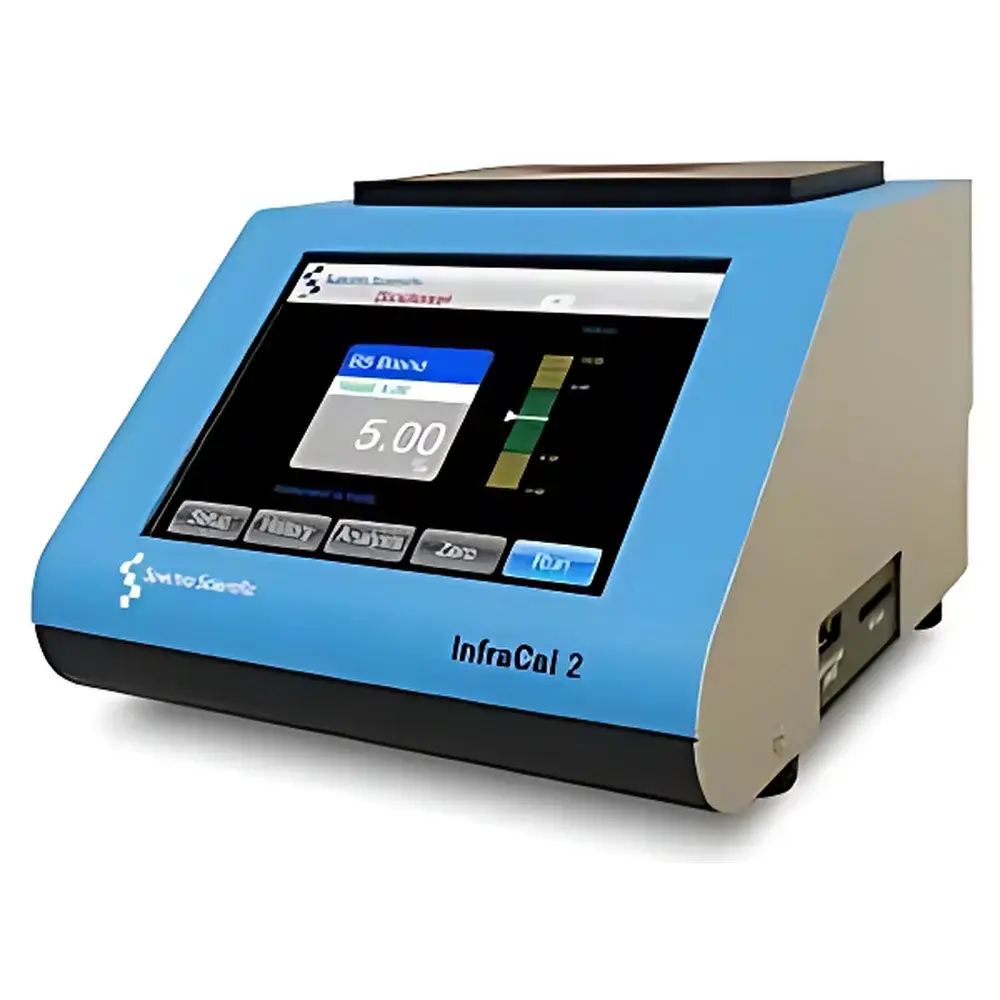
Spectro Scientific InfraCal 2 TOG/TPH Portable Infrared Oil-in-Water and Total Petroleum Hydrocarbons Analyzer
| Brand | Spectro Scientific |
|---|---|
| Origin | USA |
| Model | InfraCal 2 TOG/TPH |
| Instrument Type | Portable |
| Compliance | ASTM D7066, EPA Method 413.2 & 418.1, Equivalent to EPA 1664 & ISO 9377-2 |
| Measurement Principle | Fixed-Filter Infrared Absorption at 3.4 µm C–H Stretch Band |
| Detection Range | Sub-ppm to % w/w (oil-in-water, TPH in soil, FOG in wastewater) |
| Data Storage | Internal memory for ≥1,000 test records |
| Interface | USB 2.0 for data export |
| Calibration | Multi-point calibration curves with user-defined curve management |
| Security | Password-protected settings and calibration access |
| Environmental Rating | IP65-rated enclosure |
Overview
The Spectro Scientific InfraCal 2 TOG/TPH is a field-deployable, fixed-filter infrared analyzer engineered for rapid, quantitative determination of oil and grease (FOG), total petroleum hydrocarbons (TPH), and total oil and grease (TOG) in aqueous, solid, and semi-solid matrices. It operates on the fundamental principle of mid-infrared absorption spectroscopy—specifically targeting the aliphatic C–H stretching vibration band near 3.4 µm—a spectral region highly selective for hydrocarbon functional groups. Unlike dispersive or FTIR systems, the InfraCal 2 employs a robust, temperature-stabilized optical filter assembly with no moving parts, ensuring long-term wavelength fidelity and minimal drift under variable ambient conditions. Its design prioritizes analytical reliability in non-laboratory settings: from offshore drilling platforms and refinery outfalls to remediation sites and municipal wastewater treatment plants. The instrument delivers trace-level sensitivity (sub-ppm detection in water extracts) while maintaining full compliance with established regulatory frameworks—including ASTM D7066 for field-based oil-in-water analysis, U.S. EPA Methods 413.2 (gravimetric screening) and 418.1 (infrared quantification), and demonstrating method equivalency to the reference procedures EPA 1664 (n-hexane extraction) and ISO 9377-2 (hydrocarbon content in water by IR).
Key Features
- Field-optimized optical architecture: Fixed 3.4 µm bandpass filter with integrated reference channel for real-time baseline correction and enhanced signal stability
- Rapid analysis cycle: Complete sample preparation and measurement in under 15 minutes—no solvent evaporation, no chromatographic separation, no laboratory infrastructure required
- Multi-matrix capability: Validated protocols for water (oil-in-water), soil/sediment (TPH), wastewater (FOG), drill cuttings/mud (hydrocarbon loading), and solvent recovery streams
- Onboard data management: Internal flash memory stores ≥1,000 test records with timestamp, operator ID, calibration ID, and raw absorbance values
- Digital connectivity: USB 2.0 interface supports direct export of CSV-formatted reports compatible with LIMS and QA/QC audit workflows
- Configurable calibration framework: Up to 8 independent calibration curves per method; user-defined naming, slope/intercept validation, and version-controlled curve archiving
- Operational resilience: IP65-rated housing, shock-absorbing elastomer overmold, wide operating temperature range (–10 °C to 50 °C), and resistance to salt fog and hydrocarbon vapors
Sample Compatibility & Compliance
The InfraCal 2 accommodates samples prepared using standard EPA- and ASTM-aligned extraction techniques—including liquid–liquid extraction with n-hexane (EPA 1664), silica gel cleanup (for interference removal), and Soxhlet or ultrasonic extraction for soils (per EPA 3550C). It is validated for use with both unfiltered and filtered aqueous extracts, as well as solvent extracts of solids following gravimetric drying. Regulatory alignment extends beyond method citation: the instrument’s firmware enforces audit-trail logging of all calibration events, user logins, and result modifications—supporting GLP and GMP documentation requirements. While not inherently 21 CFR Part 11 compliant out-of-the-box, its secure password architecture, immutable record timestamps, and exportable raw data meet foundational criteria for regulated environmental testing programs subject to third-party QA review.
Software & Data Management
Data handling is managed through the embedded firmware interface—no external PC required for routine operation. Each measurement captures absorbance at the primary analytical wavelength and reference channel, computes concentration via selected calibration curve, and appends metadata (date/time, operator code, sample ID, curve ID, solvent batch if entered). USB export generates ISO 8601–formatted CSV files containing all fields required for laboratory information management system (LIMS) ingestion. Optional SpectroLink desktop software (Windows only) enables advanced curve development, statistical trend analysis across field campaigns, and generation of EPA-compliant chain-of-custody reports. All calibration parameters are digitally signed and tamper-evident upon export.
Applications
- Real-time monitoring of produced water discharge from offshore and onshore oil & gas operations
- Compliance verification of effluent limits at petroleum refineries, petrochemical plants, and metal finishing facilities
- FOG source tracking and pretreatment system performance evaluation in food service and municipal collection systems
- Oil/water separator efficiency audits and maintenance scheduling support
- In-situ assessment of hydrocarbon contamination in drill cuttings and mud systems during directional drilling
- Residual oil verification on machined or cleaned metallic components prior to plating or painting
- Purity grading of recovered solvents used in parts cleaning or degreasing lines
- Field screening of TPH in excavated soils during brownfield site characterization and remediation progress monitoring
FAQ
Does the InfraCal 2 require daily calibration?
No. The instrument uses a stable fixed-filter optical path and requires only periodic verification using certified reference standards—typically before each field deployment or at 8-hour intervals during continuous operation.
Can it measure emulsified oil in water?
Yes—provided the sample undergoes appropriate solvent extraction (e.g., n-hexane per EPA 1664) to liberate all extractable hydrocarbons, including stable emulsions and microdroplets.
Is method validation documentation available?
Spectro Scientific provides a comprehensive Validation Guide (PN: VG-INF2-01) including interlaboratory precision data, spike recovery studies across matrix types, and side-by-side comparisons versus GC-FID and gravimetric methods.
What sample volume is required for water analysis?
Standard protocol uses 10–100 mL of water sample, depending on expected concentration; lower volumes may be used with pre-concentration techniques.
How is instrument performance verified in the field?
Built-in diagnostic mode runs optical path integrity checks, detector linearity verification, and zero/reference stability tests—all logged with pass/fail status and timestamp.
Related Products







