
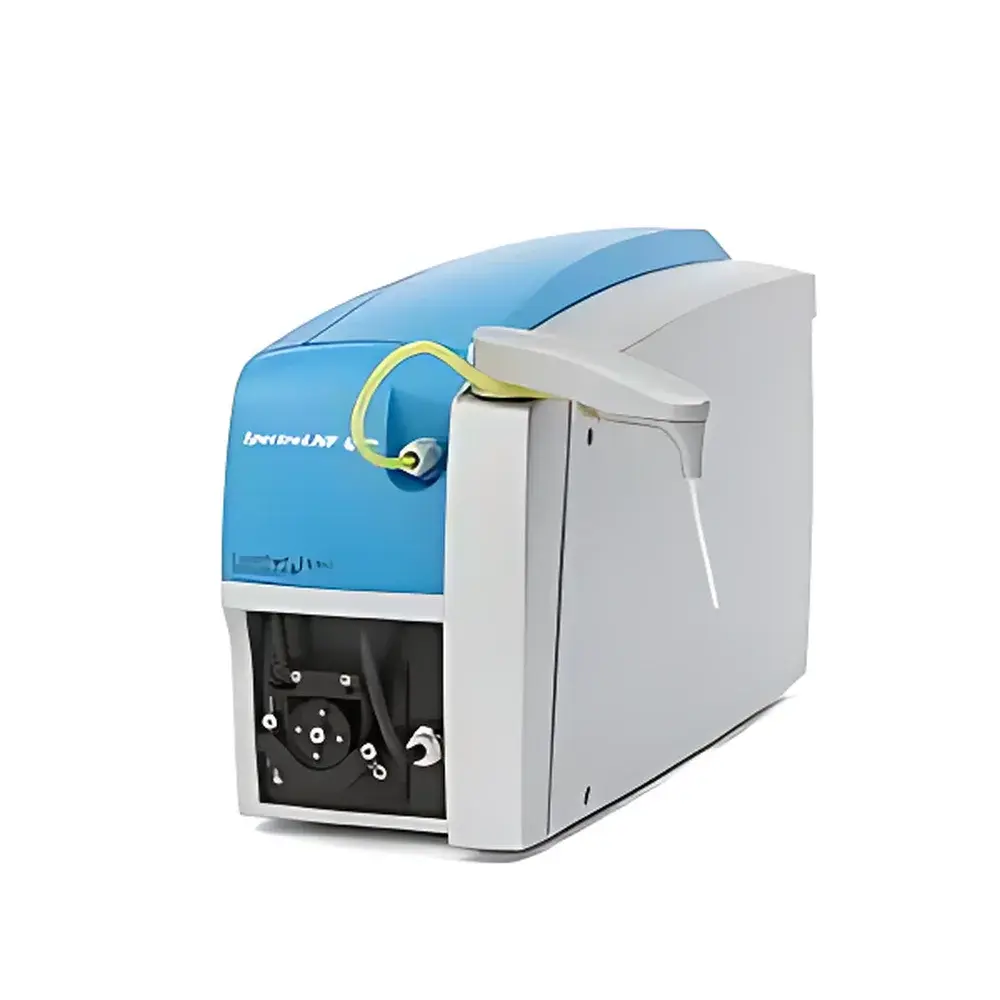
Spectro Scientific LaserNet 200 Series Portable Ferrography & Particle Analysis System
| Brand | Spectro Scientific |
|---|---|
| Origin | USA |
| Model | LaserNet 200 Series |
| Type | Portable Instrument |
| Detection Parameters | Particle Counting, Ferrous Particle Concentration & Count (>25 µm), Morphological Wear Debris Classification, Free Water (ppm), Bubble/Contaminant Discrimination |
| Standards Compliance | ASTM D7596, ISO 4406, NAS1638, SAE AS4059, ASTM D6786, ISO 11171 |
| Imaging Technology | Direct High-Resolution CCD Imaging with Laser Illumination |
| Particle Size Range | ≥2 µm (morphology-resolved), ≥20 µm (automated classification), ≥25 µm (ferrous count) |
| Max Sample Contamination Tolerance | 5,000,000 particles/mL |
| Max Soot Tolerance | 2% w/w |
| Auto-Gain Control (AGC) | Yes |
| Onboard Data Management | Asset Tracking, Trend Analysis, Custom Cleanliness Thresholds |
| Dimensions | 35.6 cm H × 36.8 cm W × 78.7 cm D |
| Weight | 8.5 kg |
Overview
The Spectro Scientific LaserNet 200 Series is a portable, laboratory-grade ferrographic particle analysis system engineered for real-time, in-field or on-site condition monitoring of lubricating oils and hydraulic fluids. It employs LaserNet Fines (LNF) technology — a patented direct-imaging methodology — to capture high-fidelity digital images of individual particles suspended in oil samples. Unlike traditional light-obscuration or resistive-pulse counters, LNF does not rely on optical extinction or electrical resistance; instead, it projects the geometric silhouette of each particle onto a high-resolution CCD sensor under controlled laser illumination. This enables deterministic measurement of particle area, equivalent circular diameter (per ISO 11171), aspect ratio, and morphological signature — critical parameters for wear mechanism identification. The system operates without sample dilution or filtration, maintaining integrity across extreme contamination conditions (up to 5 × 10⁶ particles/mL) and high soot loads (up to 2% w/w), making it uniquely suited for diesel engine oils, turbine fluids, gear oils, and aviation hydraulics.
Key Features
- True direct-imaging particle analysis with sub-micron resolution and ≥2 µm detection threshold
- Automated morphological classification of wear debris ≥20 µm using embedded artificial neural network (ANN) algorithms trained per ASTM D7596
- Simultaneous quantification of ferrous particle concentration (ppm) and ferrous count (≥25 µm) via integrated high-sensitivity magnetic field sensor
- Free water content estimation (ppm) and discrimination of bubbles, fibers, and non-metallic contaminants (e.g., silica, carbon, oxides)
- Real-time compliance reporting against ISO 4406, NAS1638, SAE AS4059, GOST 17216, NAVIR, and ASTM D6786 cleanliness standards
- User-definable cleanliness thresholds and alarm logic with historical trend tracking per asset ID
- Automatic gain control (AGC) compensates for variable oil opacity, eliminating manual calibration and enabling consistent performance across dark or degraded samples
- Compact footprint (35.6 × 36.8 × 78.7 cm), lightweight design (8.5 kg), and battery-ready architecture support mobile lab deployment and shop-floor integration
Sample Compatibility & Compliance
The LaserNet 200 Series is validated for use with mineral, synthetic, and bio-based lubricants, including engine oils (SAE 0W–60), turbine oils (ISO VG 32–100), gear oils (EP formulations), and aviation hydraulic fluids (MIL-PRF-5606, MIL-PRF-83133). Its imaging-based architecture ensures robust performance with highly opaque samples — such as soot-laden diesel crankcase oils — where conventional counters fail due to signal saturation or misclassification. The system complies with ASTM D7596 “Standard Test Method for Determination of Wear Debris and Contaminants in Used Lubricating Oils by Laser Net Fines Analysis”, and supports full auditability under GLP and GMP environments through timestamped metadata, operator ID logging, and immutable result archives. All firmware and software versions are documented per FDA 21 CFR Part 11 requirements for electronic records and signatures when configured with optional secure login and audit trail modules.
Software & Data Management
LaserNet software provides a unified interface for acquisition, analysis, reporting, and fleet-level diagnostics. Each test generates a comprehensive digital report containing raw particle images, classified wear morphology histograms, ferrous concentration trends, cleanliness code history, and water/bubble quantification. Data export supports CSV, PDF, and XML formats compatible with CMMS platforms (e.g., SAP PM, IBM Maximo) and predictive maintenance dashboards. Built-in asset management allows users to assign unique identifiers to machines, track sampling intervals, and overlay particle trends against operational parameters (e.g., runtime, load cycles, temperature). Version-controlled firmware updates ensure long-term method consistency, while encrypted local storage safeguards data integrity during offline operation.
Applications
- Early detection of abnormal wear modes: cutting, sliding, fatigue, and corrosion wear via morphology-based classification
- Differentiation between machine-generated wear debris and external contaminants (dust, sand, seal material)
- Quantitative assessment of gear mesh degradation, bearing spalling, piston ring scuffing, and hydraulic pump erosion
- Verification of filter efficiency and fluid reclamation viability
- Support for oil life extension programs through objective, morphology-driven drain interval optimization
- Root-cause analysis in failure investigations compliant with ISO 13374-2 (Condition Monitoring and Diagnostics of Machines)
FAQ
Does the LaserNet 200 require calibration with reference standards?
No. The system uses absolute geometric imaging and auto-gain control; no NIST-traceable particle suspensions or daily calibration routines are required.
Can it analyze unfiltered, undiluted used oil directly?
Yes. The LaserNet 200 is designed for direct analysis of neat oil samples, including those with >2% soot or >5 million particles/mL.
How does it distinguish ferrous from non-ferrous particles?
By combining magnetic field sensing (for ferrous mass response) with morphological image analysis — enabling simultaneous quantification of ferrous concentration (ppm) and total ferrous count (>25 µm).
Is ASTM D7596 validation included in the standard configuration?
Yes. Firmware and algorithm implementation fully align with ASTM D7596 Annex A1 for automated wear debris classification and reporting.
What level of training is required to operate the system?
Minimal. The intuitive touchscreen interface and guided workflow enable proficient operation after ≤2 hours of technician training; advanced diagnostics and trend modeling are supported via optional application engineering services.




