
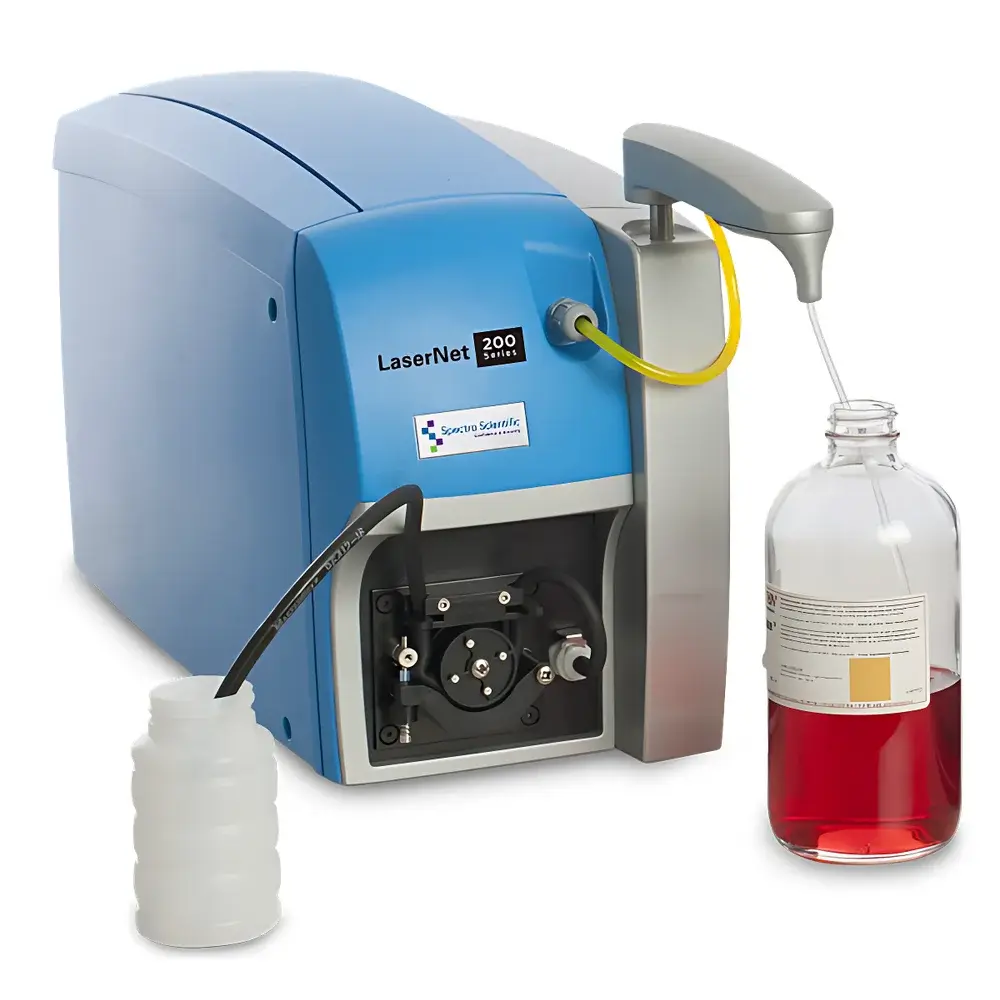
Spectro Scientific LaserNet Fines LNF200 Series Multi-Functional Wear Particle Analyzer
| Brand | Spectro Scientific |
|---|---|
| Origin | USA |
| Instrument Type | Optical Particle Counter with Direct Imaging & Ferrous Quantification |
| Technology | LaserNet Fines® |
| Compliance | ASTM D7596 |
| Measurement Principle | High-Resolution Laser Imaging + Integrated Ferromagnetic Sensor Array |
| Sample Throughput | One oil sample — full analysis in ≤ 4 minutes |
| Output Parameters | ISO 4406 & NAS 1638 cleanliness codes, particle count per size bin (≥4 µm(c), ≥6 µm(c), ≥14 µm(c), ≥21 µm(c), ≥38 µm(c), ≥70 µm(c)), ferrous concentration (ppm), ferrous particle count & size distribution (≥25 µm), automated wear debris classification (cutting, sliding, fatigue, non-metallic, fiber, water, air bubble) |
Overview
The Spectro Scientific LaserNet Fines LNF200 Series Multi-Functional Wear Particle Analyzer is an ASTM D7596-compliant, laboratory-grade optical particle analyzer engineered for comprehensive condition monitoring of lubricating oils in critical rotating and reciprocating machinery. Unlike conventional light-blockage particle counters, the LNF200 employs high-magnification laser direct imaging—combined with proprietary LaserNet Fines® optics and real-time auto-focus—to capture micron-resolved digital images of individual particles suspended in oil. This enables simultaneous quantification of contamination severity (per ISO 4406 and NAS 1638), morphological classification of wear debris, and quantitative ferrous mass concentration measurement via an integrated high-sensitivity magnetic sensor array. The system was originally developed under U.S. Navy research programs at the Naval Research Laboratory and Lockheed Martin, and has since become a benchmark instrument in naval predictive maintenance programs and ISO/IEC 17025-accredited oil analysis laboratories worldwide.
Key Features
- Single-sample, multi-parameter analysis: Delivers ISO/NAS cleanliness codes, particle size distribution (4–70+ µm(c)), ferrous concentration (ppm), ferrous particle count & size distribution (≥25 µm), and AI-assisted wear debris classification—all from one 10 mL oil aliquot in ≤4 minutes.
- Laser auto-gain control: Enables accurate particle detection in highly opaque samples—including black engine oils with elevated soot content—without dilution or pre-treatment.
- Water and air discrimination: Uses refractive index contrast and edge morphology algorithms to distinguish water droplets and entrained air bubbles from solid contaminants, eliminating false positives in cleanliness reporting.
- Zero-calibration operation: Factory-characterized optical path and sensor response eliminate routine calibration drift; traceability maintained through NIST-traceable reference standards and embedded verification routines.
- ASTM D7596 validation: Fully compliant with the standard test method for determining particle concentration and size distribution in lubricants using direct imaging particle counting, supporting regulatory and audit requirements for GLP/GMP environments.
- Embedded asset management module: Supports fleet-level trending with customizable alert thresholds, historical comparison, and automated report generation (PDF/CSV/XLSX) compliant with FDA 21 CFR Part 11 audit trail requirements.
Sample Compatibility & Compliance
The LNF200 accepts standard 10 mL glass vials containing mineral, synthetic, or bio-based lubricants—including turbine oils, hydraulic fluids, gear oils, and diesel engine oils—with viscosities up to 300 cSt at 40 °C. It accommodates samples with particle loadings up to 5,000,000 particles/mL without dilution. All analytical outputs conform to internationally recognized standards: ISO 4406:2017 (fluid cleanliness), NAS 1638 Class Code, and ASTM D7596-22. Optional firmware modules support user-defined cleanliness grading schemes aligned with OEM-specific specifications (e.g., GEK 32568, Siemens TLV 9000). The system meets electromagnetic compatibility (EMC) requirements per IEC 61326-1 and is CE-marked for laboratory use in EU member states.
Software & Data Management
LaserNet Fines software (v5.x) provides a Windows-based interface with role-based access control, electronic signature capability, and full 21 CFR Part 11 compliance—including secure user authentication, immutable audit trails, and electronic record retention. Image archives are stored with metadata (date/time, operator ID, instrument serial, sample ID, analysis parameters). Batch processing supports multi-sample queueing and automatic report consolidation. Raw image data (.tif) and structured result files (.csv) are exportable for third-party statistical analysis (e.g., JMP, Minitab) or integration into CMMS/EAM platforms via OPC UA or RESTful API. Firmware updates are delivered via encrypted USB key or secure HTTPS download with SHA-256 signature verification.
Applications
- Naval and aerospace propulsion systems: Real-time wear assessment of gas turbine and reduction gear lubricants to support mission-critical reliability decisions.
- Power generation: Monitoring of steam turbine and hydroelectric unit oils for early detection of bearing fatigue, gear pitting, and filter bypass events.
- Industrial manufacturing: Trending of hydraulic contamination in CNC machine tools and robotic actuators to optimize filter change intervals and reduce unplanned downtime.
- Third-party oil labs: Enabling accredited testing services (ISO/IEC 17025) with reduced reliance on ferrography—lowering capital cost, analyst training burden, and turnaround time.
- R&D lubricant development: Quantifying additive depletion effects, oxidation byproduct formation, and contaminant interaction dynamics under accelerated aging protocols.
FAQ
Does the LNF200 require periodic calibration with certified reference particles?
No. The system operates on a factory-characterized optical and magnetic sensor architecture. Routine verification uses internal diagnostic routines and optional NIST-traceable calibration check standards—not user-performed calibration.
Can it analyze used oil samples with high soot content (e.g., diesel engine oils)?
Yes. Laser auto-gain control dynamically adjusts illumination intensity and detector sensitivity to maintain resolution in dark, high-absorbance matrices without sample dilution.
How does it differentiate metallic wear particles from non-metallic contaminants like dust or fibers?
Through combined morphological analysis (aspect ratio, convexity, edge texture) and ferromagnetic response. Non-ferrous metals (e.g., Cu, Al) are classified by shape alone; ferrous particles trigger simultaneous magnetic signal acquisition for mass estimation.
Is remote operation or network integration supported?
Yes. The instrument supports Ethernet connectivity, SNMP monitoring, and REST API endpoints for integration into enterprise SCADA, CMMS, or cloud-based analytics platforms.
What is the minimum detectable ferrous concentration?
The integrated magnetic sensor achieves sub-ppm resolution (typical LOD: 0.3 ppm Fe) for bulk ferrous content, with particle-level detection down to 25 µm in equivalent spherical diameter.



