
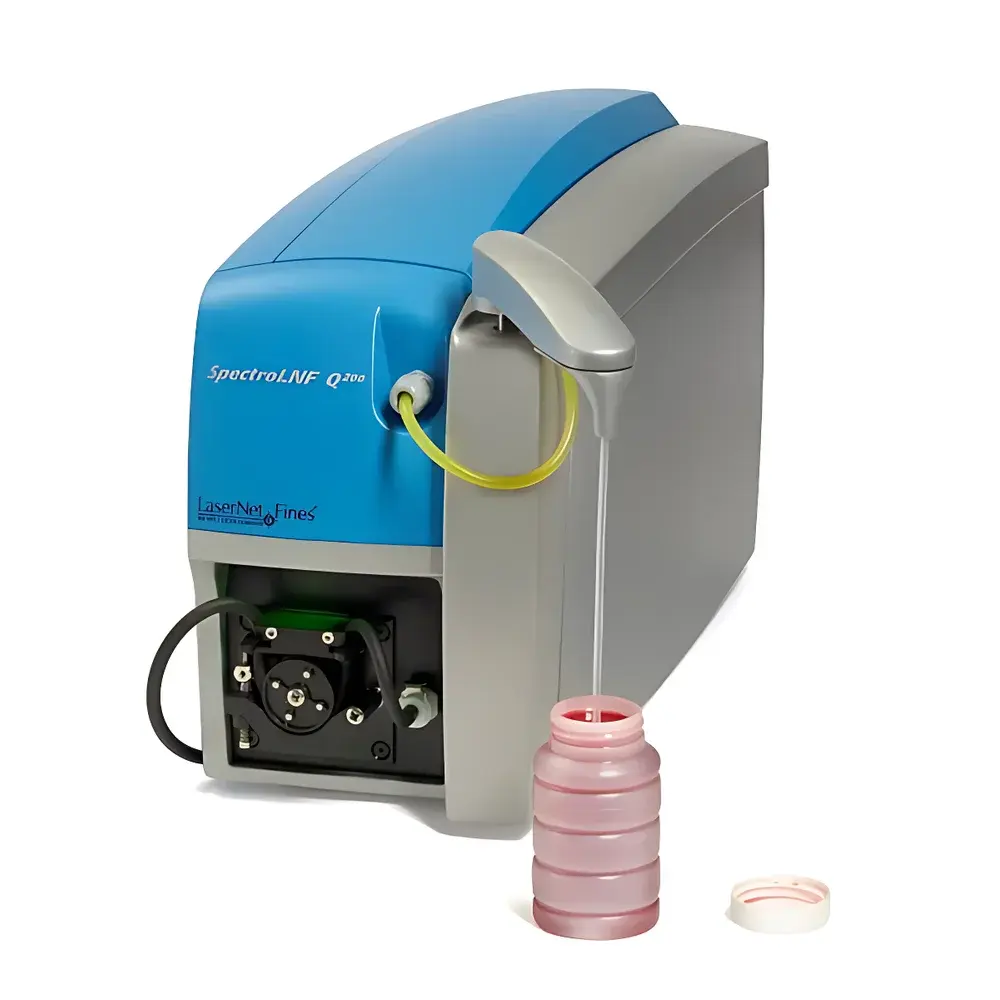
Spectro Scientific LNF220 Intelligent Ferrography Analyzer
| Brand | Spectro Scientific |
|---|---|
| Origin | USA |
| Model | LNF220 |
| Type | Laser-based Direct Imaging Ferrography System |
| Detection Principle | Pulsed Laser Illumination + High-Speed CCD Imaging + AI-Powered Particle Classification |
| Output | Particle Count, Morphology Classification (Cutting, Sliding, Fatigue, Non-Metallic, Fiber, Bubble, Water) |
| Compliance | Designed for ASTM D7690 (Standard Practice for Analysis of Wear Debris Using Direct-Imaging Ferrography) |
| Software | Embedded Neural Network Algorithm Suite |
| Connectivity | Ethernet, USB 3.0 |
| Sample Throughput | Up to 12 samples/hour (automated mode) |
Overview
The Spectro Scientific LNF220 Intelligent Ferrography Analyzer is a laboratory-grade, laser-based direct-imaging ferrography system engineered for quantitative wear debris analysis in lubricating oils and hydraulic fluids. Unlike traditional analytical ferrography—which relies on magnetic deposition and manual microscopy—the LNF220 employs a pulse-laser illumination platform coupled with high-resolution CCD imaging and embedded artificial intelligence to capture, digitize, and classify wear particles in real time. Its core measurement principle aligns with ASTM D7690, which defines standardized protocols for direct-imaging ferrography, ensuring traceable, repeatable, and operator-independent results. The system processes undiluted oil samples directly—without filtration or solvent extraction—minimizing preparation artifacts and preserving particle integrity. Designed for predictive maintenance programs in aviation, power generation, marine propulsion, and heavy industrial equipment, the LNF220 delivers objective, morphology-driven diagnostics that correlate directly with mechanical failure modes.
Key Features
- Laser-based direct imaging architecture: Uses a stabilized pulsed laser source (650 nm wavelength) to illuminate particles in flow-through sample cells, eliminating magnetic bias and enabling detection of non-ferrous and weakly magnetic debris.
- High-speed digital imaging: Integrated 4× optical amplification and 12-bit monochrome CCD camera (5 MP resolution, 100 fps capture rate) ensure accurate particle geometry capture across size ranges from 5 µm to 500 µm.
- Neural network–driven classification engine: Pre-trained convolutional neural network (CNN) model classifies particles into seven diagnostic categories—cutting wear, sliding wear, fatigue wear, non-metallic debris (e.g., silica, alumina), fibrous contaminants, entrained air bubbles, and water droplets—based on edge morphology, aspect ratio, texture, and grayscale intensity profiles.
- Automated particle counting and sizing: Reports total particle count per mL, size distribution histograms (binned at 5 µm intervals), and morphological frequency matrices aligned with ISO 4406 and SAE AS4059 contamination coding conventions.
- Robust hardware architecture: Sealed optical path, temperature-stabilized sample chamber (±0.5°C), and vibration-damped chassis support operation in ISO Class 8 cleanroom-equivalent environments without external enclosures.
Sample Compatibility & Compliance
The LNF220 accepts standard 10–20 mL volumes of mineral-, synthetic-, and bio-based lubricants, including turbine oils, gear oils, engine oils, hydraulic fluids, and greases (after solvent dilution per ASTM D7690 Annex A2). It accommodates viscosity ranges from 2 cSt to 500 cSt at 40°C and is compatible with used oil containing up to 15% water content (emulsified or free-phase) and 5% soot loading. All data acquisition and reporting modules comply with GLP documentation requirements, supporting audit-ready electronic records. System validation follows IQ/OQ protocols per ASTM E2500 and includes annual performance verification using NIST-traceable particle reference standards (e.g., PSi latex spheres, ISO MTD test dust).
Software & Data Management
The LNF220 runs Spectro’s FerroVision™ v4.2 software suite, deployed on an embedded industrial PC with Windows 10 IoT Enterprise OS. Software features include automated calibration logging, user-access-controlled method templates, multi-level password protection, and full 21 CFR Part 11 compliance—including electronic signatures, audit trails for all image processing steps, and immutable raw-data archiving. Reports export in PDF/A-2 and CSV formats, with metadata fields compliant with ISO 17025 clause 7.8.2. Integration with enterprise CMMS platforms (e.g., SAP PM, IBM Maximo) is supported via OPC UA and RESTful API endpoints. Raw image stacks (.TIFF) and processed feature vectors (.HDF5) are stored locally with optional encrypted cloud backup.
Applications
- Aircraft engine health monitoring: Early detection of gear scuffing, bearing spalling, and seal degradation via fatigue and cutting wear signature quantification.
- Wind turbine gearbox diagnostics: Discrimination between surface fatigue (incipient pitting) and abrasive wear caused by ingress contamination.
- Nuclear plant coolant loop surveillance: Identification of corrosion products (e.g., magnetite, hematite) and erosion debris in pressurized water reactor (PWR) lubricants.
- Railway traction motor analysis: Correlation of sliding wear morphology with oil film thickness breakdown under transient load conditions.
- Marine diesel engine condition assessment: Quantification of cylinder liner wear patterns and detection of coolant leakage via water droplet morphology and concentration trends.
FAQ
How does the LNF220 differ from conventional analytical ferrography (AF)?
Unlike AF—which requires magnetic separation onto glass slides followed by subjective optical microscopy—the LNF220 performs in-situ, non-contact particle imaging in liquid suspension, eliminating deposition artifacts and enabling statistical sampling of >10,000 particles per analysis.
Can the LNF220 detect non-ferrous wear particles?
Yes. Because it relies on laser scattering and contrast imaging—not magnetic attraction—it detects aluminum, copper, titanium, and ceramic particles with equal fidelity to ferrous debris.
Is the system suitable for field deployment?
The LNF220 is designed for fixed-laboratory use per ASTM D7690. For mobile applications, Spectro offers the portable LNF-FieldKit accessory package, which includes shock-mounted optics, battery power management, and ruggedized enclosure (IP54 rated).
What validation documentation is provided with the instrument?
Each unit ships with Factory Acceptance Test (FAT) report, NIST-traceable optical calibration certificate, software validation summary (IQ/OQ), and ASTM D7690 conformance statement.
Does the LNF220 support remote diagnostics and firmware updates?
Yes. Secure SSH-enabled remote access allows Spectro Field Applications Engineers to perform real-time diagnostics, log review, and over-the-air firmware upgrades—subject to customer IT security policy approval.





