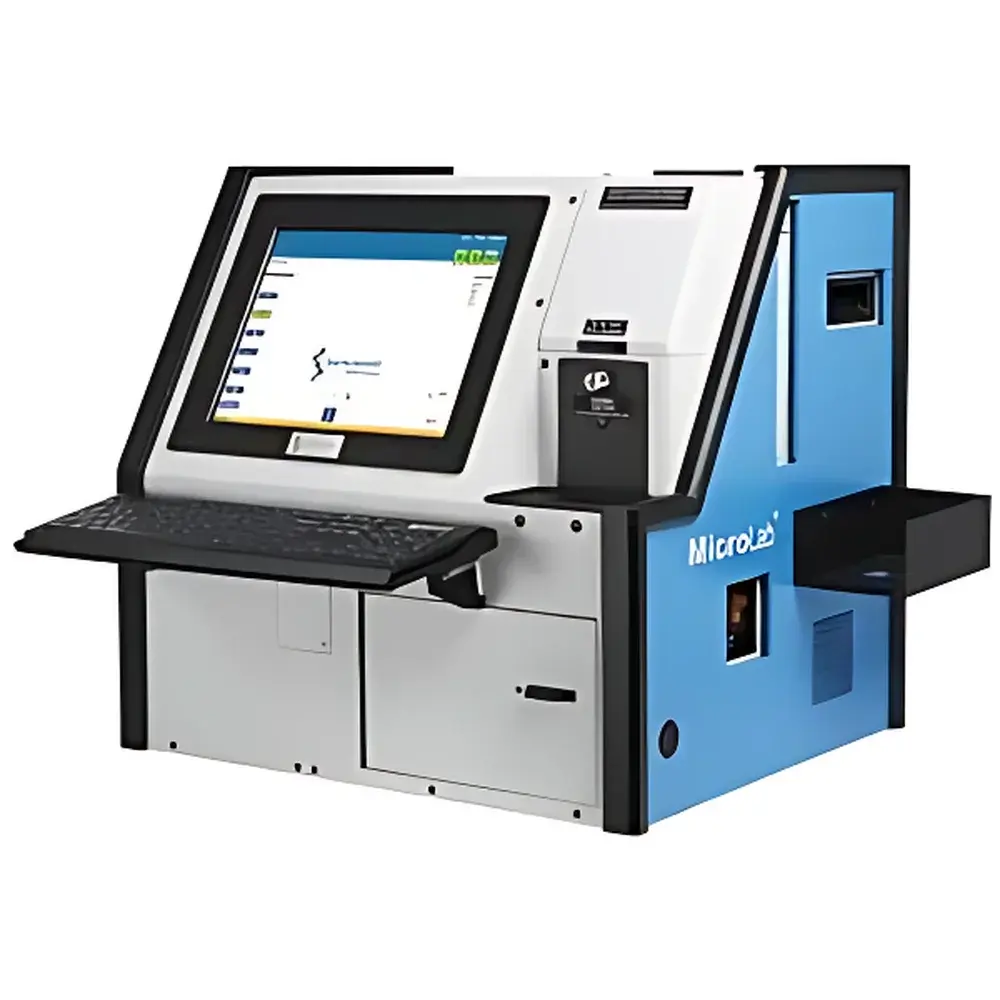
Spectro Scientific MicroLab 30 Intelligent Engine Oil Condition Monitoring System
| Brand | Spectro Scientific |
|---|---|
| Origin | USA |
| Model | MicroLab 30 |
| Detection Capabilities | Elemental Analysis (via Rotating Disc Electrode Atomic Emission Spectrometry), Infrared Spectroscopy, Kinematic Viscosity (at 40 °C and 100 °C), Acid Number, Oxidation, Nitration, Soot, Glycol, Water, Particle Count (optional module), Additive & Contaminant Elemental Profiling |
| Compliance | ASTM D7417 (Standard Test Method for Determination of Oxidation, Nitration, Soot, Glycol, Water, and Elemental Composition in Used Lubricating Oils Using Fourier Transform Infrared (FTIR) Spectroscopy, Rotating Disc Electrode Atomic Emission Spectrometry (RDE-AES), and Kinematic Viscosity) |
| Software | Embedded Expert System with >10,000 rule-based diagnostic scripts |
| Sample Throughput | ~15 minutes per sample (full suite of ASTM D7417–compliant tests) |
Overview
The Spectro Scientific MicroLab 30 Intelligent Engine Oil Condition Monitoring System is an integrated, on-site lubricant analysis platform engineered for precision, reproducibility, and operational autonomy in fleet maintenance environments. It applies three synchronized analytical modules—rotating disc electrode atomic emission spectrometry (RDE-AES), Fourier transform infrared (FTIR) spectroscopy, and dual-bath kinematic viscosity measurement—to deliver comprehensive oil condition and machine health assessment without reliance on off-site laboratories. The system operates on the principle that in-service lubricants serve as a continuous diagnostic medium: metal wear particles reflect mechanical degradation; oxidation, nitration, and soot levels indicate thermal and oxidative aging; glycol, water, and fuel dilution reveal sealing or combustion integrity failures; while additive depletion and contaminant ingress inform remaining useful life (RUL) estimation. Designed specifically for diesel and gasoline engines, generator sets, and hydraulic systems, the MicroLab 30 enables predictive maintenance by transforming raw physicochemical data into actionable asset health intelligence—directly at the point of use.
Key Features
- Automated multi-parameter analysis compliant with ASTM D7417, covering elemental composition (30+ elements), oxidation/nitration/soot/glycol/water via FTIR, and kinematic viscosity at 40 °C and 100 °C
- On-board RDE-AES subsystem for quantitative detection of wear metals (e.g., Fe, Cu, Al, Cr, Pb), contaminants (e.g., Si, Na, K), and additives (e.g., Ca, Zn, Mg, P, B)
- Dual-temperature viscosity module delivering ASTM D445–equivalent measurements and viscosity index (VI) calculation
- Embedded expert diagnostic engine comprising over 10,000 context-aware, rule-based scripts trained on two decades of field data across automotive, heavy-duty transport, marine, and power generation applications
- Self-calibrating optical and fluidic architecture with automated sample aspiration, reagent delivery, and waste management
- Color-coded, narrative-style reporting with anomaly flagging, root-cause inference, and maintenance recommendations—no spectroscopy or tribology expertise required to interpret results
Sample Compatibility & Compliance
The MicroLab 30 accepts standard 10–20 mL used engine oil samples (diesel, gasoline, natural gas, and biodiesel blends) without pre-treatment. It supports SAE viscosity grades from 0W to 60 and accommodates oils containing conventional, synthetic, and semi-synthetic base stocks. All analytical methodologies adhere to internationally recognized standards: ASTM D7417 for integrated oil analysis, ASTM D6595 for RDE-AES, ASTM D445 for kinematic viscosity, and ASTM E2412 for FTIR spectral interpretation. The system meets GLP-aligned data integrity requirements, including audit-trail logging, user-access controls, and electronic signature support—facilitating compliance with ISO/IEC 17025–accredited laboratory workflows and internal quality assurance protocols.
Software & Data Management
The MicroLab 30 runs proprietary firmware with embedded database management and secure local storage of all test records, calibration logs, and diagnostic histories. Reports are exportable in PDF and CSV formats, compatible with CMMS (Computerized Maintenance Management Systems) such as IBM Maximo, SAP PM, and Fiix. Software architecture supports role-based user permissions, instrument calibration tracking, and method version control. While not FDA 21 CFR Part 11–certified out-of-the-box, the system’s audit trail, electronic signature readiness, and data immutability features enable validation for regulated industrial environments under GMP/GLP frameworks upon site-specific qualification.
Applications
The MicroLab 30 is deployed across commercial transportation fleets, municipal transit authorities, mining and construction equipment operators, backup power generation facilities, and marine vessel maintenance programs. Typical use cases include: extending oil drain intervals based on empirical oxidation and additive depletion trends; detecting early-stage bearing wear through rising Fe/Cr ratios; identifying coolant leaks via glycol signatures before catastrophic failure; distinguishing between airborne dust (Si/Al) and internal wear (Fe/Cu); and validating lubricant compatibility during base-oil or additive package changes. Its portability and minimal infrastructure requirements make it suitable for mobile labs, depot workshops, and remote field operations where turnaround time and technician accessibility are critical constraints.
FAQ
Does the MicroLab 30 require external calibration standards or consumables beyond the supplied test kits?
No—each test kit includes pre-calibrated reference standards, sealed reagents, and disposable cuvettes. The RDE electrode is field-replaceable and self-cleaning; no daily recalibration is needed.
Can the system analyze gear oils or hydraulic fluids?
While optimized for engine oils, the MicroLab 30 can process select gear and hydraulic oils when configured with appropriate method templates and viscosity calibration ranges—consult Spectro Scientific application notes for matrix-specific validation data.
Is remote software update and technical support available?
Yes—firmware updates and diagnostic log uploads are supported via secure HTTPS connection; Spectro’s global service network provides remote troubleshooting and on-site validation assistance.
How does the expert system differentiate between normal additive depletion and abnormal contamination?
It cross-correlates elemental ratios (e.g., Ca/Zn decline vs. Si rise), FTIR band intensities (e.g., carbonyl vs. hydroxyl peaks), and viscosity drift patterns against application-specific baselines derived from historical fleet data and OEM specifications.
What training is required to operate the MicroLab 30?
Minimal—operators complete a 4-hour certified training program covering sample handling, system startup, report interpretation, and basic preventive maintenance. No chemistry or spectroscopy background is necessary.