
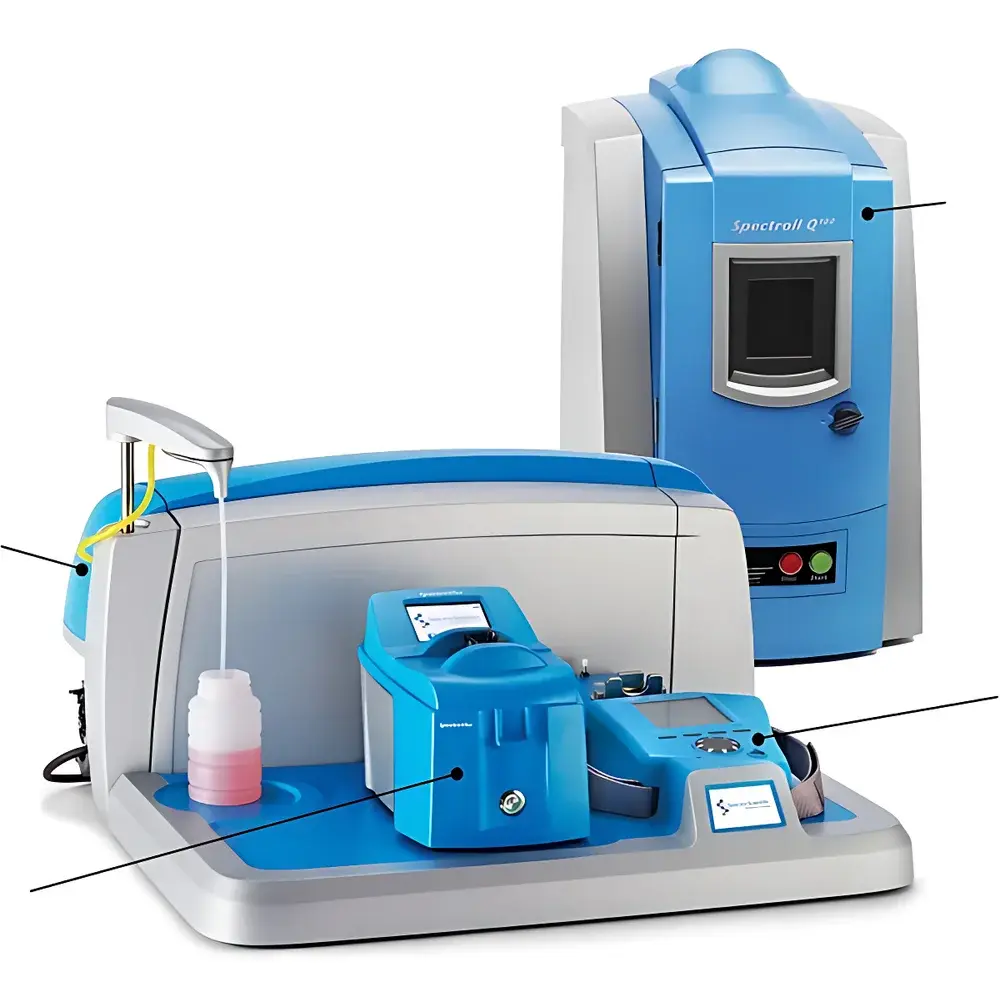
Spectro Scientific Minilab 153 On-Site Industrial Oil Condition Monitoring System
| Brand | Spectro Scientific |
|---|---|
| Origin | USA |
| Manufacturer Type | Original Equipment Manufacturer (OEM) |
| Product Category | Imported Instrument |
| Model | Minilab 153 |
| Application Scope | In-Field Lubricant Analysis |
| Detection Capabilities | Elemental Composition (24 standard elements, up to 31), Particle Contamination, Oxidation/Nitration/Sulfation Indices, Viscosity Trend Proxy, Additive Depletion Assessment |
| Compliance Framework | ASTM D6595 (Rotating Disc Electrode Atomic Emission Spectrometry), ISO 4406 (Particle Count Code), ISO 21785 (Oil Health Parameters), Compatible with Emerson AMS Machinery Health Manager |
Overview
The Spectro Scientific Minilab 153 is an integrated on-site oil condition monitoring system engineered for real-time, laboratory-grade lubricant analysis directly at the point of use—within production floors, power plants, mining sites, marine engine rooms, and wind turbine nacelles. It employs Rotating Disc Electrode Atomic Emission Spectrometry (RDE-AES), a standardized technique per ASTM D6595, to quantify elemental concentrations in used oils with detection limits in the sub-ppm range. Unlike portable IR or viscosity-only testers, the Minilab 153 delivers multi-parameter diagnostics—including wear metal profiles (Fe, Cu, Al, Cr, Pb, Sn, etc.), contaminant metals (Si, Na, B, Ca), additive package integrity (Zn, P, Ca, Mg), and oil degradation markers—enabling root-cause identification of mechanical wear modes (e.g., fatigue vs. abrasive wear), coolant ingress, dust ingestion, or oxidation-driven base oil breakdown. Its design philosophy centers on bridging the gap between lab accuracy and field operability, reducing turnaround time from days to <15 minutes per sample without chemical reagents or consumable gases.
Key Features
- Complete on-site analysis in ≤15 minutes: No sample shipment, no external lab dependency, no hazardous reagents required.
- Simultaneous quantification of 24 wear, contaminant, and additive elements (expandable to 31) via RDE-AES—trace-level precision validated against certified reference oils per ISO 17025-accredited laboratories.
- Integrated “Three-Vectors Analysis” framework: Visual triaxial plot correlating Wear (metal concentration ratios), Contamination (Si/Al/Ca), and Oil Health (oxidation/nitration indices) to classify equipment risk state—e.g., normal operation, incipient wear, severe contamination, or advanced oxidation.
- Intuitive guided workflow with touchscreen interface: Minimal operator training required; built-in calibration verification and drift compensation ensure measurement consistency across shifts and personnel.
- Direct Emerson AMS Machinery Health Manager integration: Synchronized data ingestion enables cross-modal correlation—e.g., aligning Fe trends from Minilab 153 with vibration spectral peaks at 1× or 2× shaft frequency—to distinguish bearing spalling from gear mesh anomalies.
Sample Compatibility & Compliance
The Minilab 153 accepts standard 10–20 mL volumes of used mineral, synthetic, or bio-based lubricants—including turbine oils, hydraulic fluids, engine oils, gear oils, and compressor lubricants—without dilution or pre-treatment. Sample introduction uses disposable borosilicate glass vials with magnetic stir bars, eliminating cross-contamination risks. All analytical outputs comply with ISO 4406:2017 (particle contamination coding), ASTM D7622 (spectrometric elemental analysis), and ISO 21785 (lubricant health parameter reporting). The system supports audit-ready documentation per FDA 21 CFR Part 11 requirements when deployed in regulated environments (e.g., pharmaceutical manufacturing utilities or food-grade lubricant monitoring), including electronic signatures, user access logs, and immutable result archiving.
Software & Data Management
Minilab 153 operates with OilView AMS—a purpose-built asset health management platform featuring a scalable relational database for equipment hierarchies, lubricant specifications, OEM-recommended limits, and historical baseline libraries. Software functions include automated trend analysis using moving-window statistical control (X-bar/R charts), configurable alarm thresholds per ISO 18436-4 competency levels, and scheduled email/SMS notifications for out-of-limit results or deviation patterns. Raw spectra, calibration records, and QC check reports are exportable in CSV, PDF, or XML formats for integration into CMMS (e.g., IBM Maximo, SAP PM) or enterprise analytics platforms. All data modifications are tracked with timestamped audit trails compliant with GLP/GMP documentation standards.
Applications
- Power generation: Turbine lube oil monitoring for bearing wear prediction and varnish potential assessment.
- Mining & heavy construction: Hydraulic fluid analysis on excavators and haul trucks to prevent pump and valve failure.
- Marine propulsion: Cylinder oil condition tracking in low-speed diesel engines to optimize scavenge timing and reduce liner wear.
- Wind energy: Gearbox oil surveillance across fleets to validate oil life extension strategies and prioritize gearbox replacements.
- Manufacturing: Compressor oil health monitoring in critical air systems serving cleanrooms or pneumatic controls.
FAQ
Does the Minilab 153 require daily calibration or gas supply?
No. It uses solid-state argon plasma excitation with factory-calibrated RDE electrodes; only periodic verification with reference oils (e.g., Spectro’s QCM series) is recommended per ASTM D6595 Section 8.
Can it analyze greases or solid contaminants?
No—it is designed exclusively for liquid lubricants. Grease samples must be solvent-extracted prior to analysis; direct grease testing is not supported.
How does its elemental accuracy compare to ICP-OES lab results?
Independent inter-laboratory studies (per ISO/IEC 17043) show median bias <8% for Fe, Cu, Al, and Si versus accredited ICP-OES, with repeatability (RSD) <5% at typical wear metal concentrations (10–100 ppm).
Is remote firmware update capability available?
Yes—via secure HTTPS connection to Spectro’s support portal; updates include method enhancements, regulatory compliance patches, and new OEM limit libraries.
What cybersecurity protocols are implemented?
Role-based access control (RBAC), TLS 1.2 encryption for data transmission, local database encryption (AES-256), and optional integration with corporate Active Directory authentication.





