
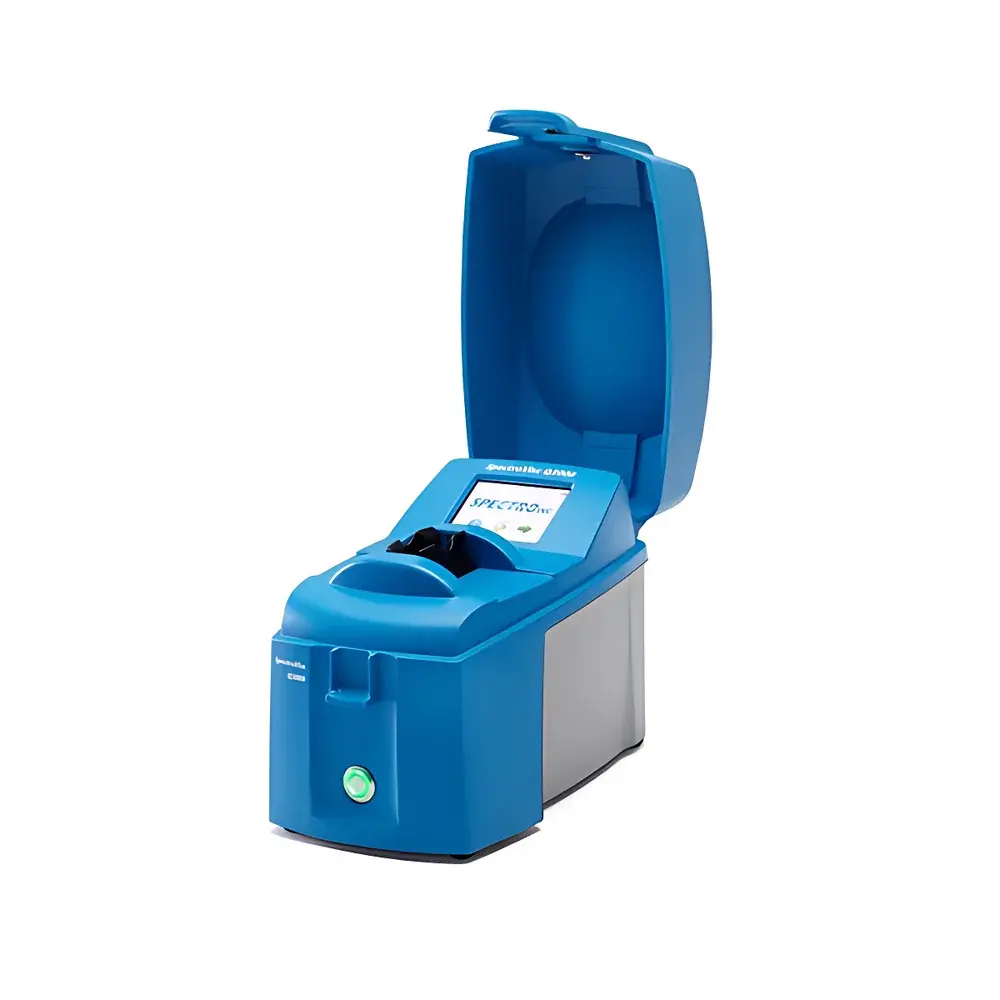
Spectro Scientific MiniVisc 3000/3050 Portable Kinematic Viscosity Analyzer
| Brand | Spectro Scientific |
|---|---|
| Origin | USA |
| Model | MiniVisc 3000 Series (10–350 cSt @ 40 °C) / MiniVisc 3050 Series (1–700 cSt @ 40 °C) |
| Measurement Principle | Gravity-driven capillary flow in split-cell microchannel |
| Temperature Control | 40 °C ± 0.1 °C (PID-regulated) |
| Sample Volume | 60 µL |
| Power | Rechargeable Li-ion battery (≥6 h runtime) |
| Display | Integrated high-resolution touchscreen |
| Weight | 1.8 kg |
| Dimensions | 152 × 127 × 203 mm (H × W × L) |
| Compliance | ASTM D445, ISO 3104, IP 71 |
Overview
The Spectro Scientific MiniVisc 3000 and MiniVisc 3050 are field-deployable kinematic viscosity analyzers engineered for precision, reproducibility, and operational simplicity in demanding industrial environments. Unlike rotational or falling-ball viscometers, the MiniVisc series employs a patented split-cell capillary microchannel design grounded in the fundamental principle of gravity-driven laminar flow—directly implementing the physical basis of ASTM D445 and ISO 3104. By measuring the time required for a precisely metered volume (60 µL) of oil to traverse a calibrated capillary under controlled thermal conditions (40 °C ± 0.1 °C), the instrument delivers true kinematic viscosity (mm²/s or cSt) without requiring density input, temperature interpolation, or solvent-assisted cleaning. This eliminates systematic errors associated with manual density correction and enables traceable, laboratory-grade results at the point of use—critical for predictive maintenance programs in power generation, marine propulsion, hydraulic systems, and rotating machinery fleets.
Key Features
- Split-Cell Capillary Technology: A mechanically separable, optically transparent sample cell allows full visual inspection and dry-cleaning with lint-free tissue—no solvents, no residue buildup, no risk of channel occlusion.
- True Kinematic Viscosity Output: Direct measurement at 40 °C; optional 100 °C equivalent calculated using user-defined viscosity index (VI) or ASTM D341 equations—no external densitometry required.
- Built-in Thermal Regulation: Dual-panel PID-controlled heating maintains uniform 40 °C across the entire flow path, ensuring compliance with standardized test temperature requirements per ASTM D445 Section 7.2.
- Field-Optimized Hardware: Integrated 7-inch capacitive touchscreen, embedded ARM-based microprocessor, and rechargeable lithium-ion battery supporting ≥6 hours of continuous operation without external power.
- Universal Fluid Compatibility: Validated for opaque, soot-laden, dyed, or highly contaminated lubricants—including engine oils, turbine oils, hydraulic fluids, and gear oils—without pre-filtration or dilution.
- Traceable Calibration Support: Multi-point calibration mode allows users to apply custom calibration curves against NIST-traceable reference oils within defined viscosity ranges (e.g., 1–100 cSt or 200–700 cSt).
Sample Compatibility & Compliance
The MiniVisc platform is validated for undiluted used and virgin lubricants across ISO VG 22 to VG 680 grades. Its optical detection system—based on high-resolution infrared photodiode arrays—accurately resolves flow onset and endpoint even in low-transmission media (e.g., blackened diesel engine oils with >5% soot loading). The device meets mechanical and electrical safety requirements per IEC 61010-1:2010 and carries CE marking for EMC and RoHS compliance. All measurement outputs conform to data integrity expectations under GLP and GMP frameworks: timestamped results include instrument ID, ambient temperature, battery level, and thermal stability verification logs. While not FDA 21 CFR Part 11-certified out-of-the-box, audit trails and exportable CSV reports support integration into validated LIMS environments with appropriate procedural controls.
Software & Data Management
No PC dependency is required for routine operation. All instrument control, real-time flow visualization, result calculation, and data storage occur onboard. The embedded operating system supports English and Simplified Chinese UI languages and stores ≥1,000 test records with metadata (date/time, operator ID, oil type tag, calibration ID). Results export via USB-C to CSV or PDF formats, preserving full traceability—including raw transit time, temperature deviation history, and pass/fail flags against user-defined specification limits. Optional Spectro Viscometer Link software (Windows-based) enables fleet-wide trend analysis, automated report generation per ISO 4406 or SAE AS4059, and synchronization with Spectro’s Oil Health Database for anomaly detection based on historical viscosity drift patterns.
Applications
- On-site condition monitoring of turbine, compressor, and gearbox lubricants in wind farms, offshore platforms, and CHP plants
- Rapid verification of oil replenishment integrity following top-up or change-out procedures
- Early detection of fuel dilution, glycol contamination, or thermal degradation in diesel and gasoline engine oils
- Verification of viscosity grade conformity during incoming inspection of bulk lubricant deliveries
- Supporting ISO 55001-aligned asset management by correlating viscosity trends with vibration, particle count, and FTIR oxidation metrics
- Training and demonstration use in OEM technical service centers and lubricant distributor labs
FAQ
Does the MiniVisc require solvent cleaning between samples?
No. The split-cell design permits complete mechanical access to the capillary surface. Cleaning requires only a single pass with dry, non-linting laboratory tissue.
Can it measure oils at temperatures other than 40 °C?
The instrument is thermally optimized and certified for 40 °C operation per ASTM D445. Alternate temperature testing is not supported due to calibration traceability constraints.
How is accuracy verified in the field?
Users may perform daily verification using supplied reference oils (e.g., NIST SRM 2783); deviation from certified values triggers automatic recalibration prompts.
Is the 100 °C viscosity value lab-validated?
The 100 °C output is a calculated estimate derived from the 40 °C measurement and user-input VI or ASTM D341 parameters—it is not a direct measurement and should not replace dedicated high-temperature testing when regulatory compliance mandates it.
What happens if the battery depletes mid-test?
Active measurements are preserved in non-volatile memory; the unit resumes normal operation upon recharge without data loss.
Related Products





