
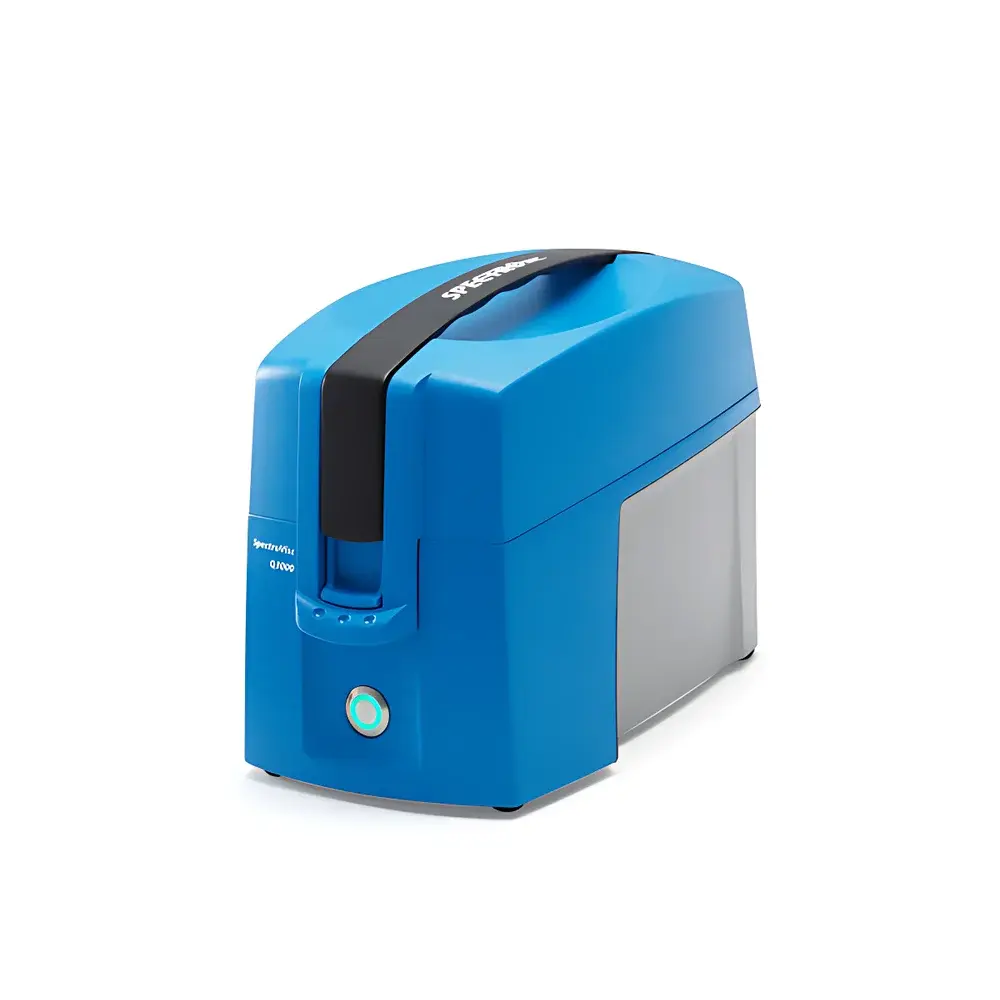
Spectro Scientific MiniVisc 3000 Portable Kinematic Viscosity Analyzer
| Brand | Spectro Scientific |
|---|---|
| Origin | USA |
| Model | MiniVisc 3000 |
| Kinematic Viscosity Range | 10–350 cSt @ 40 °C |
| Sample Volume | 60 µL |
| Temperature Control | 40 °C ± 0.1 °C |
| Power | Rechargeable Li-ion battery (≥6 h operation) |
| Weight | 1.8 kg |
| Measurement Principle | Hele-Shaw flow in split-cell microchannel |
| Compliance | ASTM D445, ISO 3104, IP 71 (indirectly supported via methodology and calibration traceability) |
Overview
The Spectro Scientific MiniVisc 3000 Portable Kinematic Viscosity Analyzer is an engineered field-deployable instrument designed for rapid, solvent-free kinematic viscosity measurement of lubricating oils and hydraulic fluids at a controlled temperature of 40 °C. It operates on the Hele-Shaw principle—where fluid flows under gravity between two precisely spaced parallel plates forming a microchannel—and measures transit time via an LED-photodiode optical detection system. Unlike capillary-based laboratory viscometers requiring volumetric timing and density correction, the MiniVisc 3000 delivers direct kinematic viscosity output without ancillary density or temperature measurements. Its patented split-cell sample chamber enables loading of only 60 µL of oil—sufficient for representative analysis while preserving in-service lubricant integrity. The device integrates a PID-controlled heating element, high-resolution infrared temperature sensing, and real-time flow velocity calculation to ensure metrological consistency with benchtop reference instruments compliant with ASTM D445 and ISO 3104.
Key Features
- Solvent-free operation: No solvents required for cleaning; sample chamber wipes clean with lint-free tissue—eliminating hazardous waste generation, solvent transport restrictions, and regulatory reporting burdens.
- True portability: Weighing only 1.8 kg and powered by an internal rechargeable Li-ion battery (≥6 hours continuous use), the MiniVisc 3000 functions independently of AC power or external computing hardware.
- Minimal sample demand: Requires just 60 µL per test—ideal for critical assets where oil volume is limited or withdrawal is logistically constrained.
- Precision thermal regulation: Maintains sample temperature at 40 °C ± 0.1 °C using dual-panel PID-controlled heating and real-time infrared monitoring—ensuring repeatability across ambient conditions from 5 °C to 40 °C.
- Universal fluid compatibility: Capable of measuring opaque, heavily sooted, dark-colored, or highly contaminated oils without dilution, filtration, or pre-treatment—validated across mineral, synthetic, and bio-based lubricants.
- Integrated human interface: Features a high-contrast capacitive touchscreen with guided workflow prompts, multilingual UI support (including English), and on-device data storage with timestamped results exportable via USB.
Sample Compatibility & Compliance
The MiniVisc 3000 accommodates a broad range of petroleum-based and non-petroleum fluids—including turbine oils, engine oils, gear oils, hydraulic fluids, compressor oils, and greases (after light homogenization). Its optical detection system is insensitive to color or particulate opacity, enabling reliable measurement even in oils with >10,000 ppm soot or varnish deposits. While not a primary compliance instrument per se, its measurement methodology aligns with the physical principles underlying ASTM D445 (Standard Test Method for Kinematic Viscosity of Transparent and Opaque Liquids) and ISO 3104 (Petroleum Products — Transparent and Opaque Liquids — Determination of Kinematic Viscosity and Calculation of Dynamic Viscosity). Calibration is traceable to NIST-certified viscosity standards, and instrument validation protocols support GLP and GMP audit requirements, including full electronic record retention and user-access logging when deployed with optional Spectro’s Fluid Analysis Management System (FAMS).
Software & Data Management
All measurement data—including kinematic viscosity (cSt) at 40 °C, calculated viscosity at 100 °C (via ASTM D341 interpolation), test date/time, operator ID, and instrument serial number—are stored locally in non-volatile memory. Results export as CSV or PDF via USB 2.0 to standard flash drives. Optional integration with Spectro’s cloud-based FAMS platform enables automated trend analysis, alarm thresholds, cross-parameter correlation (e.g., viscosity vs. particle count or elemental wear), and secure multi-site fleet reporting. The embedded firmware supports firmware updates over USB and includes built-in diagnostic self-tests for optical path integrity, thermal stability verification, and sensor response validation—critical for maintaining data integrity in uncontrolled field environments.
Applications
- Routine on-site condition monitoring of rotating equipment (turbines, compressors, gearboxes, hydraulics)
- Pre-commissioning verification of new or reclaimed oil batches
- Troubleshooting viscosity-related failures—oxidation, fuel dilution, glycol contamination, or incorrect oil top-up
- Field validation of lab-reported viscosity deviations
- Mobile maintenance teams conducting predictive maintenance in remote or offshore facilities
- Oil reclamation and blending verification prior to reuse
FAQ
Does the MiniVisc 3000 require calibration before each use?
No—factory calibration is stable for ≥12 months under normal field use. A quick verification check using a certified reference oil is recommended before critical measurement campaigns.
Can it measure viscosity at temperatures other than 40 °C?
The MiniVisc 3000 is optimized for 40 °C operation per ASTM D445 baseline requirements. It does not support variable-temperature testing; however, 100 °C equivalent values are computed algorithmically using the ASTM D341 equation and stored calibration constants.
Is the device suitable for regulatory submission or certification reports?
While widely accepted for internal condition monitoring and trending, formal regulatory submissions (e.g., API Q1, ISO 55001 audits) typically require full ASTM D445-compliant lab instrumentation. The MiniVisc 3000 serves as a validated screening tool that significantly reduces the number of samples requiring full lab analysis.
How is measurement uncertainty quantified?
Typical repeatability (within-operator, same sample) is ±0.8% RSD; reproducibility (between instruments, same sample batch) is ±1.5% RSD—verified against NIST-traceable reference oils across the 10–350 cSt range.
What maintenance is required beyond routine cleaning?
No scheduled mechanical maintenance is required. Users should inspect the optical window and electrode surfaces quarterly for abrasion or residue buildup and replace the disposable silicone gasket annually or after 500 tests—whichever occurs first.






