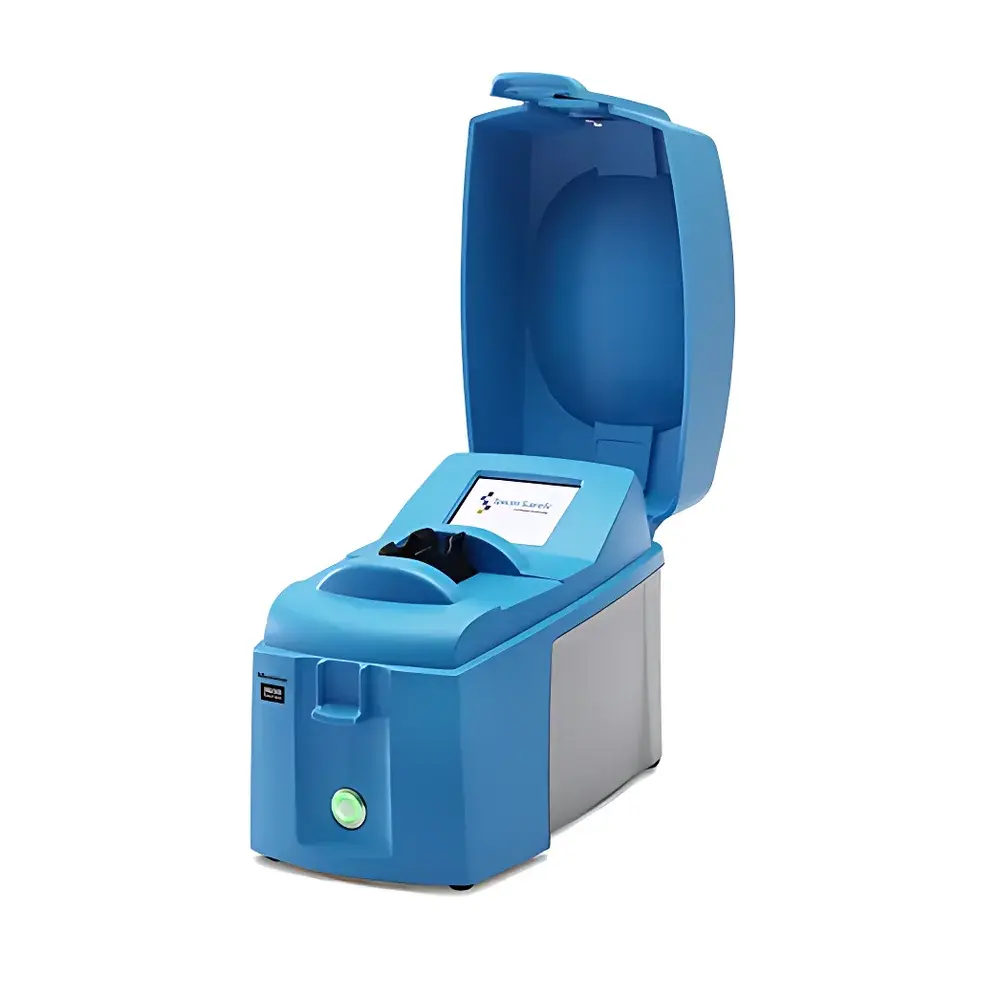
Spectro Scientific MiniVisc 3000 Series Portable Kinematic Viscosity Tester
| Brand | Spectro Scientific |
|---|---|
| Origin | USA |
| Manufacturer Type | Authorized Distributor |
| Origin Category | Imported |
| Model | MiniVisc 3000 Series |
| Pricing | Upon Request |
Overview
The Spectro Scientific MiniVisc 3000 Series is a field-deployable, battery-powered kinematic viscosity tester engineered for rapid, on-site measurement of lubricating oils at 40 °C. It employs a patented split-cell capillary viscometer design—eliminating the need for traditional U-tube capillaries, gravity-driven flow timing, or solvent-based cleaning protocols. Unlike conventional ASTM D445 or ISO 3104 laboratory viscometers, the MiniVisc 3000 operates on a calibrated micro-capillary principle where oil flow is driven by controlled pneumatic pressure and monitored via high-resolution optical detection of meniscus displacement. This enables direct, quantitative determination of kinematic viscosity (mm²/s) without sample dilution, pre-filtration, or temperature equilibration beyond ambient stabilization. The instrument is fully compliant with ASTM D8092–19, “Standard Test Method for Field Determination of Kinematic Viscosity of Used and Unused Lubricants Using a Portable Viscometer,” ensuring traceability to internationally recognized metrological frameworks and enabling acceptance of field data in regulatory and maintenance reporting contexts.
Key Features
- Battery-operated architecture: Integrated rechargeable lithium-ion battery supports ≥200 measurements per charge; no external power source required.
- Robust mechanical design: Compact footprint (15.2 × 12.7 × 20.3 cm), mass of 1.8 kg; housed in an IP54-rated aluminum chassis with shock-absorbing elastomer overmold.
- Split-cell capillary system: Precision-machined stainless-steel capillary with integrated optical sensor array—no glass components, no fragile bulbs, no consumable parts.
- Zero-solvent operation: Eliminates chlorinated solvents, acetone, or toluene; reduces hazardous waste generation by >95% versus ASTM D445 workflows.
- Rapid analysis cycle: Typical measurement time of 2–4 minutes per sample, dependent on kinematic viscosity range (1.5–100 mm²/s at 40 °C).
- Direct black-oil capability: Engineered to accommodate heavily sooted, oxidized, or particulate-laden used engine oils without centrifugation, filtration, or dilution.
- Calibration traceability: Factory-calibrated against NIST-traceable reference oils; user-accessible calibration verification using supplied check standards.
Sample Compatibility & Compliance
The MiniVisc 3000 accepts undiluted, unfiltered samples of mineral-based, synthetic, and semi-synthetic lubricants—including engine oils, hydraulic fluids, turbine oils, gear oils, and diesel fuels. It demonstrates high reproducibility (RSD < 2.1% within-run, < 2.8% between-day) across ISO VG 10 to VG 150 grades. All measurements adhere strictly to ASTM D8092 requirements for field viscometry, including temperature control tolerance (±0.1 °C at 40 °C), flow-time resolution (±0.01 s), and data recording integrity. The device meets CE marking directives for electromagnetic compatibility (2014/30/EU) and low-voltage safety (2014/35/EU). Its operational methodology aligns with ISO 5725-2 (accuracy and precision of measurement methods) and supports GLP-compliant documentation when paired with Spectro’s optional audit-trail-enabled software.
Software & Data Management
Data acquisition and reporting are managed via the optional SpectroVisc Connect desktop application (Windows 10/11), which provides encrypted local storage, CSV/PDF export, trend charting, and customizable report templates. The application enforces FDA 21 CFR Part 11–compliant user authentication, electronic signatures, and immutable audit trails—including timestamped records of calibration events, measurement parameters, operator ID, and environmental conditions (ambient temperature, barometric pressure). Raw sensor logs and processed viscosity values are stored with SHA-256 checksums to ensure data integrity. Instrument firmware updates are delivered through secure HTTPS channels with cryptographic signature validation.
Applications
- Condition-based maintenance: Monitoring viscosity drift as an early indicator of thermal degradation, oxidation, fuel dilution, or coolant contamination in rotating equipment lubricants.
- Production QC for base oil blending and finished lubricant formulation—validating batch consistency prior to release.
- Receiving inspection: Rapid verification of incoming lubricant specifications against purchase order requirements (e.g., ISO VG grade compliance).
- Fleet maintenance programs: On-vehicle testing of engine, transmission, and hydraulic systems to support oil life extension decisions.
- Field service diagnostics: Integration into mobile lab vehicles or remote site operations where access to fixed laboratory infrastructure is constrained.
FAQ
Does the MiniVisc 3000 require calibration before each use?
No. The instrument maintains factory calibration for up to 12 months or 500 measurements, whichever occurs first. A quick verification using the included reference standard oil is recommended before critical measurement campaigns.
Can it measure viscosity at temperatures other than 40 °C?
No. The MiniVisc 3000 is optimized exclusively for 40 °C kinematic viscosity per ASTM D8092. Temperature control is fixed and non-adjustable.
Is the device suitable for biodiesel or bio-lubricants?
Yes—provided the sample exhibits Newtonian flow behavior in the 1.5–100 mm²/s range at 40 °C and contains no suspended solids exceeding 10 µm in diameter.
How is measurement uncertainty quantified?
Total expanded uncertainty (k = 2) is ±3.0% relative for samples within the validated range, derived from Type A (repeatability) and Type B (calibration, temperature stability, sensor resolution) uncertainty components per GUM (JCGM 100:2008).