
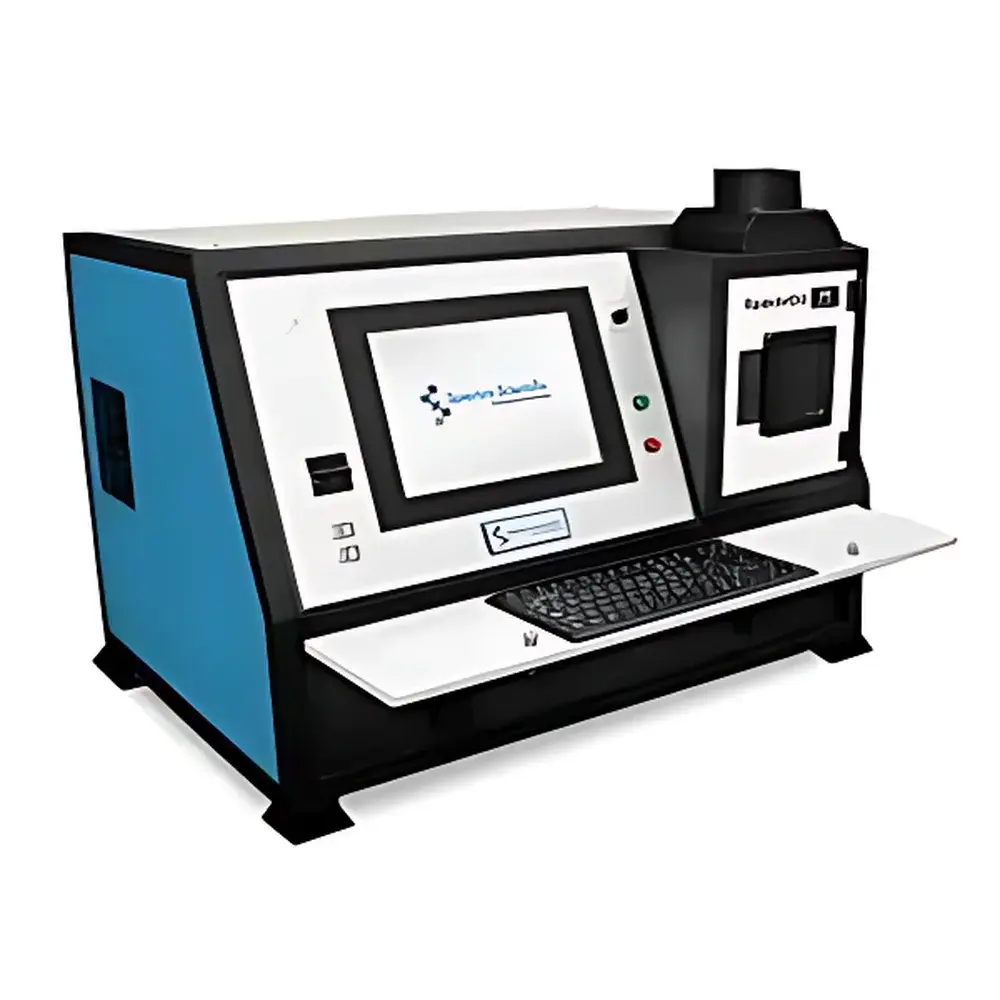
Spectro Scientific SpectrOil M/N-W Military-Grade Rotating Disc Electrode (RDE) Oil Spectrometer
| Brand | Spectro Scientific |
|---|---|
| Origin | USA |
| Model | SpectrOil M/N-W |
| Application | Elemental Analysis of In-Service Lubricants, Hydraulic Fluids, and Coolants |
| Certification | Qualified under U.S. Department of Defense Joint Oil Analysis Program (JOAP) CID-0191 |
| Element Capacity | 15 or 20 elements (JOAP-compliant configurations) |
| Measurement Principle | Rotating Disc Electrode Atomic Emission Spectrometry (RDE-AES) |
| Sample Throughput | ~30 seconds per analysis |
| Power Requirement | Standard AC mains (100–240 VAC, 50/60 Hz) |
| Form Factor | Benchtop, transportable |
| Compliance | JOAP-certified consumables and calibration protocols required for data traceability |
Overview
The Spectro Scientific SpectrOil M/N-W is a military-grade rotating disc electrode atomic emission spectrometer (RDE-AES) engineered exclusively for elemental analysis of in-service lubricants, hydraulic fluids, and engine coolants in field-deployable and laboratory-based oil analysis programs. As the only instrument formally qualified under the U.S. Department of Defense Joint Oil Analysis Program (JOAP) Contracting Instrument Description CID-0191, it serves as the sole JOAP-recognized spectrometer for wear metal, contaminant, and additive element quantification across all U.S. Armed Forces branches. Its design centers on robustness, operational simplicity, and metrological continuity—ensuring compatibility with decades of historical JOAP datasets and current DoD reporting requirements. Unlike conventional ICP-OES or XRF systems, the SpectrOil M/N-W employs a time-validated RDE excitation method: a graphite disc electrode rotates at controlled speed while immersed in a precisely metered oil sample, generating a stable plasma arc that volatilizes and atomizes dissolved and suspended particulates. Emitted spectral lines are resolved via fixed-wavelength photomultiplier tube (PMT) detectors calibrated to JOAP-specified elemental transitions (e.g., Fe I 371.99 nm, Cu I 324.75 nm, Al I 396.15 nm).
Key Features
- JOAP CID-0191 compliance: Fully certified for use in DoD-mandated oil analysis workflows, including fleet maintenance, predictive maintenance, and condition-based logistics reporting.
- No sample preparation required: Direct analysis of neat oils and coolants—no digestion, dilution, or filtration needed—reducing operator error and turnaround time.
- 30-second analysis cycle: Enables high-throughput screening in mobile labs, forward-deployed maintenance units, or centralized analytical facilities.
- Transportable benchtop architecture: Compact footprint (W × D × H: 43 × 41 × 30 cm), shock-absorbing chassis, and optional ruggedized transit case (NSN 6650-01-415-1767 / 6650-01-535-4273) compliant with MIL-STD-810G for vibration, drop, and environmental exposure.
- JOAP-traceable consumables: All electrodes (M97200 disc, M97201 rod), calibration standards (CS-24-100-200G, SMA-900-200G), and base oils (D19-0) are manufactured and certified per JOAP-approved specifications to maintain inter-laboratory data equivalence.
- Self-contained operation: Requires only standard AC power—no external argon supply, vacuum pumps, or auxiliary gas regulators—minimizing infrastructure dependencies in austere environments.
Sample Compatibility & Compliance
The SpectrOil M/N-W is validated for use with mineral-based, synthetic, and semi-synthetic lubricants; aviation turbine oils (MIL-PRF-23699, MIL-PRF-6081); hydraulic fluids (MIL-PRF-83282, MIL-PRF-5606); diesel engine oils (MIL-PRF-2104G); and ethylene glycol–based coolants. It quantifies elements in the concentration range of 0.1–1000 ppm, with detection limits optimized for critical wear metals (Fe, Cr, Al, Cu, Pb, Sn), contaminants (Si, Na, B, K), and additives (Ca, Mg, Zn, P, Mo). All measurement protocols align with ASTM D6595 (Standard Test Method for Determination of Wear Metals and Contaminants in Used Lubricating Oils or Used Hydraulic Fluids by Rotating Disc Electrode Atomic Emission Spectrometry) and support GLP/GMP documentation requirements. Data integrity is maintained through JOAP-mandated calibration verification using certified reference materials traceable to NIST SRMs.
Software & Data Management
The instrument operates via Spectro’s proprietary JOAP Edition software, which enforces strict audit trails, electronic signatures, and version-controlled calibration records per FDA 21 CFR Part 11 and DoD Instruction 5000.62. Reports generate JOAP-compliant format codes (e.g., JOAP-101, JOAP-102), include spectral quality metrics (arc stability index, background correction residuals), and export to CSV, XML, or direct integration with enterprise CMMS platforms (e.g., SAP PM, IBM Maximo). Calibration curves are locked to JOAP-defined multi-point validation protocols, and drift correction is performed automatically using internal reference channels. Software updates undergo formal JOAP change control review prior to release.
Applications
- Wear debris monitoring in gas turbine engines, main battle tanks, and naval propulsion systems.
- Contamination tracking (silicon, sodium, boron) in hydraulic systems exposed to sand, seawater, or coolant cross-contamination.
- Additive depletion profiling for total acid number (TAN)-correlated trending in extended-drain military lubricants.
- Field verification of oil service life extension decisions during expeditionary operations.
- Inter-laboratory comparison studies under the JOAP Interlaboratory Proficiency Testing Program (ILPTP).
FAQ
Is the SpectrOil M/N-W compatible with non-JOAP civilian oil analysis programs?
Yes—while optimized for JOAP compliance, its RDE-AES methodology meets ASTM D6595 and ISO 11171 requirements, making it suitable for commercial aviation, rail, and power generation applications.
Can legacy SpectrOil consumables be used with the M/N-W model?
No—only JOAP-certified consumables (e.g., M97200, CS-24-100-200G) ensure metrological equivalence with historical JOAP databases. Non-certified electrodes or standards invalidate compliance and void DoD reporting validity.
What NSN numbers correspond to the 20-element configuration with transit case?
NSN 6650-01-535-4273 (20-element system + transit case) and NSN 6650-01-535-4276 (20-element system, no case).
Does the instrument require annual recalibration by an accredited lab?
Per JOAP Technical Manual TM 10-55-1, users must perform daily performance verification using JOAP-certified check standards (e.g., D12-1001), with full calibration validation every 90 days or after 200 analyses—documented internally with full traceability.
How is data security managed during field deployment?
All data reside locally on encrypted SSD storage; network connectivity is optional and disabled by default. Export requires physical USB transfer with AES-256 encryption, consistent with DoD Information Assurance Certification and Accreditation Process (DIACAP) requirements.
Related Products





