
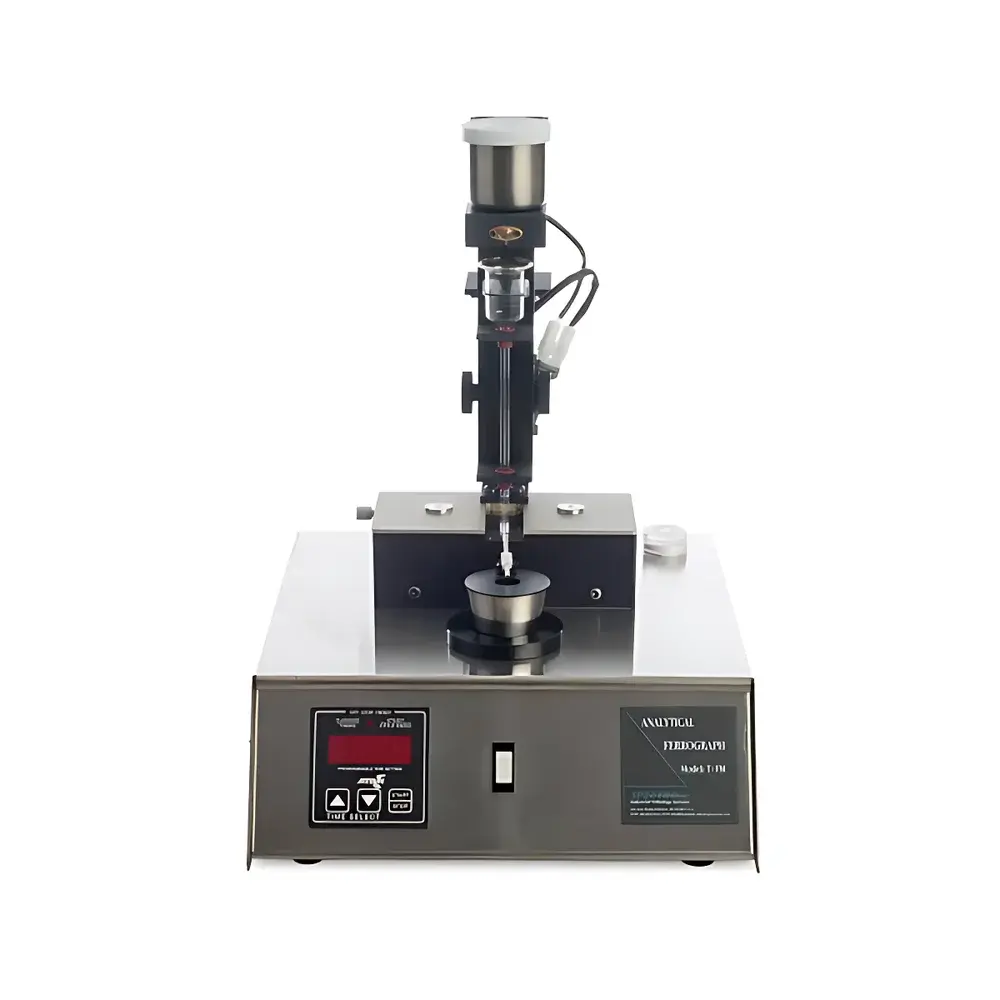
Spectro Scientific T2FM 500 Capillary Ferroscope System
| Brand | Spectro Scientific |
|---|---|
| Origin | USA |
| Model | T2FM 500 |
| Sample Capacity | Full-volume oil sample deposition |
| Particle Size Range | 0–800 µm |
| Magnetic Field Gradient | High-gradient permanent magnet array |
| Solvent Consumption | Low (no compressed air required) |
| Dimensions | 46 cm × 32 cm × 45 cm |
| Weight | 10 kg |
| Compliance | ASTM D7690 |
| Optional Accessories | Heating Plate, Dual-illumination Microscope (Red Reflective / Green Transmissive), Industrial Camera, Image Acquisition Software |
Overview
The Spectro Scientific T2FM 500 Capillary Ferroscope System is a precision-engineered ferrographic analysis platform designed for quantitative and qualitative assessment of wear debris in lubricating oils, hydraulic fluids, coolants, and fuels. It operates on the principle of high-gradient magnetic separation—leveraging capillary action and controlled magnetic field geometry to deposit ferrous and non-ferrous particles directly onto a glass substrate (ferrogram) without mechanical shear or flow-induced distortion. Unlike pump-driven ferroscopes, the T2FM 500 eliminates time-delayed fluid delivery, enabling full-volume sample deposition in a single, continuous process. This architecture ensures representative particle capture across the entire size spectrum (0–800 µm), preserving morphological integrity critical for root-cause failure analysis in rotating machinery, gearboxes, turbines, and hydraulic systems.
Key Features
- Capillary-driven deposition mechanism: Eliminates need for external pumps or compressed air, reducing system complexity and operational variability.
- High-gradient permanent magnet array: Generates spatially uniform magnetic flux density to align ferromagnetic particles linearly along the flow path—minimizing overlap, stacking, or agglomeration on the ferrogram.
- Full-sample deposition capability: Processes the entire volume of conditioned oil sample (typically 1–3 mL), ensuring statistically robust particle population representation.
- Controlled solvent rinse protocol: Programmable flow rate and volume of cleaning solvent (e.g., naphtha or xylene) remove residual base oil without inducing particle displacement or halo formation.
- Low solvent consumption: Optimized fluidics reduce solvent use by >40% compared to conventional rotary or slide-type ferroscopes.
- Modular integration-ready design: Compatible with industry-standard dual-illumination microscopes (reflective red / transmissive green), high-resolution industrial cameras, and calibrated stage positioning systems.
Sample Compatibility & Compliance
The T2FM 500 accommodates a broad range of petroleum-based and synthetic lubricants—including mineral oils, PAOs, polyglycols, and ester-based formulations—as well as water-glycol coolants and diesel/jet fuels. Its open-fluidic architecture permits direct handling of viscous samples (up to ISO VG 680) when pre-diluted per ASTM D7690 guidelines. All procedural parameters—including deposition time, solvent flush duration, and drying conditions—are documented and repeatable to support GLP-compliant laboratory workflows. The system conforms to ASTM D7690 “Standard Practice for Preparation of Direct-Read and Analytical Ferrograms”, and its output ferrograms are suitable for evaluation under ISO 4406 (contamination code), ISO 11500 (particle counting), and SAE ARP1207 (wear debris analysis for aerospace applications).
Software & Data Management
Image acquisition and preliminary particle characterization are supported via Spectro’s proprietary FerroVision™ software suite (v3.2+), which runs on Windows-based workstations. The software enables automated focus mapping, multi-field stitching, and color-channel segmentation—leveraging the dual-illumination contrast (red reflection for metallic particles; green transmission for oxides, fibers, and non-metallic contaminants). Metadata tagging includes sample ID, operator, date/time stamp, instrument serial number, and calibration log references. Audit trails comply with FDA 21 CFR Part 11 requirements when deployed with electronic signature modules and role-based access control. Export formats include TIFF (lossless), CSV (morphometric data), and PDF reports compliant with internal QA/QC templates.
Applications
- Condition-based maintenance (CBM) programs for wind turbine gearboxes, marine propulsion systems, and power generation turbines.
- Root-cause analysis of abnormal wear modes—including sliding, rolling contact fatigue, cutting, gouging, and corrosion—in heavy-duty engines and hydraulic actuators.
- Verification of filtration efficiency and contaminant ingress pathways in closed-loop lubrication systems.
- Accelerated wear testing validation in R&D laboratories developing new anti-wear additives or surface treatments.
- Forensic failure investigation in insurance and regulatory contexts where morphological evidence must withstand technical scrutiny.
FAQ
What types of oils can be analyzed using the T2FM 500?
The system supports mineral oils, synthetic hydrocarbons (PAOs), diesters, polyglycols, and water-glycol coolants—provided viscosity is reduced to ≤50 cSt via dilution per ASTM D7690.
Does the T2FM 500 require compressed air or external vacuum sources?
No. Its capillary-magnetic deposition mechanism is fully passive and self-contained—no auxiliary gas or vacuum lines are needed.
How does the T2FM 500 ensure particle morphology preservation during preparation?
By eliminating mechanical pumping forces and minimizing solvent turbulence, the system avoids particle deformation, breakage, or preferential orientation artifacts common in flow-cell ferroscopes.
Can ferrograms prepared on the T2FM 500 be used for automated image analysis?
Yes. The high-contrast, low-background ferrograms are optimized for third-party particle recognition algorithms (e.g., MATLAB-based classifiers or commercial AI tools trained on ASTM reference libraries).
Is heating functionality built-in or optional?
The heating plate is an optional accessory, configurable for temperature-controlled drying (30–60°C) to accelerate solvent evaporation while preventing thermal degradation of sensitive organic contaminants.







