
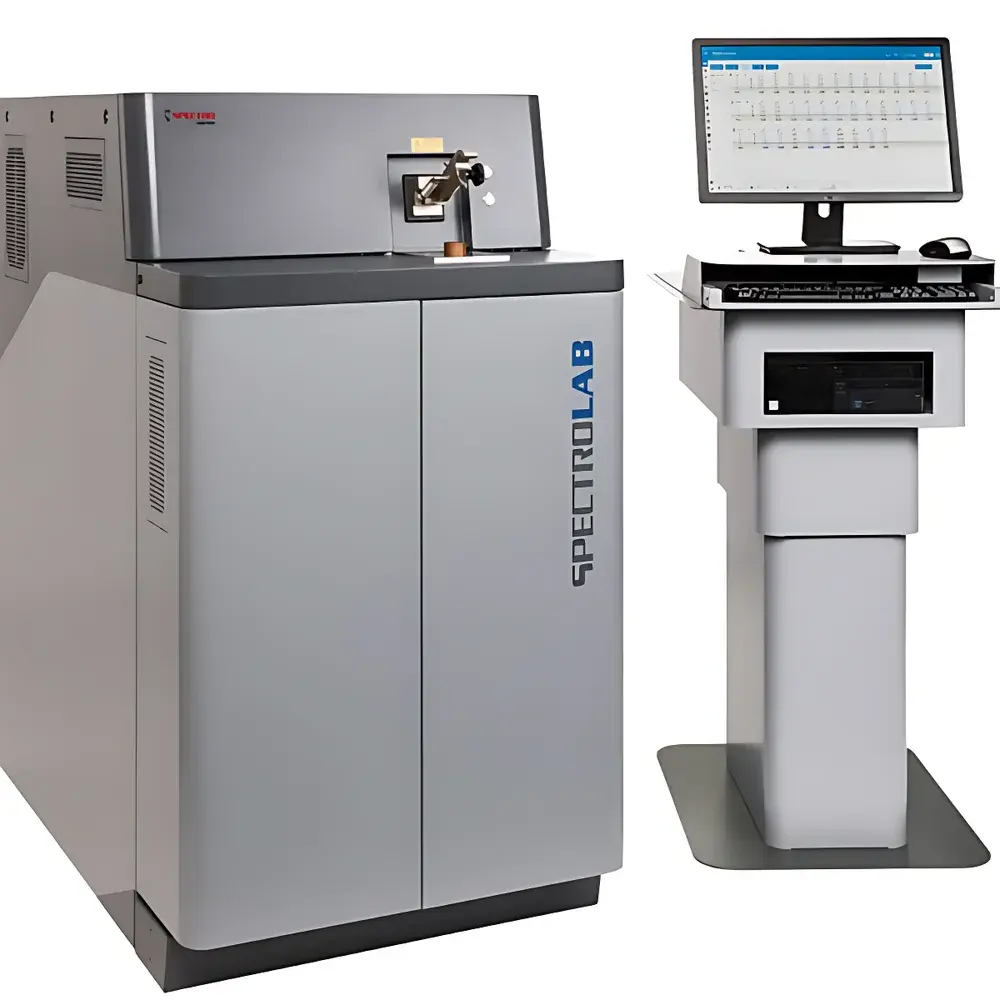
SPECTRO SPECTROLAB S LAS02 Direct-Reading Optical Emission Spectrometer
| Brand | SPECTRO |
|---|---|
| Origin | Germany |
| Model | SPECTROLAB S LAS02 |
| Instrument Type | Floor-Standing |
| Excitation Source | Spark |
| Detector Type | CMOS+T Solid-State Array |
| Focal Length | 750 mm |
| Grating Groove Density | 3600 lines/mm |
| Wavelength Range | 120–800 nm |
| Number of Channels | Application-Defined |
Overview
The SPECTRO SPECTROLAB S LAS02 is a high-performance floor-standing direct-reading optical emission spectrometer (OES) engineered for rapid, precise elemental analysis of metallic alloys in industrial and laboratory environments. Based on spark source atomic emission spectroscopy, the instrument excites solid metal samples using controlled high-voltage spark discharges in an argon-purged optical chamber. The emitted light is dispersed via a 750 mm focal length Czerny-Turner spectrometer with a high-resolution 3600 lines/mm grating, enabling spectral coverage from 120 nm (vacuum UV) to 800 nm (near-IR). Detection is performed using a proprietary CMOS+T solid-state array detector — a technological evolution replacing traditional PMT-based systems — delivering simultaneous multi-element acquisition, enhanced signal-to-noise ratio, and long-term stability without mechanical channel reconfiguration.
Key Features
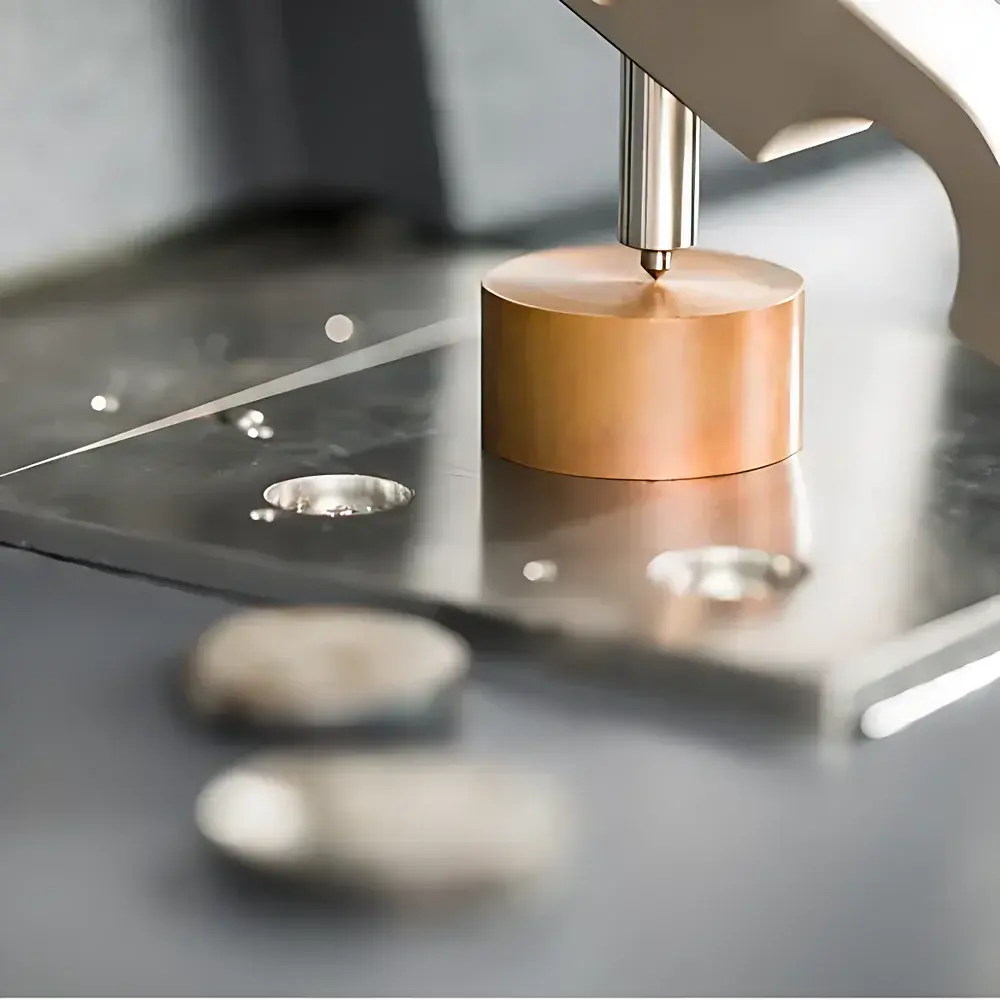
- Spark excitation optimized for reproducible ablation across ferrous and non-ferrous matrices (e.g., Fe, Al, Cu, Ni, Ti, Mg), with adjustable energy, frequency, and pre-spark conditioning.
- CMOS+T detector architecture: Provides full-spectrum capture per measurement cycle, eliminating fixed-channel limitations and enabling post-acquisition recalibration and retrospective element re-evaluation.
- iCAL 2.0 single-sample standardization: Compensates for instrumental drift and ambient temperature fluctuations (±10 °C), reducing daily calibration time by ~30 minutes and maintaining analytical consistency without reference standards for every run.
- Argon consumption optimization: 50% reduction in standby mode and 13% lower flow during active analysis versus prior-generation instruments — critical for operational cost control and sustainability compliance.
- Enhanced detection limits: 30% improvement for trace elements in high-purity copper (e.g., Ag, Bi, Pb, Se), supporting semiconductor-grade material certification and ultra-low impurity verification per ASTM E3061 and ISO 11577.
- Robust mechanical design: Sealed optical bench with thermal stabilization, integrated argon purge management, and vibration-damped base — engineered for continuous operation in foundry, rolling mill, and QC lab settings.
Sample Compatibility & Compliance
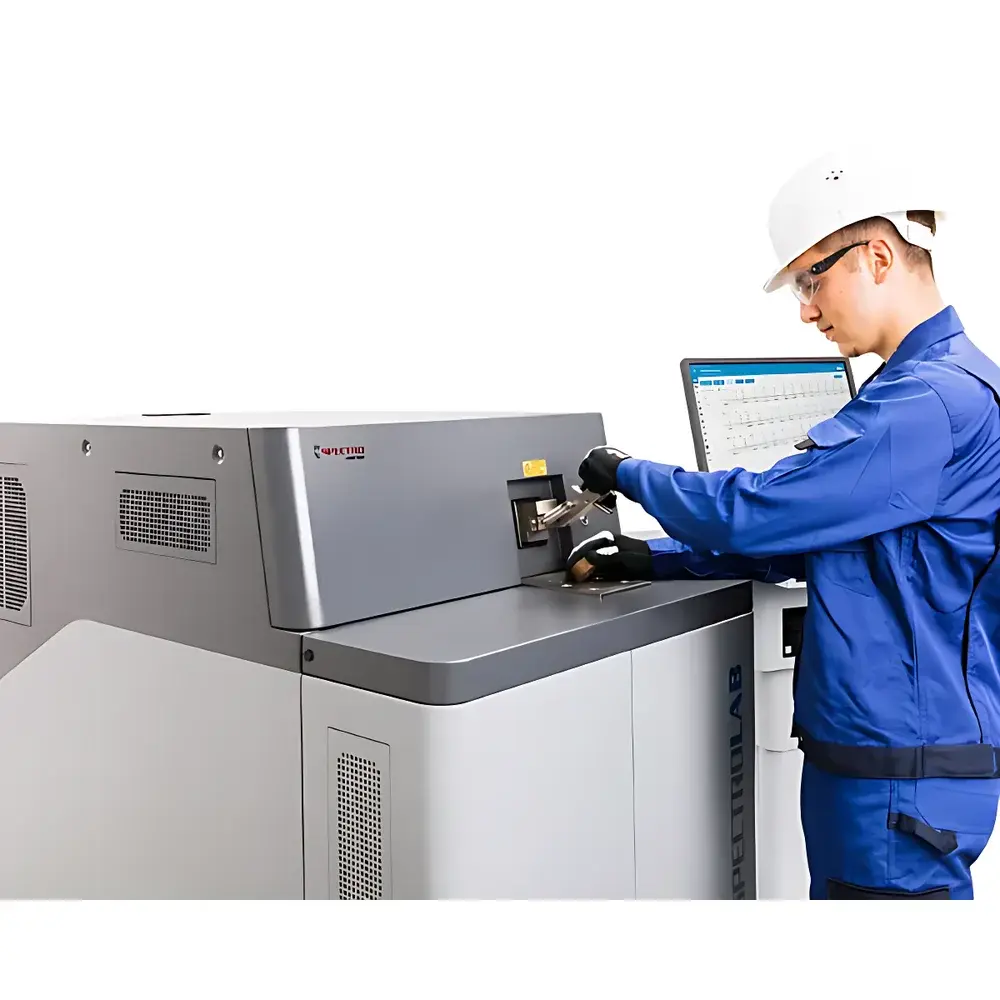
The SPECTROLAB S LAS02 analyzes solid conductive metallic samples (discs, rods, ingots, castings) ≥20 mm in diameter and ≥5 mm thick. It supports standardized sampling per ASTM E415 (carbon and low-alloy steels), ASTM E1086 (stainless steels), ASTM E1479 (aluminum alloys), and ISO 11577 (copper and copper alloys). The system complies with IEC 61000-6-3 (EMC), EN 61000-6-2 (immunity), and meets essential requirements of the EU Machinery Directive 2006/42/EC. Its software architecture supports audit trails, electronic signatures, and data integrity controls aligned with FDA 21 CFR Part 11 and EU Annex 11 for regulated manufacturing environments.
Software & Data Management
Controlled by SPECTRO’s SPARK ANALYZER PRO software, the platform provides intuitive workflow-driven operation, customizable method templates, and real-time spectral visualization. All raw spectra are stored in vendor-neutral HDF5 format, ensuring long-term archival compatibility. The software includes GLP/GMP-compliant features: user access levels with role-based permissions, full audit trail (including parameter changes, sample ID edits, and result overrides), and automated report generation compliant with ISO/IEC 17025. Data export supports CSV, XML, and LIMS integration via ASTM E1382-compliant interfaces.
Applications
The SPECTROLAB S LAS02 serves as a primary analytical tool in metal production and processing facilities requiring fast, accurate bulk and trace elemental quantification. Typical use cases include: incoming raw material inspection at steel mills and aluminum smelters; melt shop process control for alloy grade verification; final product certification for automotive castings and aerospace titanium components; scrap sorting and recycling quality assurance; and purity validation of electronic-grade copper and specialty alloys for semiconductor packaging. Its speed (≤12 s for major elements in Fe/Al/Cu; ≤20 s for full-spec low-alloy steel) enables high-throughput QC without compromising precision or detection capability.
FAQ
What sample preparation is required for spark OES analysis?
Flat, clean, and representative surfaces must be ground or milled to remove oxides and contamination; minimum surface area: 20 mm Ø, depth of analysis: ~50–100 µm.
Is vacuum pumping required for UV-range analysis?
No — the optical chamber is purged with high-purity argon (≥99.996%), enabling stable detection down to 120 nm without mechanical vacuum systems.
Can the instrument be upgraded with additional elements or calibrations post-purchase?
Yes — all calibrations are software-defined; new elements or matrix-specific methods can be added via licensed method packages without hardware modification.
How does iCAL 2.0 differ from conventional standardization protocols?
iCAL 2.0 uses a single certified reference sample to correct for both intensity drift and spectral shift in real time, eliminating the need for multi-point standardization routines across temperature gradients.
What maintenance intervals are recommended for routine operation?
Daily: electrode cleaning and argon line inspection; quarterly: optical window cleaning and spark stand alignment verification; annually: full spectrometer wavelength calibration and detector performance validation per ISO 17025 internal procedure.






