
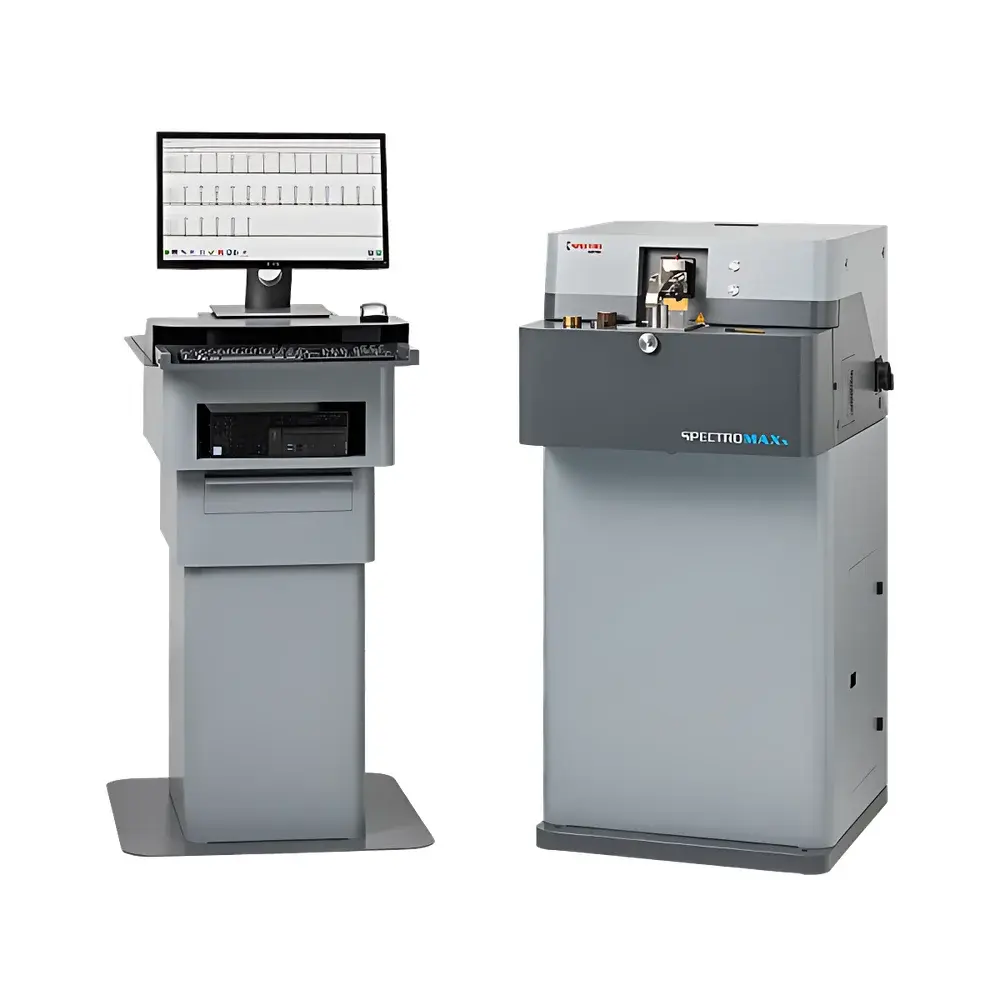
SPECTRO SPECTROMAXx (Floor-standing) Direct-Reading Optical Emission Spectrometer
| Brand | SPECTRO |
|---|---|
| Origin | Germany |
| Model | SPECTROMAXx (Floor-standing) |
| Instrument Type | Floor-standing |
| Excitation Method | Spark |
| Detector Type | CMOS |
| Focal Length | 400 mm |
| Grating Density | 3600 lines/mm |
| Wavelength Range | User-configurable |
| Number of Channels | Application-dependent |
| Compliance | ASTM E1184, ISO 11577, ISO 6871, EN 10052, USP <233>, FDA 21 CFR Part 11 (software-enabled), GLP/GMP-ready audit trail |
Overview
The SPECTRO SPECTROMAXx (Floor-standing) is a high-performance direct-reading optical emission spectrometer (OES) engineered for routine elemental analysis of metallic materials in foundries, metal production facilities, and quality control laboratories. Based on spark discharge excitation and high-resolution polychromator optics, it operates on the principle of atomic emission spectroscopy: solid metallic samples are vaporized and atomized in a controlled argon-purged spark chamber; excited atoms emit characteristic wavelengths, which are dispersed by a 400-mm focal length Czerny-Turner spectrometer equipped with a 3600 lines/mm holographic grating and detected simultaneously by a state-of-the-art CMOS detector array. This architecture enables quantitative multi-element analysis across up to 59 elements—including nitrogen in steel—within seconds per measurement, with trace-level detection limits optimized for Fe-, Al-, and Cu-based matrices.
Key Features
- Proprietary iCAL 2.0 single-standard calibration technology: dynamically compensates for thermal drift and environmental fluctuations, eliminating daily multi-point standardization and reducing calibration time by ~30 minutes per shift.
- Enhanced sensitivity: 30–40% lower limits of detection (LOD) vs. prior generation for key base matrices (Fe, Al, Cu), achieved through optimized spark source parameters, improved optical throughput, and advanced CMOS signal processing.
- Argon consumption reduction: up to 64% lower argon usage during standby mode versus predecessor models—critical for operational cost control and sustainability compliance.
- Intelligent hardware self-diagnosis: real-time monitoring of spark generator stability, purge gas flow, detector temperature, optical alignment, and electrode wear; predictive alerts for maintenance intervals (e.g., spark stand cleaning based on cumulative spark count).
- Application-driven channel configuration: flexible spectral channel allocation aligned with user-defined analytical requirements—not fixed hardware channels but software-defined spectral windows mapped to specific element lines.
- Pre-installed certified calibration curves: 68 factory-validated working curves covering 10 standard base materials (including cast iron, stainless steel, aluminum alloys, copper alloys, titanium, nickel, zinc, magnesium, lead, and precious metals), fully traceable to NIST and BAM reference materials.
Sample Compatibility & Compliance
The SPECTROMAXx accommodates solid metallic samples ranging from Ø10 mm to Ø40 mm (standard spark stand) with flat, machined surfaces. It supports analysis of as-cast, heat-treated, rolled, extruded, and welded materials—provided surface preparation meets ISO 11577 requirements (grinding depth ≥ 0.1 mm, absence of oxidation or contamination). All calibrations comply with ASTM E1184 (standard practice for OES analysis of metals), ISO 6871 (metallic dental alloys), EN 10052 (steel grade identification), and ISO 11577 (spark OES performance verification). Software features full 21 CFR Part 11 compliance including electronic signatures, role-based access control, immutable audit trails, and data integrity safeguards required for regulated environments (e.g., aerospace, medical device, and automotive Tier-1 suppliers).
Software & Data Management
Controlled by SPECTRO’s WinWDS v4.x platform, the system employs a context-sensitive, toolbar-driven interface: only functionally relevant buttons appear during active measurement sequences—minimizing operator error. Predefined application profiles store customer-specific sample IDs, reporting templates, tolerance limits, and workflow logic (e.g., automatic re-analysis if %RSD exceeds 2.5%). Raw spectral data, background-corrected intensities, and calibration coefficients are stored in vendor-neutral HDF5 format. Integrated export modules support LIMS connectivity via ASTM E1394, OPC UA, and SQL database interfaces. All analytical reports include full metadata: instrument ID, operator, timestamp, ambient conditions, argon pressure, spark energy, and measurement duration.
Applications
- Primary metal production: rapid grade identification and melt composition verification in blast furnaces, EAFs, and AOD vessels.
- Foundry process control: real-time monitoring of alloying additions (e.g., Cr, Ni, Mo, V, Nb) and residual elements (P, S, Sn, As) in ductile iron and aluminum gravity die casting.
- Finished goods QA/QC: certification testing of forgings, extrusions, and fasteners against ASTM A743, EN 10204 3.1, and ASME Section II Part A specifications.
- Nitrogen analysis in austenitic stainless steels and superalloys—critical for pitting resistance equivalent number (PREN) calculation.
- Scrap sorting and recycling: discrimination between similar-grade alloys (e.g., 304 vs. 316 stainless, 6061 vs. 6063 aluminum) using multivariate statistical classification.
FAQ
Does the SPECTROMAXx require daily recalibration with multiple standards?
No—iCAL 2.0 enables stable operation for up to 8 hours using only one calibration standard, with automated drift correction applied in real time.
Can the system analyze nitrogen in low-alloy steels?
Yes—equipped with vacuum-optimized optics and UV-enhanced CMOS detection, it quantifies nitrogen down to 20 ppm in ferritic and martensitic grades per ISO 10700.
Is remote diagnostics supported?
Yes—the embedded service interface allows secure, encrypted remote access for firmware updates, spectral diagnostics, and preventive maintenance planning.
What sample preparation equipment is recommended?
A dedicated metallurgical grinder meeting ISO 11577 surface finish requirements (Ra ≤ 0.8 µm) and spark stand cleaning kit (electrode brush, ceramic scraper, argon filter replacement tools) are included in standard delivery.
How is data integrity ensured for regulatory audits?
WinWDS implements full ALCOA+ principles: attributable, legible, contemporaneous, original, accurate, complete, consistent, enduring, and available—with electronic signature enforcement and tamper-proof audit logs archived for ≥15 years.
Related Products




