
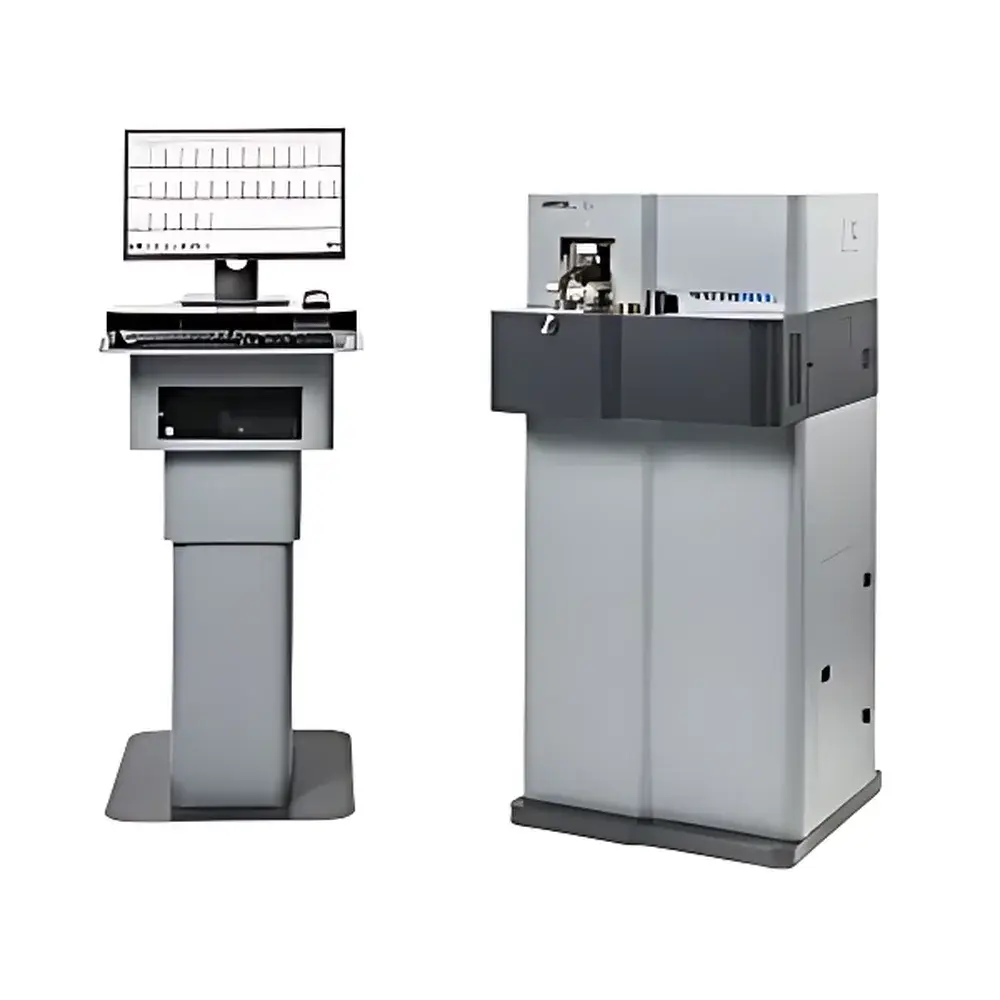
SPECTRO SPECTROMAXx08 Floor-standing Direct-Reading Optical Emission Spectrometer
| Brand | SPECTRO |
|---|---|
| Origin | Germany |
| Model | SPECTROMAXx08 |
| Excitation Source | Spark |
| Detector Type | Charge-Coupled Device (CCD) |
| Focal Length | 400 mm |
| Grating Groove Density | 3600 lines/mm |
| Wavelength Range | User-configurable |
| Number of Channels | Not applicable (Full-spectrum CCD-based system) |
| Instrument Form Factor | Floor-standing |
| Application Domain | Metal & Foundry Quality Control, Incoming/Outgoing Material Inspection, Process Monitoring |
Overview
The SPECTRO SPECTROMAXx08 is a floor-standing, spark-source optical emission spectrometer (OES) engineered for high-precision elemental analysis of metallic alloys in foundries, metal service centers, and production QA/QC laboratories. Based on the principles of atomic emission spectroscopy, it utilizes controlled spark discharge to atomize and excite sample surfaces, generating element-specific spectral lines across the ultraviolet–visible range (typically ~120–800 nm). The instrument’s 400 mm focal length Paschen–Runge optical bench—equipped with a high-resolution 3600 g/mm holographic grating—delivers exceptional spectral dispersion and line separation. Coupled with a thermally stabilized, back-thinned CCD detector array, the system captures full-spectrum data simultaneously without mechanical scanning or fixed-channel limitations. This architecture enables quantitative determination of up to 54 elements—including light elements such as C, P, S, and N—across 10 major metallic matrices (e.g., Fe, Al, Cu, Mg, Ni, Ti, Zn, Pb, Sn, Co), supporting both routine compliance testing and demanding process control applications.
Key Features
- Full-spectrum CCD detection architecture eliminates channel constraints and enables post-acquisition re-evaluation of spectral regions without hardware modification.
- Intelligent calibration logic (iCAL) permits single-sample standardization—reducing daily recalibration time by approximately 30 minutes—and maintains accuracy across ambient temperature fluctuations (±5 °C).
- Dynamic exposure control adjusts integration time per element based on signal intensity and matrix composition, optimizing precision while minimizing total analysis cycle time (up to 12% faster than prior-generation models; e.g., low-alloy steel analysis reduced by 3 seconds).
- Automated spark stand condition monitoring provides real-time feedback—including prompt alerts when electrode cleaning or argon purge optimization is required—enhancing measurement reproducibility and reducing operator dependency.
- Modular software interface separates operation from method programming: workflow-driven GUI displays only contextually relevant functions during active analysis, minimizing error risk and accelerating technician onboarding.
- Optional AMECARE M2M connectivity supports secure, encrypted remote diagnostics and proactive maintenance via direct connection to SPECTRO-certified service engineers—fully compliant with ISO/IEC 27001 data handling protocols.
Sample Compatibility & Compliance
The SPECTROMAXx08 accommodates solid metallic samples conforming to ASTM E415, ISO 11577, and EN 10315 standards for OES sample preparation (e.g., flat, polished, ≥20 mm diameter, minimum thickness 4 mm). It supports analysis of cast iron, stainless steels, aluminum alloys, copper-based materials, and high-temperature superalloys. All firmware and spectral processing algorithms are validated per GLP and GMP requirements, with full audit trail functionality (including user logins, method versioning, raw spectrum archiving, and timestamped result export) meeting FDA 21 CFR Part 11 electronic record criteria when deployed with optional SPECTRO AnalyzeSuite™ Secure Edition.
Software & Data Management
Control and analysis are managed through SPECTRO’s proprietary AnalyzeSuite™ software platform, built on a Microsoft SQL Server backend for enterprise-grade data integrity and scalability. The system supports customizable report templates (PDF, Excel, XML), automated LIMS integration via ASTM E1384-compliant interfaces, and role-based user access control (administrator, analyst, supervisor). Raw spectral data—including background-corrected intensities, peak fitting parameters, and internal standard ratios—is stored in vendor-neutral HDF5 format, ensuring long-term archival compatibility and third-party spectral library interoperability.
Applications
- Routine incoming material inspection against purchase specifications (e.g., ASTM A743, EN 10088, GB/T 223 series).
- Final product certification for aerospace-grade nickel alloys (e.g., Inconel 718, Waspaloy) requiring trace nitrogen quantification down to 30 ppm.
- Process control in ductile iron foundries—monitoring nodularity-critical elements (Mg, Ce, Ca) alongside carbon equivalent calculation.
- Scrap sorting and recycling verification, including rapid discrimination between 304/316 stainless grades and identification of hazardous contaminants (e.g., Pb, Cd, As).
- Research and development of new aluminum casting alloys, where simultaneous quantification of minor (<0.01%) and trace (<10 ppm) elements informs heat treatment response modeling.
FAQ
Does the SPECTROMAXx08 require external cooling water or compressed air?
No—it operates with integrated air-cooling and sealed argon-purged optics, eliminating dependency on facility utilities beyond standard 230 V / 50 Hz power and laboratory-grade argon (99.996% purity, dew point ≤ –60 °C).
Can the system analyze non-conductive samples such as ceramics or coatings?
Not natively; the spark source requires electrically conductive bulk metal samples. For non-metals or thin films, complementary techniques such as LA-ICP-MS or XRF are recommended.
Is method transfer possible from older SPECTRO instruments?
Yes—AnalyzeSuite™ includes backward-compatible spectral library import tools and automatic wavelength mapping alignment for legacy calibrations (SPECTROLAB, SPECTROMAXx07), subject to optical resolution and detector sensitivity harmonization.
What maintenance intervals are recommended for routine operation?
Spark stand cleaning every 500–1000 analyses (automatically tracked); optical chamber purging every 6 months; annual performance verification using certified reference materials per ISO 17025 guidelines.
How is data security ensured during remote support sessions?
AMECARE M2M employs TLS 1.3 encryption, session time-outs, and one-time authentication tokens; no local data is transmitted—only diagnostic metadata and anonymized instrument logs are shared with SPECTRO support servers.



