
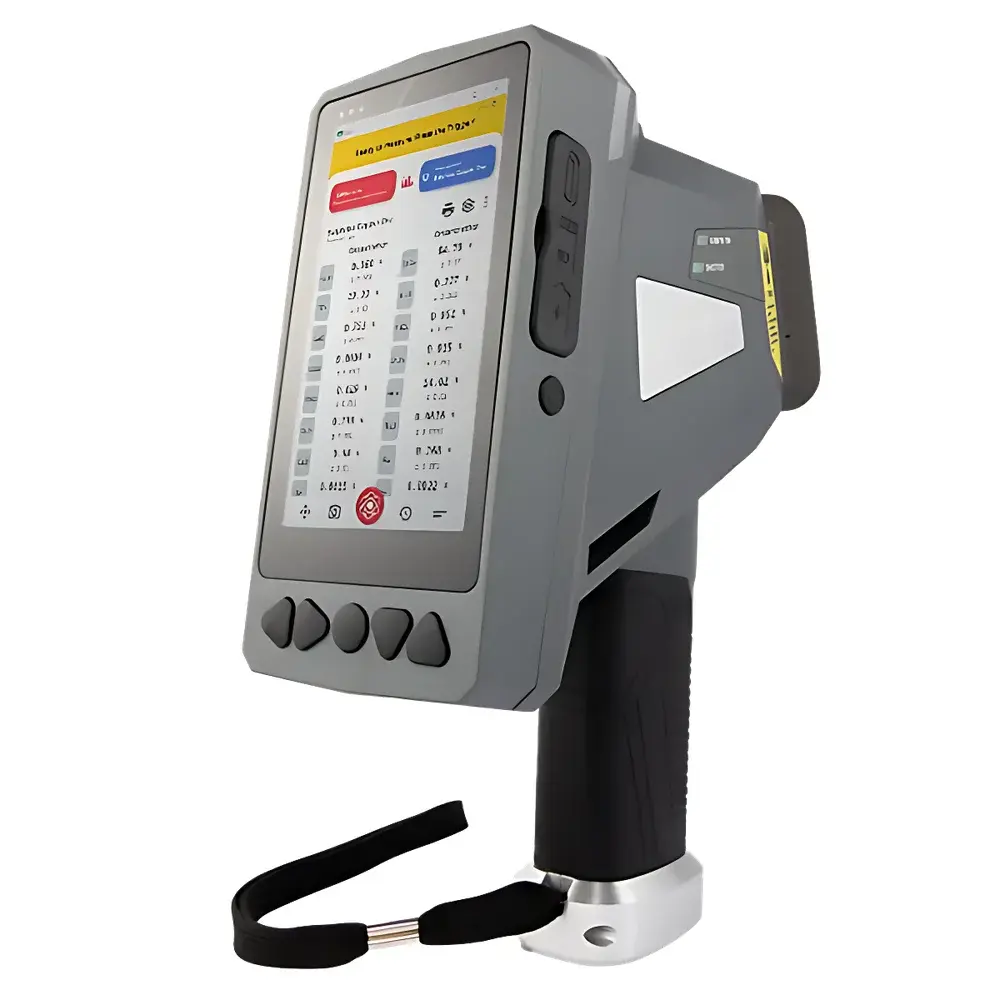
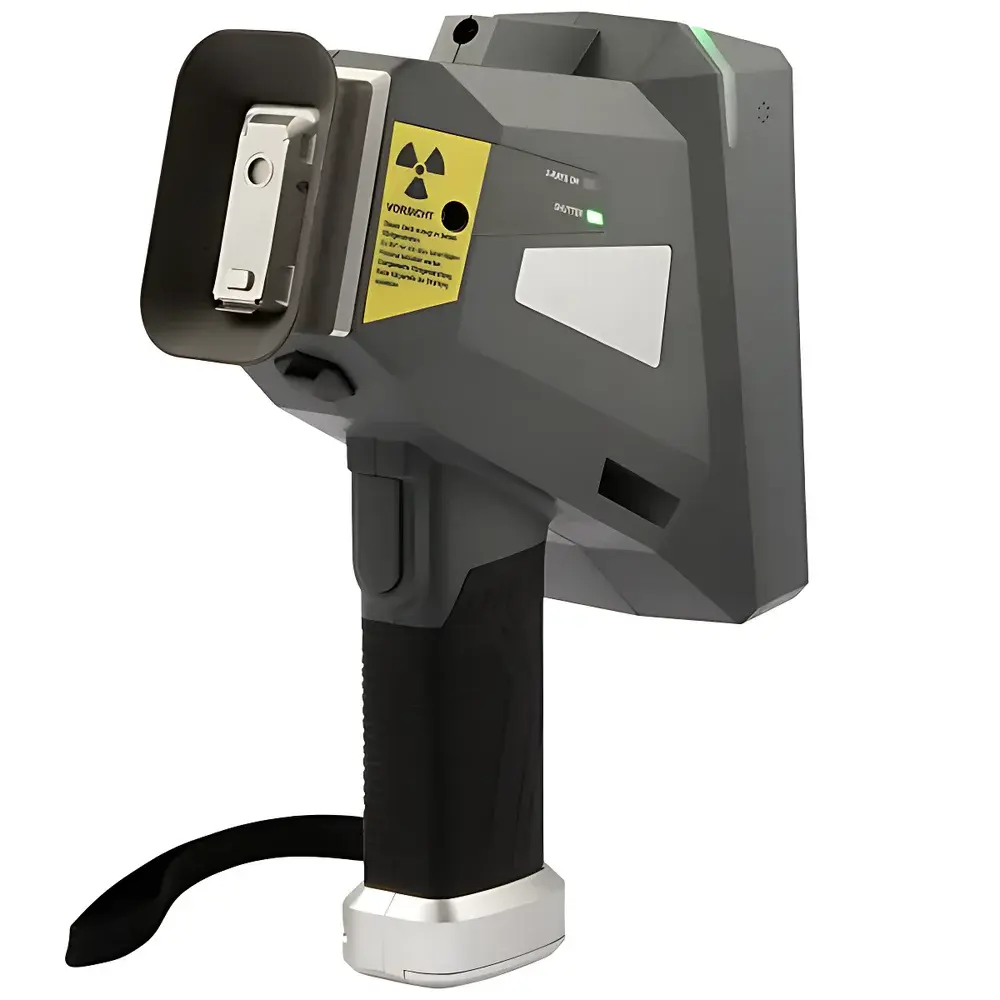
SPECTRO xSORT Handheld Energy Dispersive X-Ray Fluorescence Spectrometer
| Brand | SPECTRO |
|---|---|
| Origin | Germany |
| Model | SPECTRO xSORT |
| Portability | Handheld / Field-Deployable |
| Detection Range | Mg (12) to U (92) |
| Display | 5-inch HD touchscreen |
| Operating System | Android-based embedded OS |
| Connectivity | Wi-Fi, Bluetooth, USB, MicroSD |
| Integrated Sensors | GPS, dual cameras |
| Ergonomics | Glove-compatible physical buttons, low-force trigger, balanced weight distribution |
| Compliance | Meets ISO 12847, ASTM E2865, and EU RoHS/WEEE screening requirements |
| Software Platform | XRF Analyzer Pro (PC-based, supports audit trail, method management, and GLP-compliant reporting) |
| Sample Handling | Compatible with portable sample chamber and docking station for lab-grade repeatability |
Overview
The SPECTRO xSORT is a handheld energy dispersive X-ray fluorescence (EDXRF) spectrometer engineered for high-precision elemental analysis in demanding field environments. Utilizing a miniature X-ray tube and high-resolution silicon drift detector (SDD), it operates on the fundamental principle of X-ray fluorescence emission: incident X-rays excite inner-shell electrons in sample atoms; upon relaxation, characteristic secondary X-rays are emitted, with energies uniquely identifying elements from magnesium (atomic number 12) to uranium (92). Its compact, ergonomically refined architecture enables stable single-hand operation over extended periods—critical for geological surveys, environmental site assessments, and industrial compliance checks where laboratory access is impractical. Unlike benchtop EDXRF systems, the xSORT maintains analytical rigor without sacrificing mobility, delivering quantitative and semi-quantitative results traceable to certified reference materials (CRMs) and aligned with international standard test methods.
Key Features
- Optimized human-machine interface: 5-inch high-brightness capacitive touchscreen with glove-mode support and tactile physical buttons for reliable operation in dusty, wet, or cold conditions.
- Low-force trigger mechanism reduces operator fatigue during repetitive measurements—validated for >8-hour continuous use in mining field campaigns.
- Integrated dual-camera system captures real-time visual context: one macro lens documents sample surface morphology; the other wide-angle lens geotags each spectrum with GPS coordinates and time stamps, enabling spatial correlation in GIS workflows.
- Modular connectivity: native Wi-Fi and Bluetooth 5.0 enable secure data streaming to enterprise LIMS or cloud platforms; USB-C and MicroSD provide offline redundancy and rapid batch export.
- Docking station compatibility transforms the device into a semi-portable analyzer: when mounted, it supports automated multi-point mapping, longer counting times, and stabilized geometry—enhancing precision for regulatory-grade reporting (e.g., EPA Method 6200, ISO 12847).
Sample Compatibility & Compliance
The SPECTRO xSORT accommodates heterogeneous solid matrices without mandatory sample preparation—ideal for raw ores, slag, soil cores, scrap metal, painted surfaces, and consumer goods. Its factory-calibrated methods cover >30 pre-optimized applications across mining (Fe, Cu, Zn, Pb, Ni, Co), environmental screening (As, Cd, Cr, Hg, Pb), and restricted substance verification (RoHS, POPs, CPSIA). All firmware and calibration libraries comply with ISO/IEC 17025 documentation standards and support full traceability per FDA 21 CFR Part 11 requirements—including electronic signatures, audit trails, and method version control. Instrument performance is verified using NIST-traceable CRMs (e.g., SRM 2710a, 2711a) prior to shipment and recommended annually per manufacturer guidelines.
Software & Data Management
XRF Analyzer Pro software serves as the central hub for post-acquisition processing, statistical validation, and regulatory documentation. It provides spectral deconvolution, matrix correction algorithms (Fundamental Parameters + empirical calibration), limit-of-detection (LOD) calculation per element, and customizable report templates compliant with ISO 14001 and ISO 9001 quality frameworks. Data files (.xrf, .csv, .pdf) retain full metadata: instrument ID, operator log, GPS path, exposure parameters, and detector live-time correction factors. Role-based user permissions and encrypted local storage ensure data integrity during field-to-lab handover—essential for third-party audits and chain-of-custody documentation.
Applications
- Geological exploration: Real-time grade estimation of open-pit faces, drill core logging, and tailings characterization—reducing assay turnaround from days to seconds.
- Environmental site assessment: Rapid screening of contaminated soils per ASTM D6729 and EPA Region 9 protocols; detection limits for As and Pb routinely achieve <10 ppm at 30-second count times.
- Scrap metal sorting: Instant alloy identification (e.g., distinguishing 304 vs. 316 stainless, Ti-6Al-4V vs. CP-Ti) with classification accuracy >99.2% across >200 alloy grades.
- Consumer product safety: Screening for regulated elements (Cd, Pb, Hg, Cr⁶⁺, Br) in plastics, coatings, and electronics per IEC 62321-5 and EN 71-3.
FAQ
Does the SPECTRO xSORT require annual recalibration?
Yes—while factory calibrations remain stable under normal use, SPECTRO recommends annual performance verification using certified reference materials and optional factory recertification to maintain compliance with ISO/IEC 17025 and GLP requirements.
Can the instrument analyze light elements such as sodium or aluminum in air?
The xSORT detects Mg and heavier elements reliably in ambient air; lighter elements (Na, O, C, N) require helium purge or vacuum operation—available only on benchtop SPECTRO models, not handheld variants.
Is method development possible in the field?
Experienced users can perform smart field calibration via PC connection using XRF Analyzer Pro, importing custom CRMs and adjusting FP parameters—but this requires documented SOPs and is not intended for routine screening.
What safety certifications does the device hold?
It complies with IEC 61010-1 (electrical safety), IEC 62471 (LED/X-ray radiation safety), and carries CE marking for EMC and RoHS conformity; all X-ray emissions are fully shielded and interlocked per EN 62495.
How is data integrity ensured during wireless transmission?
Wi-Fi transfers use TLS 1.2 encryption; Bluetooth pairing employs Secure Simple Pairing (SSP); all exported reports include digital hash signatures verifiable against original acquisition logs.




