
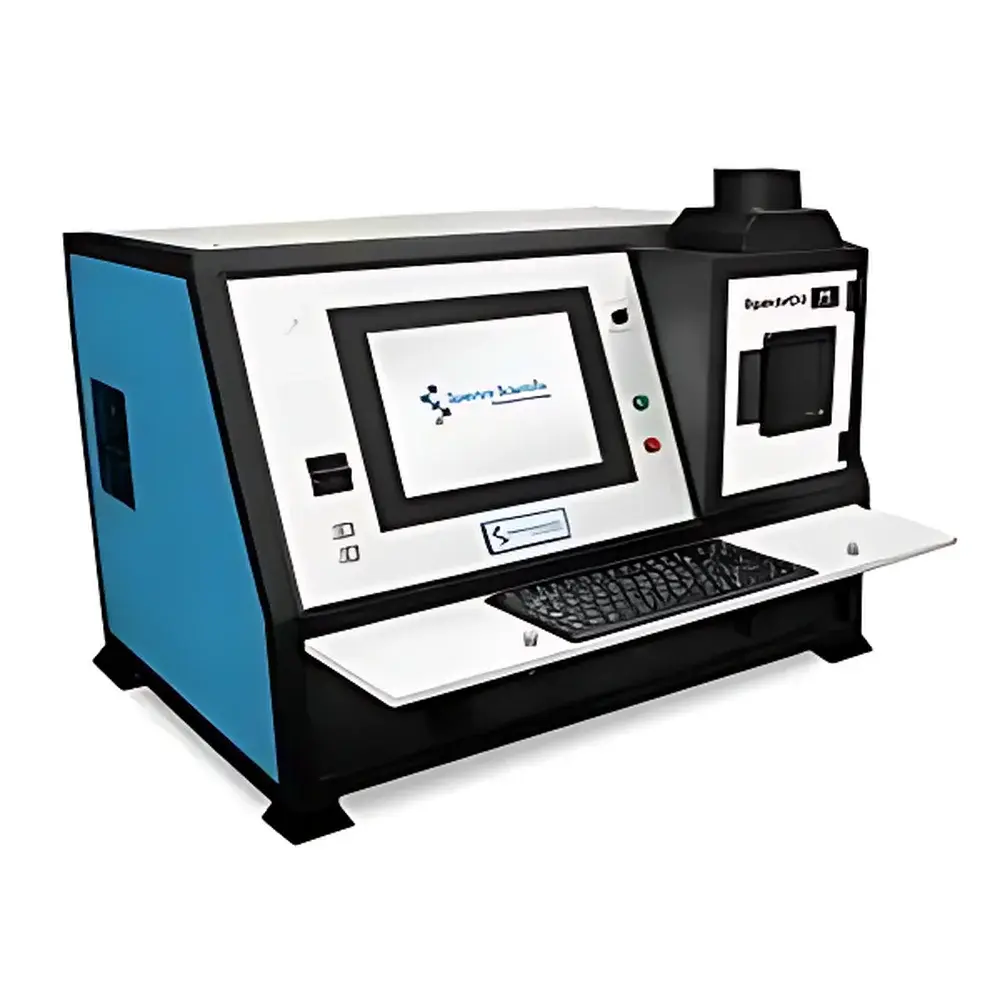
SpectrOil M Series Fuel Oil Elemental Analyzer
| Origin | USA |
|---|---|
| Manufacturer Type | Authorized Distributor |
| Origin Category | Imported |
| Model | SpectrOil M |
| Pricing | Upon Request |
| Product Category | Laboratory Instrument |
| Analytical Capability | Multi-element Quantification (Metals, Additives, Contaminants) |
Overview
The SpectrOil M Series Fuel Oil Elemental Analyzer is a benchtop rotational disc electrode atomic emission spectrometer (RDE-AES) engineered for rapid, in-laboratory elemental quantification in petroleum-based fluids—including used lubricating oils, hydraulic fluids, diesel fuels, and jet fuels. Based on the fundamental principle of arc-excited atomic emission spectroscopy, the instrument vaporizes a micro-volume of oil sample directly from a rotating tungsten disc electrode under controlled argon-free atmospheric conditions, generating characteristic spectral lines that are resolved and quantified via a high-resolution Czerny–Turner optical system with CCD detection. Unlike ICP-OES or XRF systems, RDE-AES eliminates the need for acid digestion, dilution, or matrix-matched calibration standards—enabling direct analysis of neat oil samples with minimal operator intervention. Designed to meet U.S. Department of Defense (DoD) operational requirements, the SpectrOil M is JOAP CID-0191 certified for mechanical shock and vibration resistance, making it suitable for deployment in mobile labs, field maintenance units, and remote aviation or marine facilities where environmental stability cannot be guaranteed.
Key Features
- JOAP CID-0191-compliant ruggedized chassis with integrated shock-absorbing mounting and MIL-STD-810G-aligned transport case for field mobility
- 30-second total analysis cycle time—from sample loading to calibrated elemental concentration report
- Simultaneous quantification of up to 31 elements, including wear metals (Fe, Cu, Al, Cr, Pb), contaminants (Si, Na, B, K), and additive package constituents (Ca, Mg, Zn, P, Ba)
- Integrated industrial-grade touchscreen PC with embedded firmware; no external computer or software license required
- Zero consumables beyond electrodes: operates without carrier gas, plasma support, or chemical reagents—only standard 100–240 VAC power input
- Self-calibrating optical path with real-time wavelength stabilization and drift compensation
- Pre-loaded ASTM D6595 and ASTM D6728 compliant measurement protocols with automated QC flagging for out-of-trend results
Sample Compatibility & Compliance
The SpectrOil M accepts undiluted, unfiltered oil samples (viscosity range: ISO VG 10–150) and fuels (diesel, JP-5, JP-8, F-34). It complies fully with ASTM D6595 (“Standard Test Method for Determination of Wear Metals and Contaminants in Used Lubricating Oils or Hydraulic Fluids by Rotating Disc Electrode Atomic Emission Spectrometry”) and ASTM D6728 (“Standard Test Method for Determination of Contaminants in Gasoline and Diesel Fuels by Rotating Disc Electrode Atomic Emission Spectrometry”). The system supports GLP/GMP data integrity requirements through built-in audit trail functionality, user-access controls, electronic signatures, and secure data export (CSV, PDF, XML) aligned with FDA 21 CFR Part 11 readiness. All calibration curves are traceable to NIST SRM 2720a (used engine oil) and custom-certified reference oils validated per ISO/IEC 17025 accredited procedures.
Software & Data Management
The embedded SpectrOil Control Suite provides intuitive workflow navigation via a 10.1-inch capacitive touchscreen. Each analysis generates a complete metadata-rich report containing spectral intensity plots, elemental concentration tables (ppm), trend charts against historical baselines, and pass/fail status relative to OEM-specified limits (e.g., SAE J300, OEM fluid condition monitoring thresholds). Data is stored locally in an encrypted SQLite database with optional network synchronization to LIMS via HTTPS REST API. Firmware updates are delivered over-the-air or via USB; all software revisions maintain backward compatibility with legacy calibration files and method definitions.
Applications
- Condition-based maintenance (CBM) programs for turbine engines, marine propulsion systems, and off-highway equipment
- Fuel quality assurance at refinery terminals, military depots, and NATO fuel distribution hubs
- Root-cause failure analysis of bearing, gear, and pump wear in power generation and wind turbine applications
- Additive depletion monitoring for extended drain interval validation in heavy-duty diesel engines
- Contamination control in hydraulic systems serving aerospace ground support equipment (GSE) and flight simulators
- Third-party certification testing per MIL-PRF-2104G, DEF STAN 91-91, and ASTM D4485 specifications
FAQ
Does the SpectrOil M require argon or other shielding gases?
No. The instrument operates in ambient air using proprietary electrode geometry and spark timing to suppress nitrogen/oxygen spectral interference.
Can it analyze biodiesel blends or synthetic ester-based lubricants?
Yes—validated for B5–B20 biodiesel blends and PAO/PAG synthetics within specified viscosity and conductivity ranges; method adaptation may be required for highly polar formulations.
Is method transfer possible between different SpectrOil M units?
Yes. Calibration profiles and spectral libraries are portable via encrypted USB key and retain full metrological equivalence across instruments when using identical electrode batches and reference oils.
What maintenance is required beyond electrode replacement?
Annual optical alignment verification and quarterly electrode cleaning with isopropyl alcohol; no lamp or detector replacement is scheduled within the first 10 years of operation.
How does it handle water-contaminated or severely oxidized samples?
Samples with >0.1% water content must be pre-dehydrated (per ASTM D6304); heavily oxidized oils may require dilution with base oil to prevent carbon buildup on the electrode surface—both scenarios are flagged automatically during analysis initiation.





