
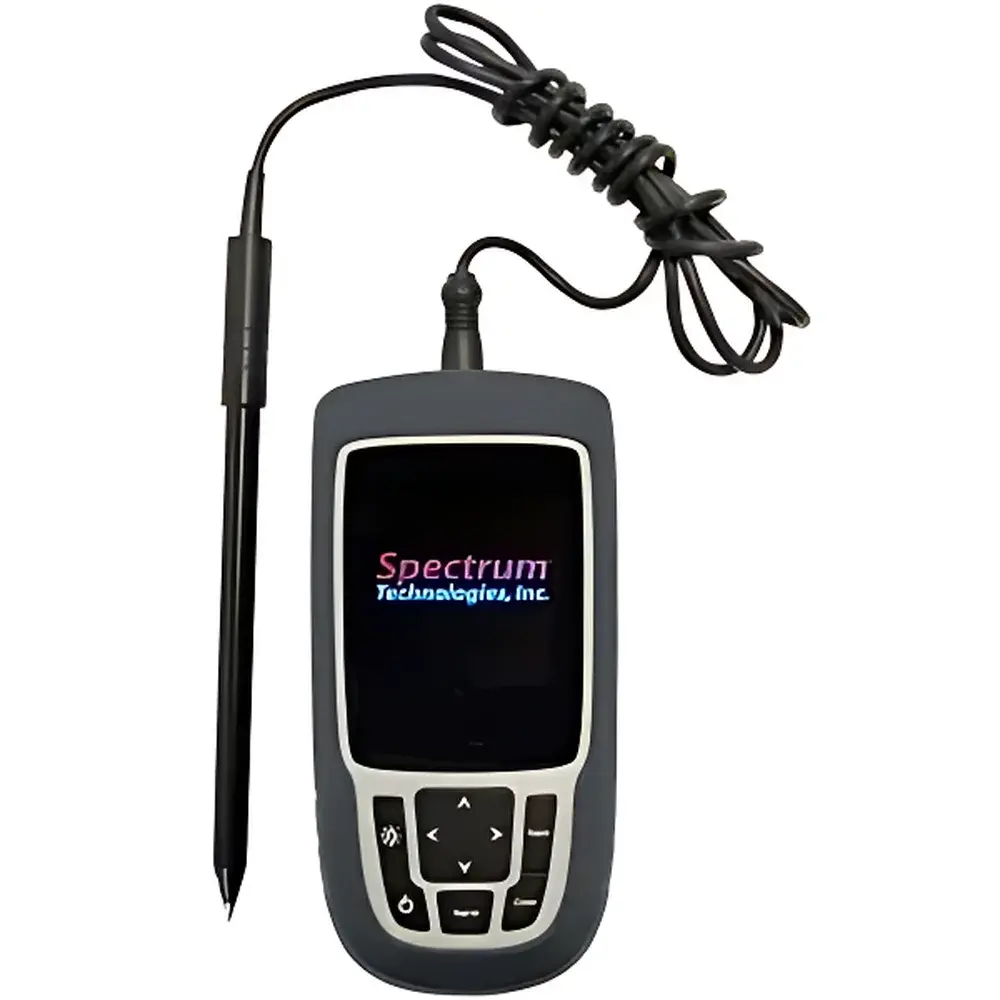
Spectrum Technologies FieldScout PH600 In-Situ Soil pH Meter
| Brand | Spectrum Technologies |
|---|---|
| Origin | USA |
| Model | PH600 |
| IP Rating | IP65 |
| Display | 3.2" backlit color LCD |
| Power | 3× rechargeable AA batteries (AC adapter included) |
| Calibration | 1-point and 2-point guided calibration |
| Electrode Type | ISFET (Ion-Selective Field-Effect Transistor) |
| pH Range | 0.00–14.00 |
| Accuracy | ±0.01 pH |
| Resolution | 0.01 pH |
| Probe Options | Needle-tip and Blunt-tip ISFET sensors |
| Probe Materials | PEEK, ABS, PVC |
| Warranty | 1 year (instrument), 6 months (probe) |
| Compliance | Designed for field-deployable GLP-aligned environmental monitoring |
Overview
The Spectrum Technologies FieldScout PH600 In-Situ Soil pH Meter is an engineered field instrument designed for direct, real-time pH measurement in heterogeneous, unprocessed soil matrices and alternative growth media—including potting mixes, hydroponic solutions, peat-based substrates, and containerized root zones. Unlike traditional glass-electrode pH meters requiring liquid junctions, equilibration time, and frequent hydration maintenance, the PH600 employs solid-state ISFET (Ion-Selective Field-Effect Transistor) sensing technology. This architecture eliminates fragile glass membranes and reference electrolyte leakage, enabling stable, drift-resistant measurements in high-solids, low-moisture, or particulate-laden environments where conventional electrodes fail. The device operates on a robust electrochemical principle: surface potential changes at the ISFET gate oxide layer—chemically modified to respond selectively to H⁺ activity—are converted into calibrated voltage outputs via integrated signal conditioning circuitry. Its compact form factor, sealed electronics, and ergonomic grip support extended handheld operation across diverse agricultural, horticultural, ecological research, and turf management workflows.
Key Features
- 3.2-inch backlit color LCD display with high-contrast interface—optimized for outdoor readability under variable ambient light conditions
- IP65-rated enclosure providing full dust ingress protection and resistance to water splashing from any direction
- Dual ISFET probe options: needle-tip configuration for penetration into compacted soils or small-volume samples; blunt-tip variant for immersion in liquids, nutrient solutions, and loose substrates
- Integrated shock-absorbing rubber overmold and gasket-sealed battery compartment and USB port—ensuring mechanical durability during repeated field deployment
- Intelligent on-device calibration wizard supporting both single-point (pH 7.0) and two-point (pH 4.0/7.0 or 7.0/10.0) procedures with real-time feedback and pass/fail validation
- Rechargeable AA battery system (3 cells) offering >12 hours of continuous operation; AC adapter included for benchtop charging and data transfer
- Non-glass sensor construction—eliminates breakage risk, removes need for storage solution, and enables rapid dry-storage between uses
Sample Compatibility & Compliance
The PH600 is validated for direct in-situ measurement in undisturbed soil profiles, containerized media, nursery trays, greenhouse benches, turf root zones, compost piles, and hydroponic reservoirs. Its ISFET probes tolerate moderate particulate loading, organic film accumulation, and low ionic strength conditions without clogging or significant response lag. While not certified to ISO/IEC 17025 for accredited testing laboratories, the instrument conforms to fundamental metrological principles outlined in ASTM D4972 (Standard Test Method for pH of Soils) and supports data integrity practices aligned with GLP (Good Laboratory Practice) documentation requirements. All firmware and calibration routines are traceable, with timestamped calibration logs stored internally for audit readiness.
Software & Data Management
Data logging is performed onboard with internal memory capable of storing up to 1,000 timestamped pH and temperature readings. Export occurs via micro-USB connection using Spectrum’s proprietary FieldScout Connect desktop application (Windows/macOS compatible), which supports CSV export, batch calibration report generation, and geotagged measurement mapping when paired with optional GPS-enabled tablets. The software enforces user-defined metadata fields (e.g., site ID, depth, substrate type), facilitating structured database ingestion for longitudinal trend analysis. No cloud dependency or subscription model is required—data ownership remains fully local and compliant with institutional IT security policies.
Applications
- Agricultural extension services performing on-farm soil health assessments and lime recommendation modeling
- Horticultural researchers evaluating pH stability in controlled-environment agriculture (CEA) systems and substrate formulations
- Ecological restoration teams assessing acidification trends in post-mining or reclaimed soils
- University teaching labs conducting comparative pedology exercises with minimal electrode maintenance overhead
- Greenhouse operations managing pH-sensitive crops such as blueberries, azaleas, and cannabis cultivars
<liTurfgrass scientists monitoring rhizosphere pH shifts in response to irrigation chemistry or fertilizer regimes
FAQ
Does the PH600 require electrode storage solution between uses?
No. ISFET probes do not contain liquid electrolytes and may be stored dry at room temperature.
Can the PH600 measure pH in saturated paste extracts?
Yes—the blunt-tip probe is suitable for immersion in extracted soil solutions; the needle-tip probe is intended for direct insertion into intact or minimally disturbed media.
Is temperature compensation automatic?
Yes. Integrated NTC thermistor provides real-time ATC (Automatic Temperature Compensation) across 0–50 °C.
What standards does the calibration process follow?
Calibration adheres to standard buffer protocols per NIST-traceable pH 4.01, 7.00, and 10.01 reference solutions; no proprietary buffers are required.
How often should the ISFET probe be recalibrated in field use?
Field practice recommends verification before each sampling session; recalibration is advised if drift exceeds ±0.03 pH relative to a fresh buffer check.







