
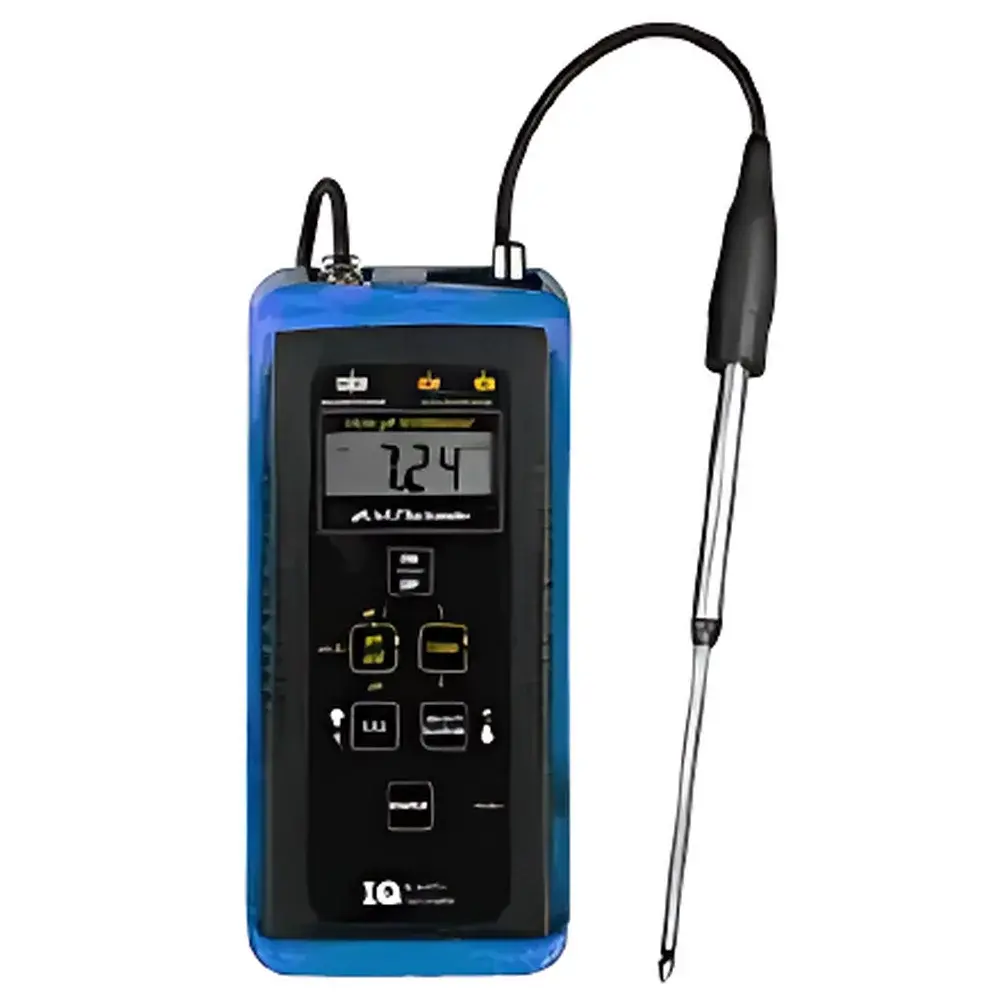
Spectrum Technologies IQ150 In-Situ Soil pH Meter
| Brand | Spectrum Technologies |
|---|---|
| Origin | USA |
| Model | IQ150 |
| Measurement Range | pH 0.00–14.00 |
| Temperature | 0–100 °C |
| Output Voltage | ±1999 mV |
| Resolution | pH 0.01/0.1, Temp 0.1 °C, Voltage 0.1/1.0 mV |
| Accuracy | pH ±0.01, Temp ±0.5 °C, Voltage ±0.1 mV |
| Calibration | 1- or 2-point |
| Buffer Recognition | 1.68, 4.00, 6.86, 7.00, 7.14, 9.18, 10.01, 11.88, 12.45 |
| Temperature Compensation | Manual or Automatic (0–100 °C) |
| Power Supply | 9 V DC battery or 12 V AC adapter |
| Dimensions | 90 × 180 × 40 mm |
| Weight | 1300 g |
Overview
The Spectrum Technologies IQ150 In-Situ Soil pH Meter is a field-deployable, dual-mode electrochemical instrument engineered for direct measurement of soil pH and temperature under native moisture conditions. Unlike conventional laboratory-based pH meters requiring slurry preparation or extraction, the IQ150 employs solid-state ion-sensitive field-effect transistor (ISFET) technology integrated into a rugged stainless-steel probe—eliminating the fragility and maintenance burden associated with traditional glass membrane electrodes. This architecture enables stable, repeatable in-situ readings in semi-solid, high-moisture soils without sample disturbance. The device operates on potentiometric principles: hydrogen ion activity at the ISFET surface modulates gate voltage, which is converted to a calibrated pH value referenced against standardized buffer solutions. Temperature is concurrently measured via an embedded thermistor, supporting either manual or automatic temperature compensation (ATC) across the full 0–100 °C range—critical for accurate pH interpretation in variable field environments.
Key Features
- Rugged stainless-steel in-situ probe with integrated ISFET silicon chip sensor—resistant to mechanical abrasion, corrosion, and thermal shock in heterogeneous soil matrices
- Dual-input design: accepts both the proprietary IQ150 stainless probe and standard BNC-compatible glass electrodes (e.g., PH30-GS epoxy-body or PH40-GS graphite-body variants)
- High-resolution display with data hold, auto-ranging, and real-time voltage output (±1999 mV) for integration with dataloggers or SCADA systems
- Comprehensive buffer recognition for nine NIST-traceable calibration standards (pH 1.68 to 12.45), enabling precise slope and offset verification per ISO 7888 and ASTM D2730
- Configurable resolution settings: 0.01 or 0.1 pH unit; 0.1 °C temperature; 0.1 or 1.0 mV voltage—optimized for regulatory reporting or rapid screening
- Robust housing (90 × 180 × 40 mm, 1300 g) rated for outdoor operation; powered by replaceable 9 V alkaline battery or optional 12 V AC adapter for extended monitoring campaigns
Sample Compatibility & Compliance
The IQ150 is validated for use in moist, non-saturated mineral and organic soils with bulk water content ≥15 wt%. It is not intended for dry, highly saline (>5 dS/m), or heavily clay-rich (>60% clay) substrates without empirical correction. Probe insertion depth should exceed 5 cm to minimize surface evaporation effects. The instrument complies with fundamental metrological requirements outlined in ISO/IEC 17025 for field instrumentation, and its calibration protocol aligns with EPA Method 9045D (Soil pH by Direct Measurement) and USDA-NRCS Soil Survey Laboratory Methods Manual (Chapter 4). While the device itself does not carry CE or UKCA marking, its electrical safety and EMC performance meet IEC 61010-1:2010 criteria for portable measuring equipment used in non-hazardous environments.
Software & Data Management
The IQ150 operates as a standalone, microprocessor-controlled meter with no onboard memory or USB connectivity. All measurements are displayed in real time and must be manually recorded or externally logged via its analog voltage output (0–1999 mV, corresponding to pH 0–14). For compliance-driven applications—including GLP-regulated environmental site assessments or long-term agronomic monitoring—the device supports traceable calibration through documented two-point verification using certified buffers. Audit-ready calibration logs, operator ID, date/time stamps, and measurement location metadata must be maintained externally in accordance with 21 CFR Part 11 principles if used in FDA-regulated contexts (e.g., pesticide residue studies on food crops).
Applications
- On-site assessment of soil acidity for precision agriculture planning and lime recommendation modeling
- Long-term monitoring of acid sulfate soil oxidation in coastal wetland restoration projects
- Pre- and post-remediation pH profiling at brownfield sites subject to RCRA or CERCLA oversight
- Validation of compost maturity and stability during aerobic digestion processes
- Field verification of pH gradients in constructed treatment wetlands and bioretention systems
- Research-grade soil solution characterization in lysimeter and rhizotron studies
FAQ
Can the IQ150 measure pH in dry or compacted soils?
No. Accurate readings require sufficient pore moisture to establish ionic continuity between the ISFET surface and soil solution. Soils with gravimetric water content below 10–12% typically yield unstable or non-reproducible values.
Is the stainless-steel probe suitable for repeated insertion into rocky or gravelly soils?
Yes—the probe tip is hardened stainless steel (AISI 316 grade) with a conical geometry designed to withstand moderate mechanical resistance. However, forced insertion into bedrock or dense cobble layers may damage the sensing surface and void warranty coverage.
Does the IQ150 support automatic temperature compensation when using external glass electrodes?
Yes. When a temperature-compensated glass electrode (e.g., PH40-GS with integrated thermistor) is connected via BNC, the meter applies ATC based on the electrode’s internal temperature signal.
How often should calibration be performed during continuous field use?
Calibration is recommended before each sampling session and after every 10–15 measurements—or immediately following exposure to extreme pH conditions (e.g., pH < 2 or > 12)—to maintain ±0.01 accuracy within specified operating limits.
Related Products







