
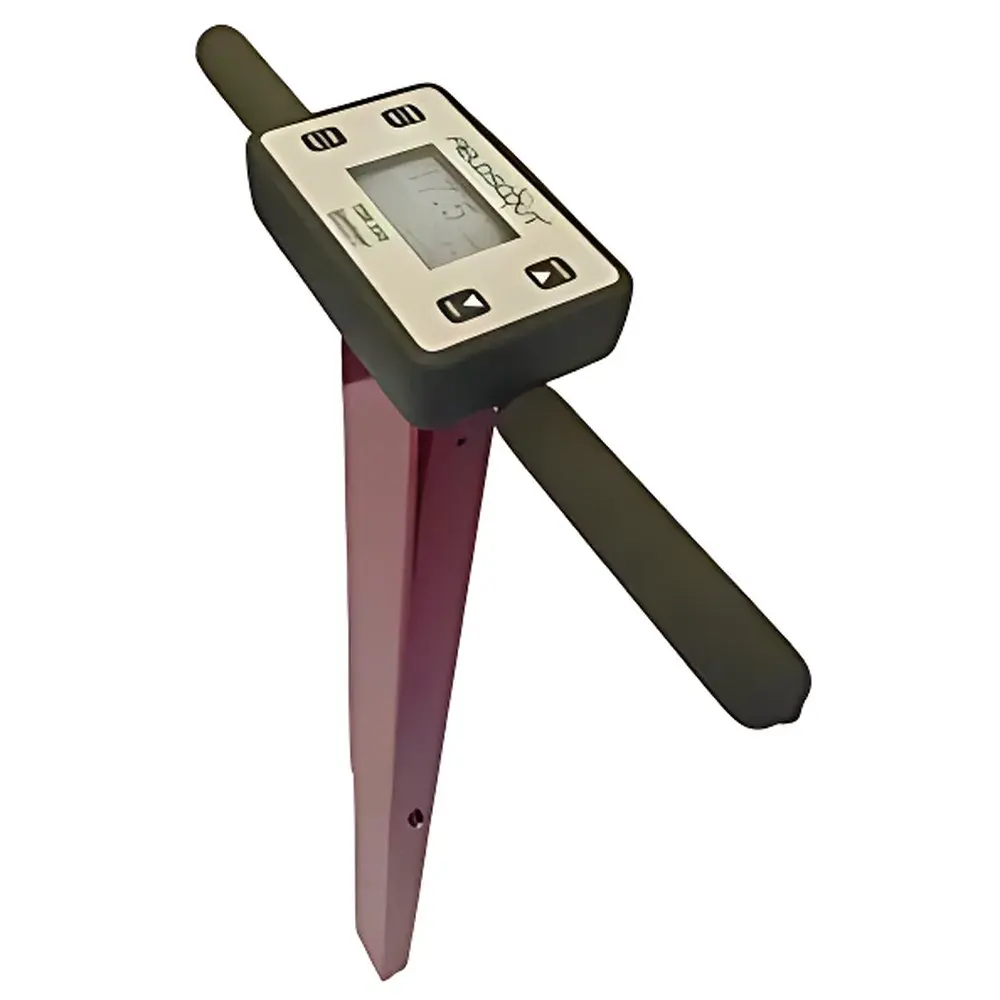
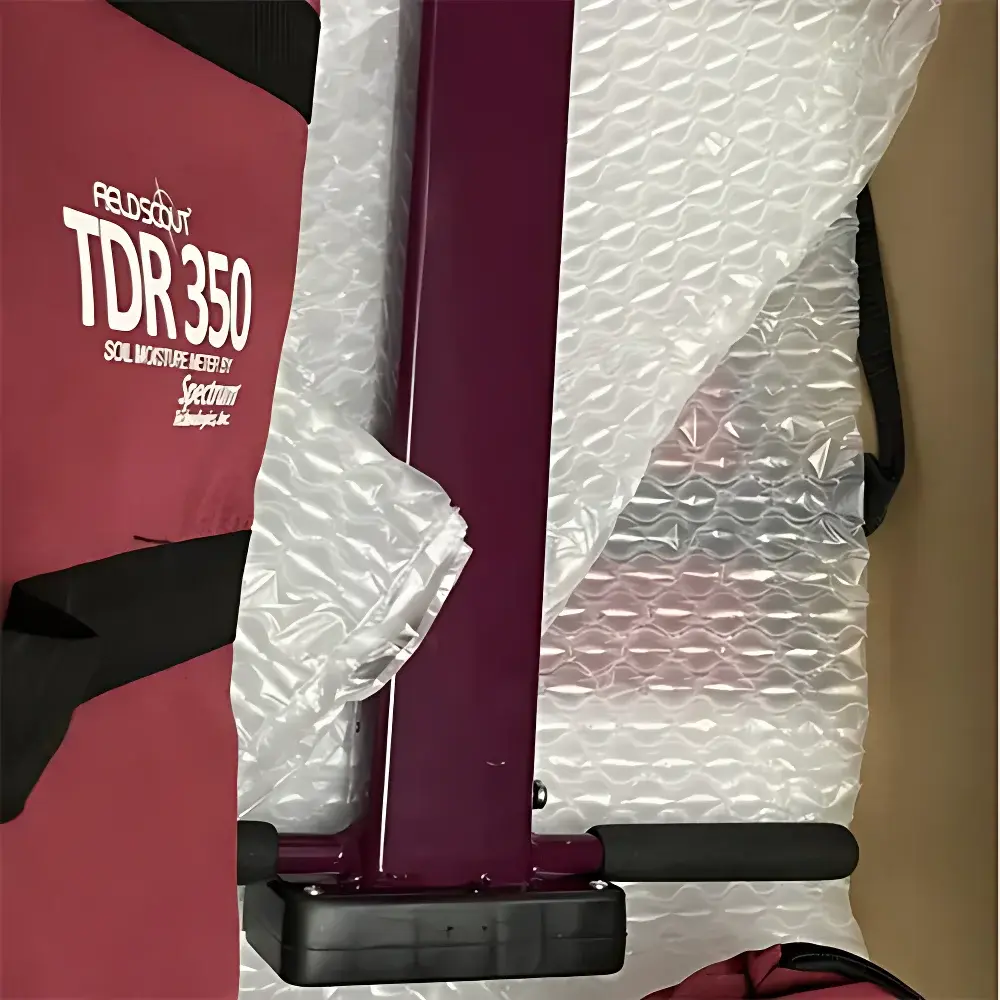
Spectrum Technologies TDR350 Portable Soil Moisture/Temperature/EC Meter
| Brand | Spectrum Technologies |
|---|---|
| Origin | USA |
| Model | TDR350 |
| Instrument Type | Multi-parameter Soil Analyzer |
| Measurement Principle | Time-Domain Reflectometry (TDR) |
| Moisture Range | 0–saturation (volumetric water content, VWC) |
| Moisture Resolution | 0.1% VWC |
| Moisture Accuracy | ±3.0% VWC (at EC < 2 mS/cm) |
| EC Range | 0–5 mS/cm |
| EC Resolution | 0.01 mS/cm |
| EC Accuracy | ±0.1 mS/cm |
| Temperature Range | −30°C to +60°C |
| Temperature Resolution | 0.1°C |
| Temperature Accuracy | ±1.0°C |
| Probe Length Options | 3.8 cm, 7.5 cm, 12 cm, 20 cm |
| Probe Diameter | 5 mm |
| Inter-electrode Spacing | 33 mm |
| Data Storage Capacity | >50,000 GPS-tagged measurements |
| Connectivity | Integrated Bluetooth 4.2 + GPS module |
| Power Supply | 4 × AA alkaline batteries |
| Display | Backlit graphical LCD |
| Optional Accessory | IR surface temperature sensor (non-contact, spectral range 8–14 µm) |
Overview
The Spectrum Technologies TDR350 Portable Soil Moisture/Temperature/EC Meter is a field-deployable, multi-parameter soil characterization instrument engineered for high-reproducibility in-situ measurement of volumetric water content (VWC), bulk electrical conductivity (EC), and soil temperature. It employs time-domain reflectometry (TDR)—a well-established electromagnetic technique in soil physics—where a fast-rise step pulse is transmitted along parallel stainless-steel waveguide rods inserted into the soil; the travel time of the reflected signal correlates directly with the dielectric permittivity of the surrounding medium, enabling robust VWC quantification across the full range from oven-dry to saturation. Simultaneously, the device measures bulk EC using a four-electrode (or two-electrode, depending on probe configuration) conductance method, with automatic temperature compensation applied to both EC and VWC outputs. The integrated thermistor provides direct contact-based soil or surface temperature readings, while the optional infrared (IR) sensor enables non-contact surface or canopy temperature acquisition—critical for calculating crop water stress index (CWSI) and monitoring thermal anomalies in precision agriculture applications.
Key Features
- True TDR-based volumetric water content measurement with factory-calibrated dielectric models for mineral soils, organic media, and amended substrates
- Simultaneous real-time acquisition of VWC, bulk EC, and temperature—no manual mode switching required
- Four interchangeable probe lengths (3.8 cm, 7.5 cm, 12 cm, and 20 cm) optimized for shallow-rooted turfgrass, horticultural beds, agronomic row crops, and deeper profile assessment
- Integrated GPS receiver (WAAS-enabled) and Bluetooth 4.2 radio for georeferenced data logging and wireless synchronization with mobile or desktop platforms
- Backlit graphical LCD display with intuitive icon-driven interface—designed for outdoor readability under variable ambient lighting
- Ergonomic telescoping handle with depth-stop mechanism ensures consistent insertion depth and operator comfort during repetitive field sampling
- Onboard memory stores over 50,000 timestamped, location-stamped records—including raw waveform metadata where applicable
- Optional IR temperature sensor (8–14 µm spectral response) compliant with ASTM E1933 and ISO 18434-1 standards for surface emissivity-corrected thermal measurement
Sample Compatibility & Compliance
The TDR350 is validated for use in mineral soils (sand to clay loam), peat-based growing media, compost-amended substrates, and hydroponic root zones. Its TDR architecture inherently minimizes salinity-induced measurement drift common in capacitance-based sensors, especially at EC levels exceeding 2 mS/cm. All firmware and data handling protocols comply with GLP-aligned field data integrity requirements. GPS-derived coordinates meet NMEA 0183 v4.10 specification, and logged datasets include UTC timestamps, horizontal dilution of precision (HDOP), and satellite count—supporting traceability in regulatory reporting contexts such as USDA NRCS Soil Health Monitoring or EPA Region 10 Agricultural Runoff Assessment programs.
Software & Data Management
Data export is supported via USB-C or Bluetooth to Spectrum’s proprietary FieldScout™ Mobile App (iOS/Android) and desktop FieldScout™ PC Software (Windows). Both platforms support batch export in CSV, Shapefile (.shp), and GeoJSON formats—with embedded metadata fields for probe ID, operator ID, calibration date, and QA/QC flags. Audit trails record all parameter edits, file exports, and firmware updates. The software suite is compatible with FDA 21 CFR Part 11-compliant environments when deployed with appropriate organizational controls (e.g., electronic signatures, role-based access, and change logs).
Applications
- Irrigation scheduling and deficit irrigation management in vineyards, orchards, and row-crop systems
- Turfgrass moisture optimization for golf courses, sports fields, and municipal landscapes
- Soil salinity mapping in reclaimed coastal farmland and arid-zone agriculture
- Root-zone monitoring in greenhouse substrate production and container nursery operations
- Long-term soil moisture network deployment for climate resilience studies and watershed modeling
- Validation of satellite-based soil moisture products (e.g., SMAP, Sentinel-1) through ground-truthing campaigns
FAQ
Does the TDR350 require soil-specific calibration?
No—factory calibration covers typical mineral soils (0–50% clay); optional user-defined calibrations can be loaded via FieldScout™ for high-organic or saline substrates.
Can the IR sensor measure canopy temperature without physical contact?
Yes—the optional IR module operates at fixed 1:1 distance-to-spot ratio and supports emissivity adjustment (0.90–0.99) for leaf, soil, or mulch surfaces.
Is the GPS module capable of sub-meter accuracy?
With WAAS correction enabled, horizontal accuracy is typically ≤1.5 m RMS; RTK-GNSS integration is not supported natively but achievable via external NTRIP client pairing.
How often should the probe be cleaned between measurements?
Stainless-steel rods should be wiped with isopropyl alcohol after each use in high-EC or clay-rich soils to prevent residue buildup affecting signal integrity.
What battery life can be expected under continuous field operation?
Approximately 20–25 hours of active measurement time per set of four AA alkaline cells; low-power sleep mode extends standby duration to >30 days.







