
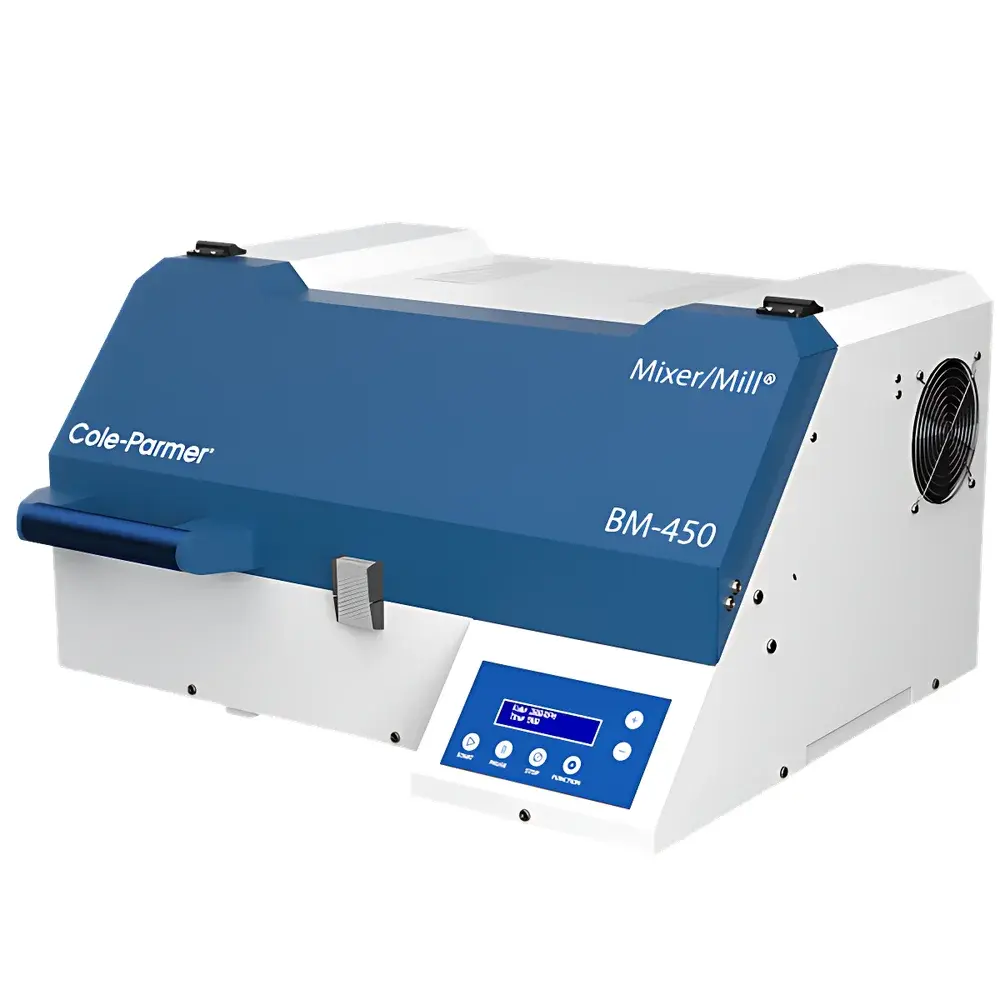
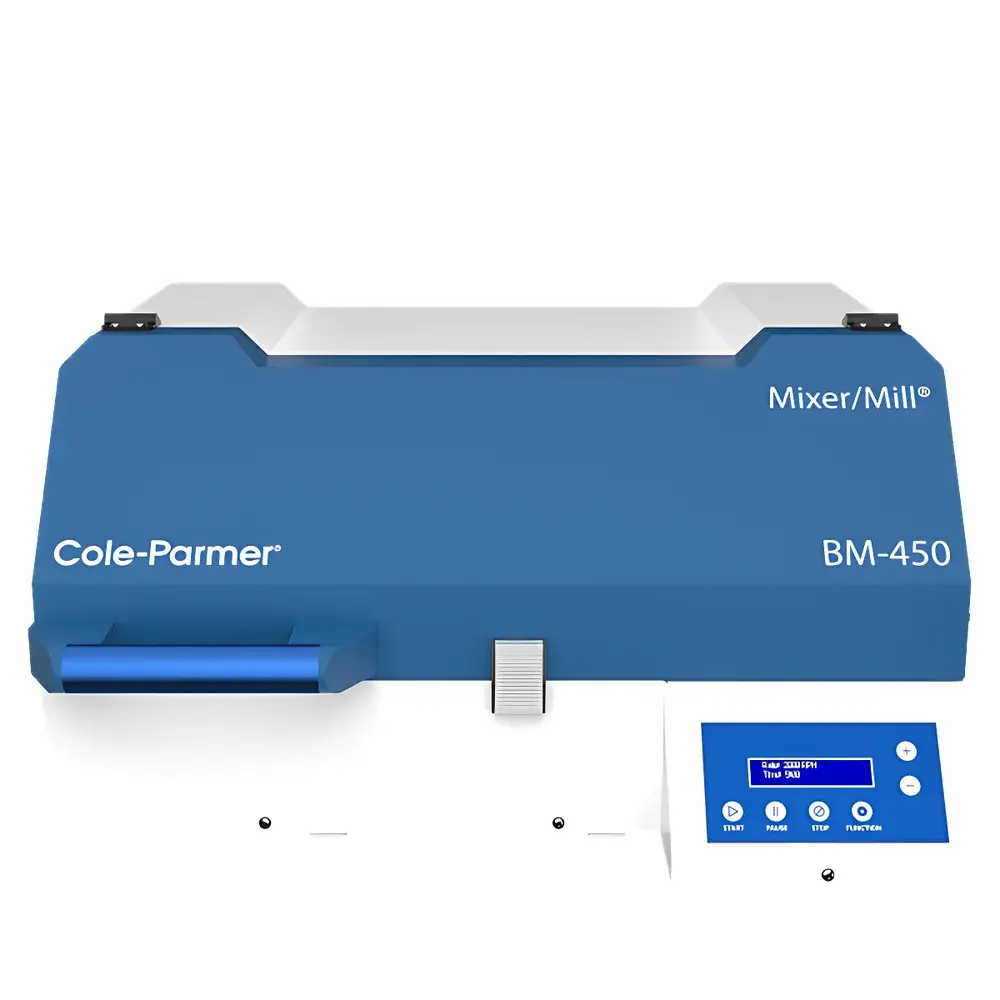
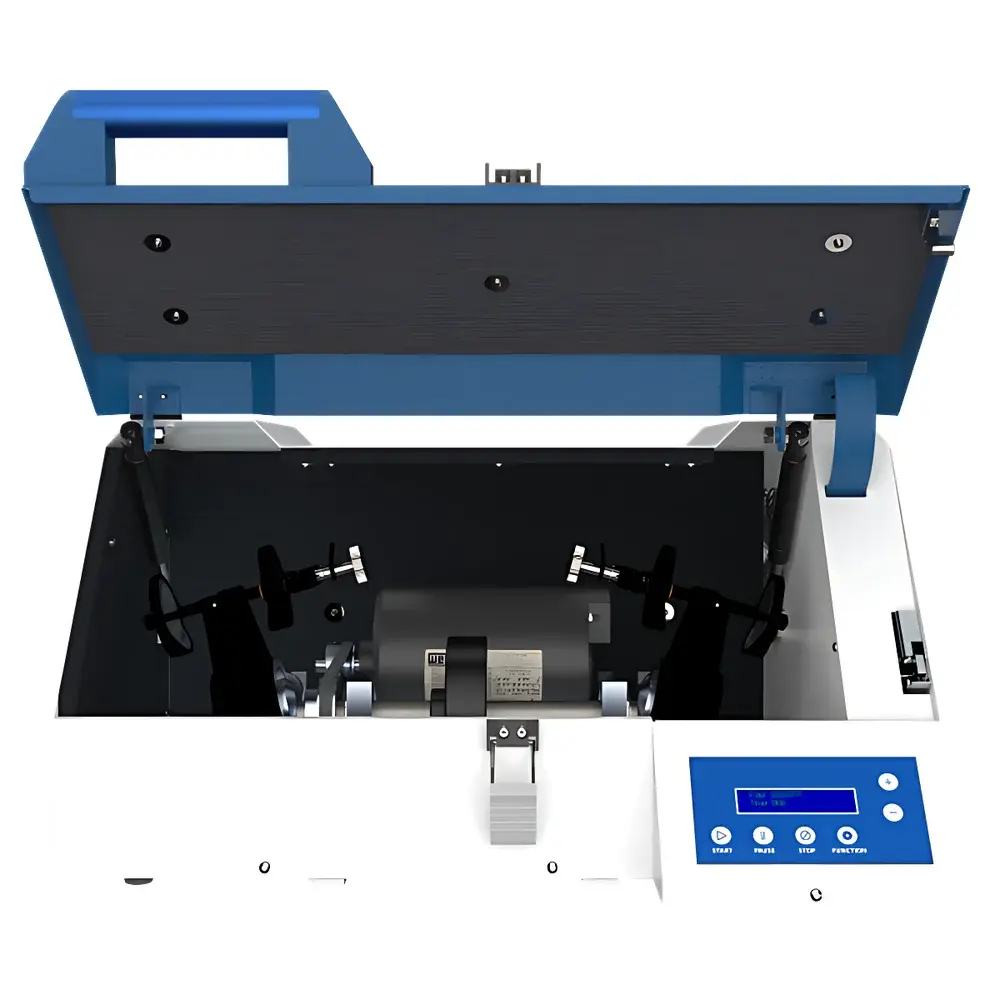
SPEX BM-450 High-Energy Ball Mill (Formerly 8000D)
| Brand | SPEX SamplePrep |
|---|---|
| Origin | USA |
| Model | BM-450 |
| Instrument Type | High-Energy Ball Mill |
| Sample Suitability | Hard & Brittle Materials |
| Feed Size | <30 mm |
| Final Particle Size | <5 nm |
| Batch Capacity | 2 jars per run |
| Operating Speed | 1725 rpm |
| Motion Type | Patented 3D Figure-Eight Oscillation |
| Clamp Stroke | ±59 mm (front-back), ±25 mm (left-right) |
| Clamp Frequency | 1060 cycles/min |
| Cooling | Integrated Air-Cooling System for Clamp Assembly |
| Control Interface | Programmable LCD Touch Panel |
| Max Program Duration | 10000 minutes |
| Grinding Jar Design | Seamless Arc-Profile Interior (No Dead Zones) |
Overview
The SPEX BM-450 High-Energy Ball Mill (formerly designated 8000D) is an industrial-grade, high-intensity mechanical milling system engineered for reproducible nanoscale particle size reduction, mechanical alloying, and solid-state reaction initiation. It operates on the principle of high-frequency, three-dimensional figure-eight oscillation — a patented motion profile that subjects grinding jars to simultaneous horizontal displacement, vertical vibration, and rotational torque. This kinematic architecture delivers significantly higher specific energy input per unit time compared to conventional planetary or shaker mills, enabling rapid amorphization, crystallite size refinement below 5 nm, and homogeneous phase mixing in intermetallic, ceramic, and composite precursor systems. Designed and manufactured in the United States by SPEX SamplePrep — a pioneer with over 59 years of dedicated development in mechanical sample preparation — the BM-450 meets stringent engineering benchmarks for thermal stability, mechanical repeatability, and long-term operational robustness under continuous high-load duty cycles.
Key Features
- Patented 3D figure-eight oscillation mechanism delivering up to 3× higher effective energy transfer versus standard planetary motion, validated through comparative calorimetric and XRD crystallite size analysis.
- Integrated air-cooling system actively dissipates heat from the clamp assembly during extended operation, minimizing thermal degradation of temperature-sensitive samples (e.g., polymers, organometallics, pharmaceutical intermediates).
- Programmable LCD control panel with real-time parameter monitoring, allowing precise setting of run duration (1–10,000 minutes), pause intervals, and automatic shutdown with audible/visual alerts.
- Optimized grinding jar geometry featuring continuous arc-profile interior surfaces — eliminating stagnant zones at jar walls and base — ensuring full sample engagement with grinding media and uniform energy distribution.
- Dual-jar configuration supports parallel processing of two independent samples under identical kinetic conditions, enhancing throughput while maintaining inter-batch comparability.
- Heavy-duty three-phase induction motor coupled to precision-machined eccentric drive shafts ensures consistent amplitude and frequency stability across the full operational lifetime.
Sample Compatibility & Compliance
The BM-450 accommodates a broad spectrum of inorganic and organic materials, including but not limited to: metallic alloys (Fe-Al, Ni-Ti, Mg-based), refractory oxides (Al2O3, ZrO2, SiC), catalyst supports (zeolites, activated carbon), geological matrices (granite, basalt, shale), pharmaceutical excipients, and ROHS-compliant electronic waste fractions (PCB substrates, solder residues). Its mechanical design conforms to UL 61010-1 and IEC 61000-6-2/6-3 standards for laboratory equipment safety and electromagnetic compatibility. While not certified for GMP manufacturing environments, its programmable logging capability (time-stamped start/stop events, total cycle count) supports GLP-aligned documentation workflows. Data integrity is preserved via non-volatile memory storage; however, full 21 CFR Part 11 compliance requires integration with validated third-party LIMS or ELN platforms.
Software & Data Management
The BM-450 operates as a standalone instrument with embedded firmware controlling all motion parameters and safety interlocks. No proprietary software installation is required. All operational data — including set duration, actual runtime, motor status, and emergency stop triggers — are stored locally in EEPROM with timestamp resolution of ±1 second. Export functionality is not natively supported; however, users may document parameters manually or integrate external timers/data loggers for audit-trail purposes. For laboratories implementing digital quality systems, the device’s repeatable mechanical performance enables correlation of input settings (jar mass, ball-to-powder ratio, rotation speed) with output metrics (BET surface area, XRD FWHM, DLS hydrodynamic diameter) using statistical process control (SPC) frameworks compliant with ISO 17025 Annex A.
Applications
- Mechanical alloying of immiscible metal systems for metastable phase synthesis (e.g., Cu-Nb, Al-Fe).
- Nanocrystalline ceramic powder production for sintering feedstock (TiO2, BaTiO3, hydroxyapatite).
- Top-down nanomaterial synthesis from bulk precursors without chemical reagents.
- Activation of mineral phases (e.g., kaolinite, illite) for enhanced reactivity in geopolymer formulations.
- Homogenization and dispersion of multi-component catalyst formulations prior to thermal treatment.
- Particle size reduction of brittle pharmaceutical APIs to improve dissolution kinetics.
- Preparation of reference materials for inter-laboratory proficiency testing in geochemical and metallurgical QA/QC programs.
FAQ
What is the maximum recommended single-run duration for continuous operation?
The BM-450 is rated for uninterrupted operation up to 12 hours (720 minutes) per cycle under standard ambient conditions (20–25°C, ≤60% RH). Extended runs beyond this require manual cooling intervals and verification of clamp bearing temperature.
Can the BM-450 be used for cryogenic milling?
No. The BM-450 does not support liquid nitrogen jacketing or cryo-adapted jar assemblies. For low-temperature applications, SPEX offers separate cryomill-compatible accessories only on select legacy models.
Is jar material selection critical for achieving sub-5 nm final particle size?
Yes. Achieving consistent sub-5 nm results requires matched jar/ball material combinations (e.g., tungsten carbide jars with WC balls) to minimize contamination and maximize impact energy transfer. Stainless steel configurations typically yield >20 nm median sizes under identical parameters.
Does the BM-450 comply with ASTM E2904 or ISO 13320 for particle size analysis validation?
The instrument itself is not a particle sizing device and therefore falls outside the scope of those standards. However, its output powders are routinely characterized per ASTM E2904 (for laser diffraction) and ISO 13320 (for dynamic light scattering) in downstream analytical workflows.
How frequently should the eccentric drive bearings be serviced?
Under typical academic or R&D usage (≤20 hrs/week), lubrication inspection is recommended every 1,000 operating hours; full bearing replacement is advised at 5,000-hour intervals or when axial play exceeds 0.05 mm.
Related Products



